Asia Markets Fall as Oil Surge Deepens Fears of a Longer Iran War Shock
Asian stock futures fell and oil extended a historic monthly rise as investors priced in a longer Iran war, higher inflation and renewed recession risk for energy-importing economies across Asia and Europe.
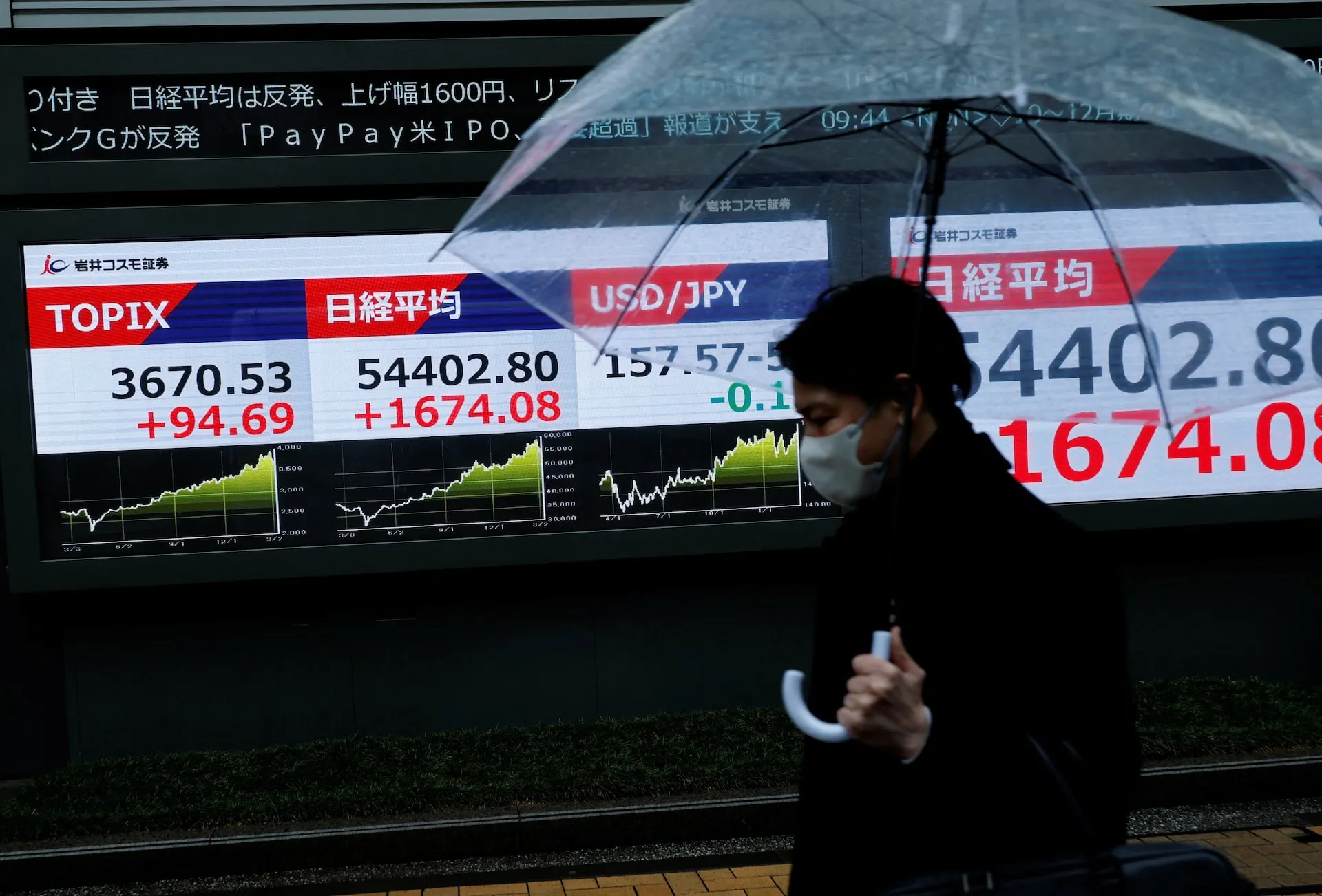
Asian markets opened the new week with the kind of tone that usually appears only when investors decide a geopolitical crisis is no longer a headline risk but a macroeconomic fact. Futures tied to Japan's Nikkei pointed sharply lower, U.S. equity futures also slipped, and Brent crude pushed higher again as traders adjusted to the prospect that the Iran war and the disruption around the Strait of Hormuz may last well beyond an initial exchange of strikes. The central market judgment on Monday was not subtle: energy costs are rising fast, inflation assumptions are being revised upward, and the odds of a broader growth slowdown are climbing with them.
The core market move was oil. Brent crude rose to $115.33 a barrel while U.S. crude climbed to $102.52, extending a surge that traders were treating as one of the sharpest oil shocks in decades. Reuters described that surge as larger than the jump that followed Iraq's invasion of Kuwait in 1990, a comparison that helps explain why traders across equities, bonds and currencies are now treating the present shock as something more serious than a brief wartime spike. When the world's most sensitive benchmark for transport and industrial fuel is repriced that quickly, markets usually begin to think not only about energy bills but about second-round effects on freight, food, aviation, manufacturing and household budgets.
What gives the move broader significance is the mechanism behind it. The market response is tied to the effective clampdown on the Strait of Hormuz, one of the world's critical energy chokepoints, which has already pushed up prices for oil, gas, fertiliser, plastic, aluminium, aircraft fuel and shipping inputs. Reuters reported that prices for food, pharmaceuticals and petrochemical products are also set to rise as the supply shock spreads through industrial chains. That is the part policymakers cannot dismiss as speculative trading: once higher fuel costs begin to filter into basic goods and transport, the political problem moves from trading desks to consumers and central banks.
Asia looks especially exposed. Much of the region depends heavily on Middle Eastern energy, and that leaves importers in Japan, South Korea, India and much of Southeast Asia more vulnerable to a sustained shipping disruption than the United States, which Reuters noted retains a relative advantage as a net energy exporter. Futures for Japan's Nikkei were trading around 50,870, a steep implied drop from Friday's 53,373 close, while the dollar stayed firm near 160.42 yen after crossing the 160 level last week for the first time since July 2024. Those moves matter because they combine two pressures that often reinforce each other for Asian importers: a pricier dollar and a pricier barrel.
Investors are also reconsidering whether the conflict will end quickly. Pakistan said on Sunday it was preparing to host what it called meaningful talks to end the war in coming days, but Tehran simultaneously accused Washington of preparing a land assault while the United States moved more troops into the region. Yemen's Iran-aligned Houthis have now launched attacks on Israel as well, widening concern that the conflict could spill further into commercial shipping routes beyond Hormuz. That combination — diplomatic signaling on one side, military reinforcement on the other — helps explain why markets are listening to peace talk headlines without truly believing they guarantee a near-term de-escalation.
Analysts quoted in the market coverage gave that skepticism explicit form. Madison Cartwright of CBA argued that Iran's leverage over the Strait of Hormuz, its ability to disrupt global energy and food markets, and its continuing missile and drone capacity leave Tehran with limited incentive to concede quickly. She said CBA expects the war to last at least into June, with risks tilted toward an even longer conflict. Bruce Kasman of JPMorgan warned that if the Strait remains closed for another month, oil could move toward $150 a barrel and industrial users could face serious supply constraints. Those are not fringe projections; they are the kinds of scenarios large institutions put in front of clients when they believe a geopolitical shock has become a portfolio-defining event.
There is, however, another side to the argument, and it deserves real weight. Markets have a habit of extrapolating the worst case in the earliest days of a supply shock, and some of Monday's repricing may reflect that instinct as much as settled economic reality. Gold, notably, was little changed at $4,487 an ounce even as oil surged and equities weakened, a sign that not every traditional defensive trade is behaving as if a full systemic panic is under way. Investors are clearly worried, but they are not yet pricing a uniformly catastrophic outcome across every asset class. That leaves room for a reversal if shipping flows improve, if Hormuz is reopened, or if diplomatic channels gain traction faster than military moves suggest today.
Even so, the inflation consequences are already reshaping interest-rate expectations. Reuters reported that markets now imply 12 basis points of Federal Reserve tightening this year, compared with expectations for 50 basis points of cuts only a month ago. In Europe, investors were already bracing for inflation data that could show the energy shock feeding into prices more quickly than central bankers had hoped, even before the full effect of higher shipping and fuel costs has washed through the system. Bond markets have responded accordingly: ten-year U.S. Treasury yields are up roughly 47 basis points for the month and two-year yields about 54 basis points. That is the uncomfortable policy mix central bankers dislike most — weaker growth prospects arriving at the same time as fresh inflation pressure.
Official voices will now matter almost as much as battlefield developments. Federal Reserve Chair Jerome Powell and New York Fed President John Williams are both due to speak later on Monday, giving investors an immediate test of whether policymakers see this as a temporary geopolitical distortion or the beginning of a broader inflation regime shift. U.S. retail sales, manufacturing data and payrolls later this week will also show whether the American economy is entering the oil shock from a position of resilience or vulnerability. Pakistan's offer to host talks gives governments something to point to diplomatically, but markets will want evidence, not language. In this environment, official optimism that is not matched by restored shipping capacity or calmer energy pricing is unlikely to persuade traders for long.
The deeper lesson from Monday's price action is that the Iran war is no longer being compartmentalised as a regional security story. It is now being priced as a global cost-of-capital story, a trade-flow story and a consumer-price story all at once. That distinction matters because once a conflict enters the inflation and growth calculus of central banks, pension funds, airlines, manufacturers and household budgets, the threshold for relief becomes much higher. A few encouraging diplomatic statements may steady nerves for a session, but a durable reversal will likely require visible changes in shipping access, military posture and energy supply expectations.
For now, the conservative reading is also the plain reading: markets are signaling that war risk has become economic risk in a direct and measurable way. Oil is the clearest warning light, but equities, bond yields and currency moves all point in the same direction. Investors who spent the first weeks of the conflict treating it as containable are being forced to price a tougher possibility — that a longer confrontation in and around the Gulf could keep inflation higher, growth lower and policy choices narrower well into the second quarter. If that judgment proves wrong, the relief rally could be sharp. If it proves right, Monday may be remembered less as a bad trading day than as the moment global markets accepted that the war's economic bill was going to be large.
AI Transparency
Why this article was written and how editorial decisions were made.
Why This Topic
This is the strongest genuinely newsworthy cluster on the board because it converts the Iran war from a regional conflict update into a global macroeconomic event. The story affects energy, inflation, monetary policy, transport and trade simultaneously, giving it broader consequences than the higher-scoring sports item. It also differs materially from the site's recent Palm Sunday, terrorism, social-media and banking stories, so the deduplication risk is low.
Source Selection
The cluster's Reuters/CNA signal provides the essential factual base: market levels, oil prices, rate expectations, analyst scenarios, Pakistan's diplomatic line, Houthi involvement and the Asia-specific exposure channel. I used the same reporting spine for both languages to keep citations aligned and avoid faithfulness issues. External Reuters fetches were used only for situational awareness and image confirmation, not for numbered factual claims beyond the cluster-supported narrative.
Editorial Decisions
Lead with the market and inflation shock rather than moral framing. Tone stays analytical, restrained and skeptical of official optimism. Removed unsupported percentage figures flagged by evidence_quality and kept all factual claims tied to cluster-safe source language.
About the Author
Editorial Reviews
0 approved · 0 rejectedPrevious Draft Feedback (1)
4 gate errors: • [evidence_quality] Statistic "59%" not found in any source material • [evidence_quality] Statistic "53%" not found in any source material • [evidence_quality] Statistic "2.7%" not found in any source material • [evidence_quality] Statistic "1.9%" not found in any source material
Discussion (0)
No comments yet.