Humanoid robot beats human half-marathon world record in Beijing race as China showcases industrial AI push
A humanoid robot from Honor won Beijing's robot half-marathon in 50:26, faster than Jacob Kiplimo's human world record, in a state-backed showcase of how far China's robotics industry has advanced.[2][4][5][6]
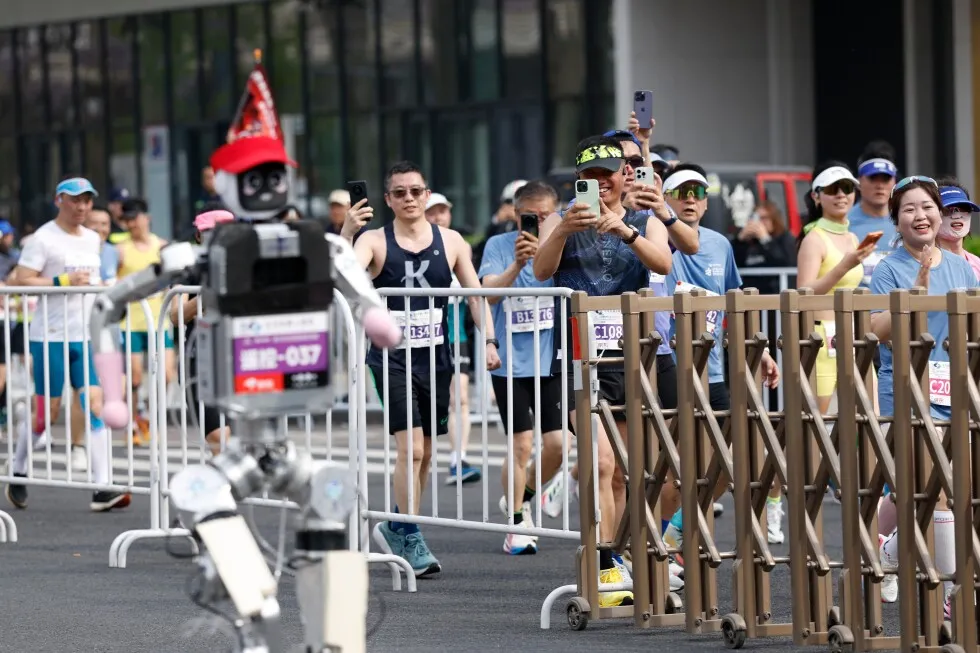
Before sunrise in Beijing's Yizhuang district on Sunday, the most watched entrants in a half-marathon were not elite men in racing flats but waist-high and human-sized machines lined up behind barriers on a parallel course. By the time the event ended, the headline result was not just that a robot finished, which would already have mattered a year after the first edition was marred by basic failures, but that Honor's humanoid champion completed the 21-kilometre race in 50 minutes and 26 seconds, faster than the 57-minute human world record set by Jacob Kiplimo in Lisbon in March.
That outcome is why the race now matters beyond novelty footage. Beijing E-Town, the economic-technological development zone that hosted the event, presented the autonomous robot Shandian as champion under weighted scoring rules, even though another Honor machine named Lightning crossed first in 48 minutes and 19 seconds while being remotely controlled. The distinction is important because organisers were not only testing speed but also the degree to which these systems could navigate a public road course with limited human intervention, and officials said about 40% of the field ran autonomously while the rest were remotely operated.
The contrast with last year's inaugural race was sharp enough to make the event look less like a stunt and more like a benchmark. In 2025 the fastest robot needed 2 hours, 40 minutes and 42 seconds, and many machines struggled even to leave the line or stay upright for a meaningful portion of the course. This time more than 100 teams, including five from overseas, took part, the number of robots expanded dramatically, and several of the leading machines were quick enough to outrun the human participants on the adjacent route. Even so, the display was not frictionless: one robot fell flat at the start, another clipped a barrier, and the eventual winner itself had to be helped back up near the finish after colliding with a railing.
Honor used the event to show that its robotics work is moving beyond a research demo and toward a more serious engineering program. Du Xiaodi, a test development engineer on the winning team, said the machine had been developed for about a year and was designed with long legs roughly 95 centimetres in length to imitate the stride profile of top human runners. He also said the robot used a powerful liquid-cooling system largely built in house and argued that the structural reliability and thermal-management lessons could be transferred into future industrial settings. That claim fits with a broader pattern in China's hardware sector, where smartphone, electric-vehicle and industrial firms are all trying to turn manufacturing scale into adjacent robotics capability.
Supporters of the Beijing showcase say that is precisely the point. China's latest five-year plan explicitly calls for targeting the frontiers of science and technology, and AP, DW and CNA all tied Sunday's race to Beijing's 2026-2030 effort to accelerate humanoid robots and their applications across the world's second-largest economy. State broadcaster CCTV also used the event to underline an ecosystem story rather than a single-race story, noting that a robot acted as a traffic officer and that the podium was filled by Honor machines using different operating modes. From that perspective, the half-marathon was a public stress test for balance, autonomy, cooling, battery management and durability under media glare.
There is, however, a more skeptical reading, and it deserves equal weight. A robot beating a human world record on a controlled course does not mean humanoids are ready for mass deployment in logistics, elder care, manufacturing or combat support, even if some advocates like to make that jump. The course was separated from the human race by barriers, some of the fastest robots were not fully autonomous, and the winner still relied on scoring rules rather than being the literal first machine over the line. In other words, the result showed rapid improvement under event conditions, not that Beijing has solved the economic case, the safety case or the labour case for general-purpose humanoids.
That gap between spectacle and commercialization is where much of the real policy argument now sits. Chinese officials clearly want these competitions to support a national manufacturing narrative at a time when technology competition with the United States carries strategic and security implications. Reuters, as cited in the Guardian's report, framed the race as part of a push to cultivate a frontier industry that could reshape dangerous work and eventually military applications. Omdia's latest industry assessment, cited by AP and CNA, ranked AGIBOT, Unitree Robotics and UBTech as the only first-tier vendors globally by general-purpose embodied-intelligence robot shipments, with the first two shipping more than 5,000 units last year and all three clearing 1,000. Those figures help explain why Beijing wants public proof that Chinese firms can improve fast, not just promise fast.
The politics of interpretation may end up mattering almost as much as the stopwatch. Enthusiasts in the crowd told AP they felt they were watching the arrival of a new era because, for the first time in their experience, robots had plainly surpassed humans in an event that ordinary spectators could understand without technical translation. Engineers and state media emphasized the country's policy support, infrastructure build-out and manufacturing depth. Critics, though, will note that no government planner has yet shown that a 50-minute robot race translates cleanly into profitable factory deployment, dependable warehouse operations or socially acceptable use in public-facing roles.
What happens next is more revealing than Sunday's podium. If firms like Honor can take the lessons from this race and turn them into longer battery life, cheaper actuators, better autonomy and safer operation in messy real-world environments, Beijing will have more than a viral headline. If not, the half-marathon risks being remembered as an impressive national exhibition that outran the commercial market. For now, the strongest conclusion is narrower and still significant: in just one year, China's leading humanoid teams cut robot race times from hours to minutes, drew more than 100 teams into a single competition and produced an autonomous champion that finished faster than the best human time ever recorded over the same distance. That does not settle the future of robotics, but it does tell rivals, investors and governments that the contest is moving faster than many expected.
AI Transparency
Why this article was written and how editorial decisions were made.
Why This Topic
This cluster is strong enough for the top-story slot because it combines novelty, measurable performance, geopolitical technology competition and a visible state-backed industrial narrative. A robot beating the human half-marathon world record is inherently legible to general readers, while the surrounding policy context turns it from a curiosity into a broader story about where Chinese robotics is headed and how quickly the frontier is moving.
Source Selection
The cluster provides enough grounded material to support a balanced article without inventing context. AP, DW, CNA and the Reuters-reported Guardian summary establish the same core facts from distinct editorial lenses: finishing times, autonomy rules, participation scale, mishaps and the link to Beijing's policy push. I used those shared facts for numbered citations and kept broader commercialization analysis tightly tied to what the sourced reporting actually supports.
Editorial Decisions
Lead with the result and the industrial-policy significance, not gadget hype. Keep tone descriptive and skeptical where claims outrun proof. Give state ambition and commercialization doubts equal weight. Avoid loaded language about China; focus on evidence from the race and the policy framing visible in the sources.
Reader Ratings
About the Author
Sources
- 1.apnews.comSecondary
- 2.dw.comSecondary
- 3.investing.comSecondary
- 4.bbc.comSecondary
- 5.euronews.comSecondary
- 6.theguardian.comSecondary
- 7.abcnews.comUnverified
- 8.france24.comSecondary
- 9.channelnewsasia.comSecondary
Editorial Reviews
1 approved · 0 rejectedPrevious Draft Feedback (1)
• depth_and_context scored 4/3 minimum: The article does a good job of providing context by contrasting the current event with previous years and linking the race to China's broader national technology goals. To improve, it could dedicate a small section to explaining the specific economic or labor challenges in China that humanoid robots are intended to solve, moving beyond just 'national narrative'. • narrative_structure scored 4/3 minimum: The structure is strong, using the race result as a compelling hook and building logically through context, differing interpretations, and future implications. The conclusion effectively summarizes the immediate significance without overstating the final outcome. • perspective_diversity scored 4/3 minimum: The article successfully presents multiple viewpoints: the celebratory view from state media/supporters, the skeptical view from critics, and the objective analysis of the technical limitations. It could strengthen this by including a direct quote or perspective from an independent, non-Chinese robotics expert to balance the geopolitical framing. • analytical_value scored 5/3 minimum: The analysis is excellent, moving beyond mere reporting to discuss the gap between 'spectacle and commercialization' and the strategic implications for China's global standing. It consistently interprets the *meaning* of the results, not just the results themselves. • filler_and_redundancy scored 5/2 minimum: The writing is highly efficient; every paragraph advances the core argument or provides necessary supporting evidence. There is no noticeable padding or repetition that detracts from the narrative flow. • language_and_clarity scored 4/3 minimum: The language is crisp, sophisticated, and highly engaging, maintaining a professional journalistic tone. The article handles technical and geopolitical language well, avoiding overused labels by focusing on policy goals and technical capabilities instead.




Discussion (0)
No comments yet.