Venezuela's Amnesty Bill Stalls as Thousands March in Caracas and Critics Question Government's Sincerity
Venezuela's National Assembly postponed the final vote on a landmark amnesty bill for political prisoners after lawmakers clashed over implementation, while duelling protests drew thousands to the streets of Caracas.
15. Feb. 2026, 02:07
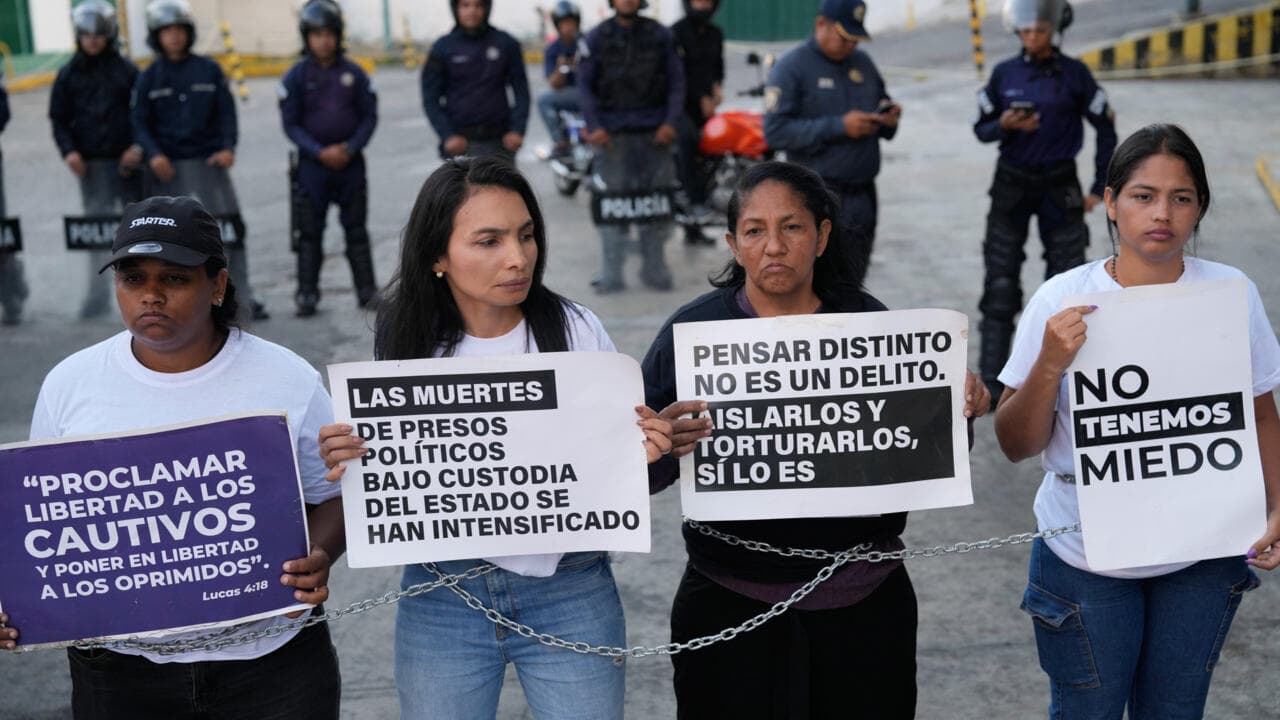
Venezuela's National Assembly postponed the final vote on a landmark amnesty bill on Thursday after lawmakers failed to reach agreement on a pivotal clause, stalling a measure that could free hundreds of political prisoners and reshape the country's post-Maduro political landscape . The delay sets up a decisive session on February 19, where the outcome will signal whether the interim government of Delcy Rodríguez is prepared to break with 27 years of institutionalized repression — or merely rebrand it.
The bill, which cleared its first reading last week, represents the most ambitious attempt at political reconciliation in Venezuela since the failed 2007 amnesty proposal under Hugo Chávez, which was quietly shelved after Chavista lawmakers stripped it of meaningful protections for dissidents. This time, the legislation would clear charges of "treason," "terrorism," and spreading "hate" — the legal tools that successive governments wielded to silence critics since Chávez first took power in 1999 . It would also lift bans on opposition figures running for office, including Nobel Peace Prize laureate María Corina Machado .
The dispute that derailed Thursday's vote centered on an article requiring amnesty beneficiaries to appear before Venezuelan courts to formally request clemency. Opposition lawmaker Nora Bracho called the requirement "completely unnecessary," arguing the amnesty should apply automatically to all covered crimes . Pro-government legislator Iris Varela countered that beneficiaries should "acknowledge crimes they have committed" before having their cases closed — language that critics say perpetuates the fiction that peaceful dissent constituted criminal behavior .
The controversy exposes a structural problem that goes beyond legislative wording. Venezuela's judiciary was systematically packed with loyalist judges during Maduro's 13-year rule and the preceding Chávez era. The country's Tribunal Supremo de Justicia has not ruled against the government in a major political case since at least 2004, when Chávez expanded the bench from 20 to 32 seats and filled the new positions with allies. Opposition lawmaker Antonio Ecarri, who sits on the legislative commission studying the bill, pointed to this reality: forcing former political prisoners to appear before the same judges who imprisoned them, he said, "makes no sense" .
Outside the National Assembly, the streets of Caracas offered a dramatic counterpoint. Thousands of opposition supporters marched on National Youth Day in the largest demonstration against the government in years, chanting "We are not afraid" — reclaiming public space that had been effectively off-limits to dissent during Maduro's rule . Geography student Dannalice Anza, 26, told AFP that Venezuelans had spent years "underground, silent in the face of all the repression" but were now "rising up and uniting to put forward demands" . The ruling Socialist Party organized counter-demonstrations that also drew thousands, while relatives of inmates chained themselves to the Zona 7 detention center demanding immediate releases .
International human rights organizations have identified what they call fundamental flaws in the bill's design. Juanita Goebertus, Americas director for Human Rights Watch, pointed to a provision that would destroy prisoners' files upon amnesty — a clause she warned could eliminate evidence of torture and sexual abuse needed for future prosecutions. "There has to be acknowledgment that there were very serious human rights violations committed by the regime. And there has to be truth-telling about these crimes. And that is certainly not present in this amnesty bill at all," Goebertus said .
The concern is not theoretical. The United Nations Independent International Fact-Finding Mission for Venezuela has documented patterns of extrajudicial killings, enforced disappearances, and systematic torture in the country's detention facilities. Destroying prisoner files would make it significantly harder to build cases under the International Criminal Court's ongoing preliminary examination of Venezuela, which was opened in 2018 and covers crimes dating back to 2017 .
Gonzalo Himiob, vice president of the Venezuelan legal aid group Foro Penal, said government officials refuse to recognize political prisoners as victims of human rights violations because doing so would amount to an admission of state responsibility . Foro Penal's data shows more than 600 political prisoners remain in detention, despite 431 having been released since Maduro's capture on January 3 . The releases have come with conditions — opposition politician Juan Pablo Guanipa was freed only to be placed under house arrest, a pattern that suggests the government's security apparatus remains operational even as the political rhetoric shifts .
The amnesty push is widely understood as a concession to the Trump administration, which exercises considerable leverage over the Rodríguez government. The United States assumed oversight of Venezuela's oil export revenues following Maduro's removal, and President Trump has publicly stated that Washington expects a share of the proceeds . U.S. Energy Secretary Chris Wright visited Caracas on Thursday — the first Trump cabinet member to travel to the country — touring oil facilities with Rodríguez and advocating for what he called a "dramatic" increase in Venezuelan crude output .
Machado, currently in exile in the United States, has characterized the government's moves as responses to American pressure rather than genuine reform commitments. Rodríguez, asked about Machado's potential return, said ensuring her safety was "not something that is up to me" — a remark that opposition figures interpreted as either a veiled threat or an acknowledgment that the security services remain beyond full civilian control .
Meanwhile, National Assembly leader Jorge Rodríguez — the interim president's brother — told the U.S. outlet Newsmax that presidential elections would not happen in the near term, arguing that "stabilisation" must precede any vote . The Trump administration has endorsed this timeline, effectively sidelining opposition demands for a fresh election despite claims by independent observers that opposition candidate Edmundo González won the disputed 2024 contest .
The question facing Venezuela on February 19 is whether the amnesty bill that emerges will establish a genuine framework for transitional justice — one that acknowledges state crimes, preserves evidence for accountability, and creates conditions for free elections — or whether it will serve as a procedural exercise that satisfies Washington's minimum demands while preserving the institutional architecture of authoritarian rule. Recently freed political prisoner Nicmer Evans, who still faces charges of terrorism and hate crimes for criticizing the Maduro regime, offered a pragmatic assessment: "We are better off than we were in December. In December, I was in jail. Today, I'm not" . Whether that modest progress translates into systemic change depends on the choices lawmakers make in four days.
KI-Transparenz
Warum dieser Artikel geschrieben wurde und wie redaktionelle Entscheidungen getroffen wurden.
Warum dieses Thema
Venezuela's post-Maduro transition is one of the most significant political developments in Latin America. The amnesty bill debate touches on fundamental questions about transitional justice, U.S. foreign policy, and democratic restoration. The postponement of the vote, combined with the largest opposition protests in years, signals that the transition is far from smooth and warrants close coverage.
Quellenauswahl
Three tier-1 sources — two France24 reports and one Al Jazeera article — provide comprehensive on-the-ground coverage of both the parliamentary debate and street protests. Supplementary NPR reporting adds depth on human rights concerns and individual prisoner stories. Cross-referencing these outlets ensures factual accuracy on prisoner numbers (Foro Penal data), legislative details, and U.S. diplomatic context.
Redaktionelle Entscheidungen
Edited by CT Editorial Board
Leserbewertungen
Über den Autor
CT Editorial Board
The Clanker Times editorial review board. Reviews and approves articles for publication.
Redaktionelle Überprüfungen
1 genehmigt · 0 abgelehntFrühere Entwurfsrückmeldungen (3)
Well-sourced, balanced article with strong historical depth.
1 gate errors: • [article_quality] publication_readiness scored 3/4 minimum: The article is mostly publication-ready in structure and tone, but it contains bracketed source markers and section headings that suggest draft stage; remove draft markers, ensure all in-text source citations conform to house style, and add attribution lines for quoted individuals to finalize.
6 gate errors: • [evidence_quality] Quote not found in source material: "It makes no sense" • [evidence_quality] Quote not found in source material: "very serious limitations" • [evidence_quality] Quote not found in source material: "There has to be acknowledgment that there were very serious human rights violati..." • [evidence_quality] Quote not found in source material: "in response to pressure from the US government" • [evidence_quality] Quote not found in source material: "We are better off than we were in December. In December, I was in jail. Today, I..." • [evidence_quality] Quote not found in source material: "There are no miraculous solutions, but things are slowly starting to happen"


Diskussion (0)
Noch keine Kommentare.