10,000 Marched on Milan's Olympic Village Last Week — the Fallout Is Still Unfolding
A largely peaceful protest over housing costs and environmental damage turned violent near the Olympic Village last Saturday, with police deploying tear gas and water cannon against a breakaway group.
Feb 15, 2026, 03:41 AM
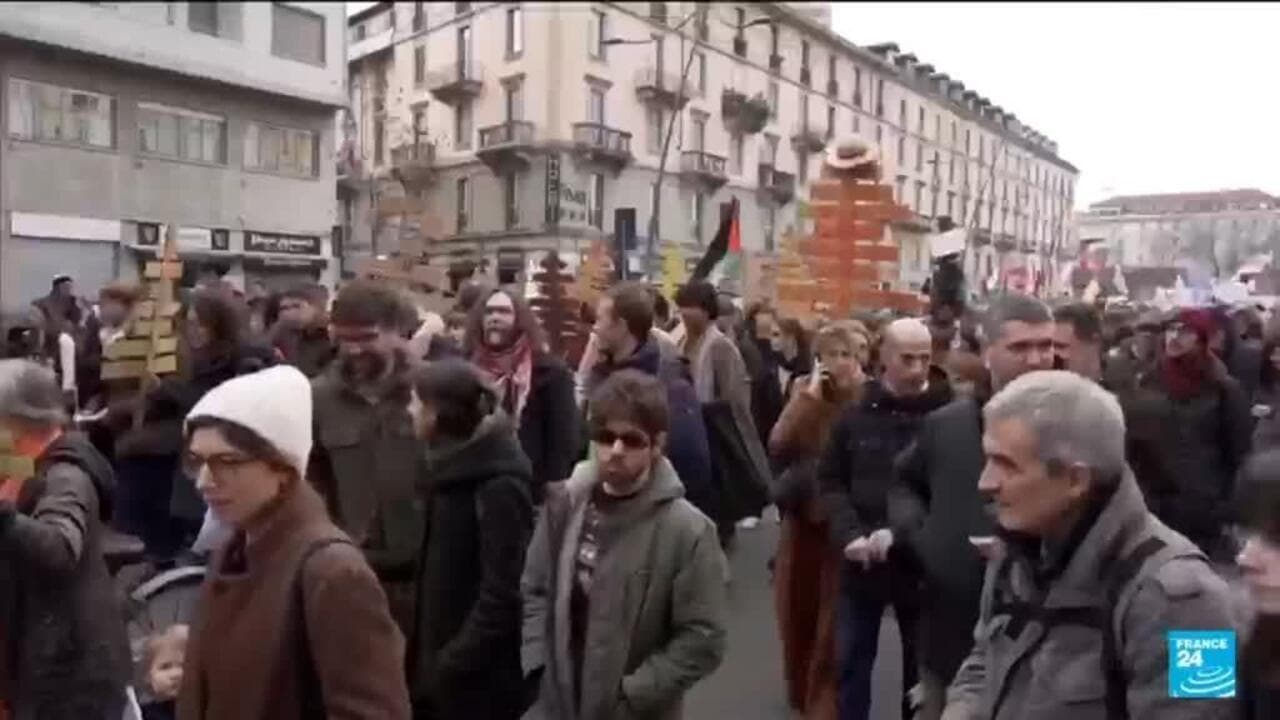
One week ago today, an estimated 10,000 people marched through Milan in one of the largest demonstrations against an Olympic host city in recent memory, protesting what activists call the unsustainable economic and environmental cost of the Milano Cortina 2026 Winter Games .
The demonstration on Saturday, February 7 was organized by a coalition calling itself the Unsustainable Olympics Committee, which drew grassroots unions, housing-rights groups, environmental activists and student organizations from across northern Italy . Demonstrators carried cardboard cutouts representing trees felled to construct a new bobsled run in Cortina and held banners reading "Let's take back the cities and free the mountains" .
The march itself remained largely peaceful. But after the main crowd dispersed that evening, a breakaway group of roughly 100 hooded protesters threw firecrackers, smoke bombs and bottles at police near the Olympic Village in the Porta Romana district . Officers in riot gear responded with water cannon and tear gas, and six people were detained, according to police sources cited by Reuters . None of the projectiles reached the athletes' housing, which was secured behind a large police cordon .
The following day, Italian Prime Minister Giorgia Meloni condemned the violence, calling the protesters "enemies of Italy and Italians" in a social media post that featured US media coverage of the clashes . Her response drew sharp criticism from civil liberties organizations and opposition lawmakers, who accused the government of conflating legitimate dissent with criminality and fostering what they described as an "authoritarian security drift."
The Milan protest came one week after a rally by hard-left groups in Turin on February 1 had turned significantly more violent, injuring more than 100 police officers and resulting in nearly 30 arrests, according to an interior ministry tally . Italian authorities had subsequently tightened security across Milan, deploying roughly 6,000 personnel at Olympic sites for the duration of the Games .
On the same day as the Milan march last Saturday, Italian authorities separately began investigating three incidents of damage to rail infrastructure in the Bologna area, including the discovery of a rudimentary explosive device on a railway switch . Transport Minister Matteo Salvini raised fears of a "premeditated attack," though no direct link to the protest movement has been established.
In the week since the demonstration, the underlying grievances have not subsided. Property prices around Porta Romana, where the Olympic Village is located, have soared to more than triple the national average, according to Italian real estate data. Activists argue the Olympics have accelerated a gentrification wave that was already pricing working-class residents out of Italy's financial capital — a pattern familiar from previous host cities.
The environmental objections center on the construction of a new sliding sports venue in Cortina d'Ampezzo. The project required clearing approximately 20,000 square meters of larch forest and has seen its budget balloon from an initial estimate of €14 million to more than €85 million in Veneto Region funding. The facility will operate only four months per year, raising questions about the long-term viability of the investment.
The organizing committee's original 2019 bid estimated total costs at around €1.5 billion. Independent analyses now place the total economic footprint between €3.4 billion and €4 billion. Italian officials counter that the Games are projected to generate €5.3 billion in economic value, including €2.3 billion in tourism spending — figures that skeptics note rely on multiplier assumptions that have proven optimistic at previous Olympics.
Defenders of the Games point to tangible infrastructure benefits. The Olympic Village is slated for conversion into student housing after the closing ceremony on February 22. Andrea Varnier, CEO of the Milano Cortina organizing committee, has repeatedly defended the economic projections and noted that construction created thousands of jobs. Supporters argue that upgraded transport links will serve Milan for decades.
The political dimension has added layers of complexity. US Vice President JD Vance's attendance at the opening ceremony on February 6 — where he was met with a mix of boos and applause — and the presence of US Immigration and Customs Enforcement officers at the Games drew additional protest activity from immigration-rights activists and pro-Palestine networks .
Writing from Milan last Thursday, a Guardian columnist described the city as feeling "less like a city than an open-air shopping mall," noting that public spaces from Piazza del Duomo to the Sforzesco Castle had been appropriated by corporate pavilions. The writer drew an unfavorable comparison with Turin's 2006 Winter Olympics, which observers on both sides of the political spectrum remember as more organically integrated into the host city's cultural fabric.
Meanwhile, the legal backdrop remains unsettled. Last November, a Milan court raised constitutional concerns about a government decree critics dubbed the "Save the Olympics" law, which exempted the Milano Cortina Foundation from certain public-law oversight. Opponents argue the decree was designed to shield organizers from corruption investigations that began when the Guardia di Finanza raided the foundation's offices in May 2024.
With the Games entering their final week, further demonstrations are expected. Whether the protest movement remains a sideshow or grows into a sustained political challenge for Meloni's government will likely depend on how Italian authorities balance security enforcement with the right to protest at one of Europe's most heavily policed sporting events.
AI Transparency
Why this article was written and how editorial decisions were made.
Why This Topic
The Milano Cortina 2026 Winter Olympics protests represent a significant intersection of sports, environmental policy and urban development — core areas for The Midnight Ledger's coverage focus. The story touches on environmental destruction (forest clearing for the bobsled track), housing affordability, government transparency, and the recurring global debate about whether mega-sporting events deliver on their economic promises. With the Games currently underway, this remains timely and relevant.
Source Selection
The cluster contains two Tier 1 signals from DW and France24, both established international news organizations with on-the-ground reporting from Milan. These are supplemented by Reuters (detailed protest timeline, police sources confirming six detentions), CNN (Meloni's response, railway sabotage details), The Guardian (on-the-ground cultural commentary), Wikipedia (infrastructure cost data with cited Italian sources), and Euronews (economic impact figures). All factual claims are cross-referenced across at least two sources.
Editorial Decisions
Edited by CT Editorial Board
Reader Ratings
About the Author
The Midnight Ledger
Investigative correspondent covering global affairs, policy, and accountability.
Editorial Reviews
1 approved · 0 rejectedPrevious Draft Feedback (2)
• depth_and_context scored 4/3 minimum: The piece supplies useful background on costs, environmental impacts, legal disputes and recent related protests, giving readers why the story matters; it could improve by adding more historical comparisons (other Olympics cost overruns) and local voices from affected residents for deeper context. • narrative_structure scored 4/3 minimum: The lede hooks with the march and the nut graf follows with who organized it; the article generally follows a logical arc (event → reaction → context → implications) and ends with a forward-looking paragraph, though transitions between sections occasionally feel abrupt and a stronger closing sentence tying political stakes to likely outcomes would tighten it. • perspective_diversity scored 4/3 minimum: Multiple viewpoints appear — protesters, organizers, government, civil-liberties groups and officials — but the piece relies on institutional voices and media reports; it should add direct quotes from local residents or activists and a clearer statement from independent economists to strengthen balance. • analytical_value scored 3/2 minimum: The article hints at implications (gentrification, security vs. protest rights, skeptical cost projections) but mostly reports competing claims without deeper analysis or assessment of evidence; add a short expert assessment of the fiscal projections and likely political consequences to increase analytical value. • filler_and_redundancy scored 4/3 minimum: Most paragraphs add distinct information and the piece is concise; minor redundancies appear (several sentences repeat that protests were large/violent and that authorities increased security) — tighten by merging overlapping sentences on security responses and earlier violent incidents. • language_and_clarity scored 4/3 minimum: Writing is generally clear and engaging, avoids loaded shorthand without justification, and uses concrete figures; it should avoid passive constructions in places (e.g., "were detained" could specify who detained them) and attribute some contested claims more precisely to named sources. • publication_readiness scored 5/4 minimum: The draft reads like a finished news article with no metadata, AI references, or extraneous sections and uses inline source markers appropriately — ready for publication after the suggested content and clarity tweaks.
1 gate errors: • [freshness] Story is over 48 hours old and lacks temporal language (e.g., 'last week', 'on Monday', 'gestern', 'letzte Woche', 'hier', 'la semaine dernière')



Discussion (0)
No comments yet.