Ben Roberts-Smith wins bail as Australia’s Afghan war-crimes case moves toward a long trial
Australia’s most decorated living veteran, Ben Roberts-Smith, was granted bail 10 days after being charged with five war-crime murders in Afghanistan, setting up a long legal fight over battlefield conduct, due process and national accountability.[1][2][3]
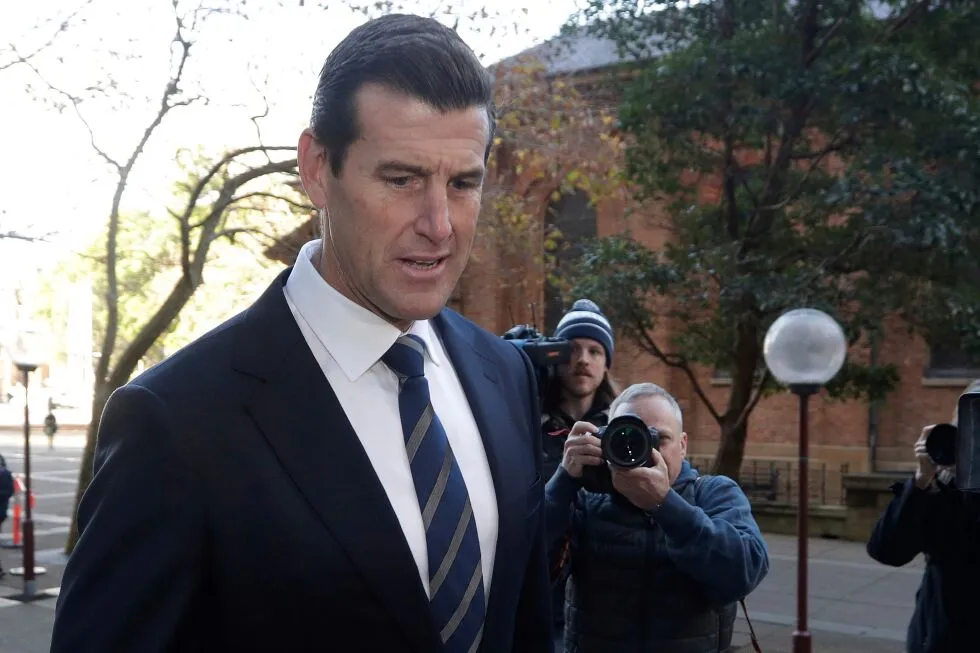
An Australian court on Friday granted bail to Ben Roberts-Smith, the country’s most decorated living veteran, 10 days after prosecutors charged him with five counts of war-crime murder tied to killings in Afghanistan between 2009 and 2012. The decision does not resolve the case, but it does move the country’s most politically sensitive military prosecution into a new phase: one in which the court will weigh how far the state can press historic battlefield allegations while still respecting the presumption of innocence owed to a soldier who for years was held up as a national hero.
Judge Greg Grogin ruled in Sydney that Roberts-Smith had shown exceptional circumstances sufficient to justify release from custody pending further proceedings. Prosecutors had argued he posed a risk of fleeing Australia or interfering with witnesses and evidence, while the defense argued that the case was unusually complex and that any trial timetable would stretch over years rather than months. That argument carried weight because the prosecution itself acknowledged the matter would be long, document-heavy and legally unusual in the Australian system.Australia’s most decorated veteran granted bail on war crimes charges related to Afghan deathsapnews.com·SecondaryBen Roberts-Smith arrives at the Federal Court in Sydney, Australia, on June 9, 2021. (AP Photo/Rick Rycroft, File) Britain’s Queen Elizabeth II greets Corp. Ben Roberts-Smith from Australia, who was recently awarded the Victoria Cross, during an audience at Buckingham Palace in London, Nov. 15, 2011.
The charges themselves are severe. Australian authorities allege Roberts-Smith murdered five Afghans in Uruzgan province during deployments in 2009 and 2012. The prosecution case, as summarized in current reporting, is that two victims were allegedly shot by Roberts-Smith himself and that three others were allegedly shot by subordinates acting on his orders and in his presence. Under Australian law, war-crime murder covers the intentional killing of people not taking active part in hostilities, including civilians, prisoners of war or wounded fighters. If convicted, Roberts-Smith faces the possibility of life imprisonment on each count.
The case matters well beyond one defendant because it reopens a broader reckoning over Australia’s two-decade Afghanistan mission. A 2020 military report found evidence that elite Australian troops unlawfully killed 39 Afghan prisoners, farmers and other noncombatants. Around 40,000 Australian military personnel served in Afghanistan between 2001 and 2021, and 41 were killed during that campaign. Those figures explain why this prosecution cuts so deeply: it sits at the intersection of battlefield sacrifice, national mythmaking and the unresolved question of whether democratic states are prepared to punish their own decorated soldiers when alleged atrocities surface years later.
Roberts-Smith has denied the allegations and has not yet entered pleas. His lawyers have framed the prosecution as extraordinary, arguing that domestic courts are being asked to judge wartime conduct by a soldier repeatedly deployed abroad by his own government. That line of defense is likely to resonate with Australians who believe combat decisions are too easily second-guessed from the safety of courtrooms and news studios. It also gives conservative and military-minded critics of the case a serious argument: a criminal court must prove specific murders beyond reasonable doubt, not merely show that a war was messy, brutal or morally compromised.
At the same time, the state’s position is not hard to understand. Federal police said the alleged victims were not taking part in hostilities at the time of the killings, and prosecutors described the accusations as among the gravest known to criminal law. If the evidence ultimately supports that view, then the case is not about relitigating military strategy or punishing service in Afghanistan as such. It is about whether Australian institutions are willing to enforce the same rules of armed conflict they publicly endorse abroad.
The Roberts-Smith file already carries a heavy public history because a civil defamation case in 2023 ended with a judge finding that many of the war-crimes allegations reported by newspapers were substantially true on the civil standard of proof. But that point cuts both ways. For critics of Roberts-Smith, the civil ruling suggested the allegations were too serious to dismiss as media invention. For his defenders, the same history is a warning against confusion: civil findings reached on a balance of probabilities are not criminal convictions, and the prosecution must now meet the much higher standard of proof beyond reasonable doubt.
That distinction is why the bail ruling matters politically as well as legally. A government and justice system that keep a defendant in custody for years before trial risk looking as though punishment is arriving before verdict. A government that releases a decorated former soldier accused of killing Afghan civilians risks appearing hesitant in the face of grave allegations. The court tried to steer between those pressures by emphasizing process rather than spectacle: the charges remain intact, the legal risk remains enormous, and bail is not exoneration.Australia’s most decorated veteran granted bail on war crimes charges related to Afghan deathsapnews.com·SecondaryBen Roberts-Smith arrives at the Federal Court in Sydney, Australia, on June 9, 2021. (AP Photo/Rick Rycroft, File) Britain’s Queen Elizabeth II greets Corp. Ben Roberts-Smith from Australia, who was recently awarded the Victoria Cross, during an audience at Buckingham Palace in London, Nov. 15, 2011.
There is also a wider institutional problem behind the case. The defense says the proceedings are likely to be beset by delays because of the novelty of the prosecution, the overseas setting, and the possibility that other former soldiers could yet be charged, some of them now living abroad. That means the Roberts-Smith prosecution could become a test of whether Australia has built a credible domestic mechanism for handling alleged war crimes committed by its own forces once the wars are over and the politics have turned cold. Long delays may be unavoidable, but they carry costs for defendants, witnesses, victims’ families and public confidence alike.
For now, the immediate result is narrow but important. Roberts-Smith is out on bail, the prosecution remains in place, and the matter is heading toward what all sides expect to be a drawn-out legal contest. Supporters will say the bail ruling is a reminder that even a deeply unpopular defendant is entitled to ordinary legal protections. Critics will say bail should not distract from the gravity of the accusations or from the larger Afghan accountability record that brought this prosecution into being. Both points are true, and that is why this story is likely to stay in Australia’s politics long after the courtroom formalities begin to blur.
What happens next will matter more than Friday’s headline. Prosecutors will have to turn a case shaped by military files, old deployments and contested witness testimony into a criminal presentation that survives a much stricter standard of proof. The defense will try to show that the allegations rest on unreliable recollection, institutional pressure and hindsight judgment about combat conditions. The Australian public, meanwhile, will be asked to hold two ideas at once: that decorated service deserves respect, and that serious allegations of unlawful killing deserve a full, unsentimental hearing in court.
AI Transparency
Why this article was written and how editorial decisions were made.
Why This Topic
This is a high-newsworthiness rule-of-law and military-accountability story with clear international relevance. Roberts-Smith is not a marginal defendant but Australia’s most decorated living veteran, and the bail ruling pushes a landmark Afghan war-crimes prosecution into a longer public phase. The case combines state power, military prestige, alleged unlawful killings, and a live dispute over how democracies judge battlefield conduct years later.
Source Selection
The cluster offers three current same-day signals with enough overlap to support a safe analytical piece: AP for the core procedural facts, Al Jazeera for a sharper summary of the allegations and public-history context, and ABC’s wire version for corroboration on bail arguments, charging details and the legal standard. That combination is strong enough for balanced sourcing without depending on thin single-source narration.
Editorial Decisions
Straight, non-moralizing treatment of a legally and politically sensitive war-crimes case. The piece gives equal weight to the prosecution’s accountability argument and the defense view that wartime conduct must be judged under a strict criminal standard rather than public outrage. It avoids hero-villain framing, keeps headlines descriptive, and emphasizes due process, institutional credibility and what the long timetable means next.
Reader Ratings
About the Author
Sources
- 1.apnews.comSecondary
- 2.abcnews.comUnverified
- 3.aljazeera.comSecondary
Editorial Reviews
1 approved · 0 rejectedPrevious Draft Feedback (1)
• depth_and_context scored 5/3 minimum: The article excels at providing necessary context, detailing the legal standards (war-crime murder, beyond reasonable doubt), the scope of the conflict (2001-2021, 40,000 personnel), and the broader institutional implications for Australia's military accountability. • narrative_structure scored 4/3 minimum: The structure is strong, moving logically from the immediate news hook (the bail decision) to the background charges, the broader national implications, and concluding with a forward-looking analysis of what happens next. It maintains a clear, journalistic arc. • perspective_diversity scored 5/3 minimum: The piece masterfully balances multiple viewpoints: the prosecution's gravity, the defense's procedural arguments, the public's conflicted feelings, and the institutional critique regarding accountability mechanisms. • analytical_value scored 5/3 minimum: The article consistently moves beyond mere reporting by analyzing the *meaning* of the bail decision—it's a test of institutional will, not just a legal ruling. It interprets the tension between national mythmaking and legal accountability. • filler_and_redundancy scored 5/2 minimum: The writing is dense with information but highly efficient; every paragraph advances the core argument or provides necessary background detail without repeating points unnecessarily. • language_and_clarity scored 5/3 minimum: The prose is crisp, authoritative, and precise. It handles complex legal and military terminology with clarity, avoiding overused labels by focusing instead on the specific legal standards and policy conflicts.



Discussion (0)
No comments yet.