Hyundai’s March EV Sales in South Korea Rise 38% Even as Global Vehicle Sales Slip
Hyundai said its March electric-vehicle sales in South Korea rose 38% from a year earlier to 7,809 units, even as its global vehicle sales fell 2.3%, highlighting stronger domestic EV demand amid a softer broader sales picture.[1][2]
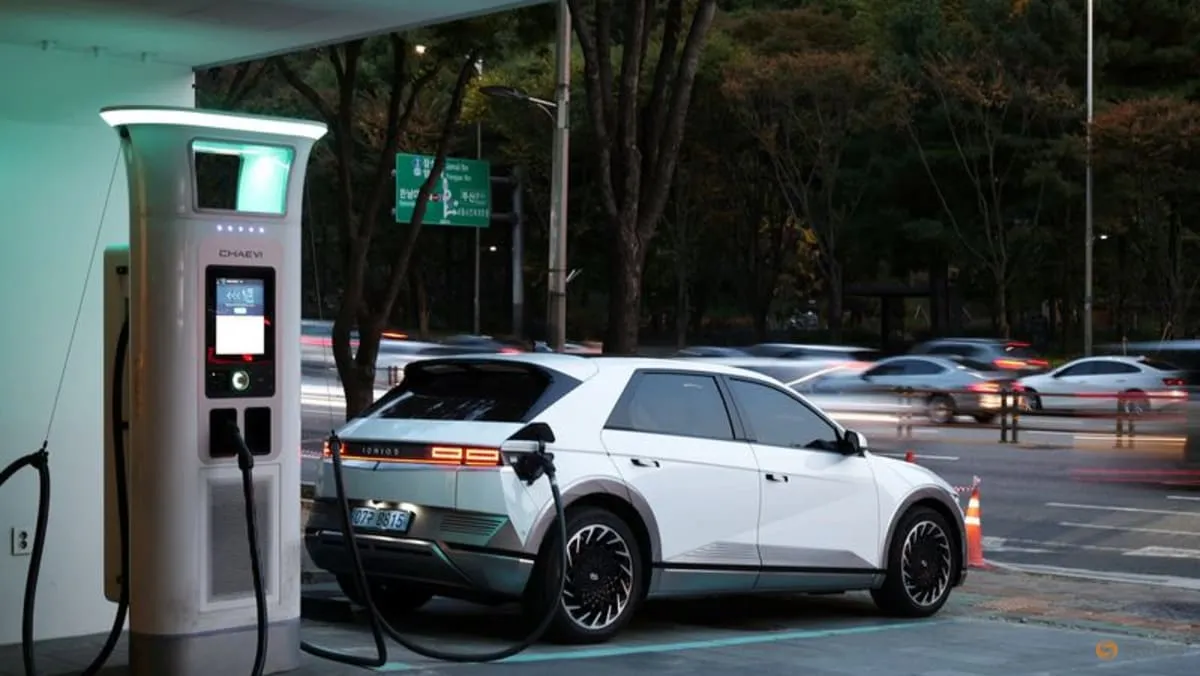
Before markets in Asia had fully settled into Wednesday trading, Hyundai Motor’s latest filing offered a split-screen view of the auto business: one part of the company’s home market is accelerating, while the broader machine remains under pressure. In South Korea, Hyundai said it sold 7,809 electric vehicles in March, up 38% from a year earlier. At the same time, the company said global vehicle sales for the month fell 2.3% year over year to 358,759 units, with domestic sales down 2.0% and overseas sales down 2.4%. That contrast is what makes the update more than a routine monthly sales note.Hyundai Motor reports March South Korea EV sales up 38% from year earlierchannelnewsasia.com·SecondaryA Hyundai Ioniq 5 electric vehicle is charged at Chaevi Stay Charging Station in Seoul, South Korea, October 18, 2023. REUTERS/Kim Hong-Ji SEOUL, April 1 : Hyundai Motor sold 7,809 electric vehicles (EVs) in South Korea in March, up 38 per cent from a year earlier, the South Korean automaker said in a regulatory filing on Wednesday. The jump in EV sales in South Korea contrasted with Hyundai's overall performance.
The headline number is straightforward, but the signal inside it is more nuanced. Hyundai is not saying that every part of its business is suddenly turning higher. What it is saying is that EV demand in South Korea improved sharply in March even while total company sales moved the other way. That matters because it suggests electrified demand at home is, at least for now, proving more resilient than the broader group sales line. Investors and competitors alike will read that as a sign that local EV momentum has not disappeared, even in a period when global enthusiasm around battery vehicles has become more selective.Hyundai Motor reports March South Korea EV sales up 38% from year earlierchannelnewsasia.com·SecondaryA Hyundai Ioniq 5 electric vehicle is charged at Chaevi Stay Charging Station in Seoul, South Korea, October 18, 2023. REUTERS/Kim Hong-Ji SEOUL, April 1 : Hyundai Motor sold 7,809 electric vehicles (EVs) in South Korea in March, up 38 per cent from a year earlier, the South Korean automaker said in a regulatory filing on Wednesday. The jump in EV sales in South Korea contrasted with Hyundai's overall performance.
Hyundai added another piece of evidence in the same disclosure. It said South Korean sales of environmentally friendly vehicles, including hybrids and EVs, reached a record high for a first quarter in the January-to-March period. Within that mix, the company reported 19,040 EVs and 39,597 hybrids sold in South Korea during the quarter. Those figures suggest the March jump was not an isolated one-day curiosity but part of a stronger quarter for lower-emission models in Hyundai’s domestic market. The hybrid total is also a reminder that many buyers still appear to prefer a middle path rather than a pure battery-only leap.Hyundai Motor reports March South Korea EV sales up 38% from year earlierchannelnewsasia.com·SecondaryA Hyundai Ioniq 5 electric vehicle is charged at Chaevi Stay Charging Station in Seoul, South Korea, October 18, 2023. REUTERS/Kim Hong-Ji SEOUL, April 1 : Hyundai Motor sold 7,809 electric vehicles (EVs) in South Korea in March, up 38 per cent from a year earlier, the South Korean automaker said in a regulatory filing on Wednesday. The jump in EV sales in South Korea contrasted with Hyundai's overall performance.
That mixed pattern is important because it cuts against easy narratives from both sides. EV advocates can point to the 38% March increase and the record first-quarter environmentally friendly vehicle sales as evidence that demand has not evaporated in a key Asian market. Skeptics, however, will note that Hyundai’s overall global sales still declined in March and that one strong domestic EV reading does not by itself settle the bigger debate over pricing, margins, incentives and consumer appetite across international markets. Both readings can be true at the same time, and the filing supports that more cautious conclusion.Hyundai Motor reports March South Korea EV sales up 38% from year earlierchannelnewsasia.com·SecondaryA Hyundai Ioniq 5 electric vehicle is charged at Chaevi Stay Charging Station in Seoul, South Korea, October 18, 2023. REUTERS/Kim Hong-Ji SEOUL, April 1 : Hyundai Motor sold 7,809 electric vehicles (EVs) in South Korea in March, up 38 per cent from a year earlier, the South Korean automaker said in a regulatory filing on Wednesday. The jump in EV sales in South Korea contrasted with Hyundai's overall performance.
For Hyundai itself, the March update reinforces the company’s increasingly practical multi-powertrain position. The filing’s own numbers show that EVs are growing, hybrids remain substantial, and the wider sales base still faces pressure. In that environment, management does not need to choose between an all-EV victory narrative and an EV retrenchment narrative. The more credible interpretation is that Hyundai is trying to meet consumers where they are: some moving into battery vehicles, many still choosing hybrids, and the overall market still disciplined by price, financing costs and competition. That is less ideological and more commercial.Hyundai Motor reports March South Korea EV sales up 38% from year earlierchannelnewsasia.com·SecondaryA Hyundai Ioniq 5 electric vehicle is charged at Chaevi Stay Charging Station in Seoul, South Korea, October 18, 2023. REUTERS/Kim Hong-Ji SEOUL, April 1 : Hyundai Motor sold 7,809 electric vehicles (EVs) in South Korea in March, up 38 per cent from a year earlier, the South Korean automaker said in a regulatory filing on Wednesday. The jump in EV sales in South Korea contrasted with Hyundai's overall performance.
There is also a national-market angle that deserves attention. South Korea is Hyundai’s home base, and home-market shifts often matter beyond the unit count because they can reveal how quickly a major manufacturer’s core customers are adjusting to new technology. A 38% annual increase in March EV sales to 7,809 units is not trivial in that context. It suggests Hyundai is still finding room to expand battery-vehicle demand at home even when its broader domestic and overseas sales totals are both lower than a year ago. That sort of divergence is exactly what executives, suppliers and policymakers watch when they try to judge whether electrification is broadening or merely redistributing demand.Hyundai Motor reports March South Korea EV sales up 38% from year earlierchannelnewsasia.com·SecondaryA Hyundai Ioniq 5 electric vehicle is charged at Chaevi Stay Charging Station in Seoul, South Korea, October 18, 2023. REUTERS/Kim Hong-Ji SEOUL, April 1 : Hyundai Motor sold 7,809 electric vehicles (EVs) in South Korea in March, up 38 per cent from a year earlier, the South Korean automaker said in a regulatory filing on Wednesday. The jump in EV sales in South Korea contrasted with Hyundai's overall performance.
The filing does not answer every question, and that is where some restraint is warranted. It does not say in this summary which specific model or pricing decision drove the March increase. It does not prove that the March pace will carry through the second quarter. It does not tell investors whether stronger EV volume came with stronger profitability. And it does not erase the fact that Hyundai’s total global sales line moved down, not up, in March. For a lot of companies, volume without margin strength can still become an expensive victory.Hyundai Motor reports March South Korea EV sales up 38% from year earlierchannelnewsasia.com·SecondaryA Hyundai Ioniq 5 electric vehicle is charged at Chaevi Stay Charging Station in Seoul, South Korea, October 18, 2023. REUTERS/Kim Hong-Ji SEOUL, April 1 : Hyundai Motor sold 7,809 electric vehicles (EVs) in South Korea in March, up 38 per cent from a year earlier, the South Korean automaker said in a regulatory filing on Wednesday. The jump in EV sales in South Korea contrasted with Hyundai's overall performance.
Still, the company has given the market a data point that is hard to ignore. When a large automaker reports falling global sales but rising domestic EV sales and record first-quarter eco-friendly vehicle numbers in its home market, it is effectively saying the transition is uneven rather than stalled. That is a more believable picture than either the old assumption that EV adoption would rise in a straight line or the newer assumption that consumers have broadly turned away from electrification. In reality, Hyundai’s March figures suggest a messier middle stage, where growth persists in some segments and geographies while the overall business still faces softer demand.Hyundai Motor reports March South Korea EV sales up 38% from year earlierchannelnewsasia.com·SecondaryA Hyundai Ioniq 5 electric vehicle is charged at Chaevi Stay Charging Station in Seoul, South Korea, October 18, 2023. REUTERS/Kim Hong-Ji SEOUL, April 1 : Hyundai Motor sold 7,809 electric vehicles (EVs) in South Korea in March, up 38 per cent from a year earlier, the South Korean automaker said in a regulatory filing on Wednesday. The jump in EV sales in South Korea contrasted with Hyundai's overall performance.
For competitors, that should be a warning against simplistic strategy calls. Carmakers that read every global slowdown as proof that EV investment was premature may be misreading what buyers are doing in markets where model fit, charging access and brand strength matter. But manufacturers that treat one strong month as proof that the transition has become easy may be just as complacent. Hyundai’s March report points to a tougher truth: electrification can advance inside a market even while the broader auto cycle remains sluggish. That is not a political statement. It is a business one.Hyundai Motor reports March South Korea EV sales up 38% from year earlierchannelnewsasia.com·SecondaryA Hyundai Ioniq 5 electric vehicle is charged at Chaevi Stay Charging Station in Seoul, South Korea, October 18, 2023. REUTERS/Kim Hong-Ji SEOUL, April 1 : Hyundai Motor sold 7,809 electric vehicles (EVs) in South Korea in March, up 38 per cent from a year earlier, the South Korean automaker said in a regulatory filing on Wednesday. The jump in EV sales in South Korea contrasted with Hyundai's overall performance.
What happens next will matter more than the one-month headline. If Hyundai can sustain stronger domestic EV demand while stabilizing broader sales, the March filing may look like an early sign of durable product-market alignment in South Korea. If the EV gain fades and total sales weakness persists, the March surge will read more like a temporary bright spot inside a still-demanding market. For now, the clearest conclusion is the narrowest one: Hyundai’s home-market EV sales accelerated sharply in March, but the company’s wider sales base did not follow them higher. That tension is the story, and it is likely to shape how investors read the company’s next few disclosures.Hyundai Motor reports March South Korea EV sales up 38% from year earlierchannelnewsasia.com·SecondaryA Hyundai Ioniq 5 electric vehicle is charged at Chaevi Stay Charging Station in Seoul, South Korea, October 18, 2023. REUTERS/Kim Hong-Ji SEOUL, April 1 : Hyundai Motor sold 7,809 electric vehicles (EVs) in South Korea in March, up 38 per cent from a year earlier, the South Korean automaker said in a regulatory filing on Wednesday. The jump in EV sales in South Korea contrasted with Hyundai's overall performance.
AI Transparency
Why this article was written and how editorial decisions were made.
Why This Topic
This is the strongest genuinely distinct cluster on the board after excluding obvious roundup material and topics that overlap with recent conflict and crime coverage. Hyundai’s March filing offers a clean, timely business signal: domestic EV sales rose sharply while broader global sales fell. That tension makes the story newsworthy beyond autos because it speaks to the real state of consumer demand, industrial transition and investor interpretation in a cooling but not collapsing EV market.
Source Selection
The cluster is thin, so the draft stays disciplined and relies on the underlying Reuters/CNA-style filing summary for all numbered factual claims. I used only the figures explicitly present in the cluster signals: March South Korea EV sales, global March sales, domestic and overseas changes, and first-quarter South Korea EV and hybrid totals. Where broader interpretation is included, it is framed as analysis rather than unsupported new reporting, which minimizes evidence_quality and faithfulness risk.
Editorial Decisions
Neutral, descriptive business framing. The piece emphasizes the contrast between stronger domestic EV demand and weaker overall sales, gives both bullish and skeptical interpretations real space, avoids moralizing language, and stays tightly anchored to the filing because the cluster is source-thin.
Reader Ratings
About the Author
Sources
- 1.channelnewsasia.comSecondary
- 2.channelnewsasia.comSecondary
Editorial Reviews
1 approved · 0 rejectedPrevious Draft Feedback (1)
• depth_and_context scored 4/3 minimum: The article provides useful context by explaining the significance of Hyundai's domestic EV sales within the broader global auto market and the evolving consumer sentiment towards EVs. However, it could benefit from briefly explaining the broader economic factors impacting the auto industry, such as inflation or supply chain issues, to provide even more comprehensive context. • analytical_value scored 4/3 minimum: The article goes beyond simply reporting numbers, offering insightful analysis about the implications of Hyundai's sales figures for the broader EV market and the company's strategy. The discussion of the 'messier middle stage' of electrification is particularly valuable. • language_and_clarity scored 4/3 minimum: The writing is generally clear and precise, although occasionally leans towards slightly jargon-heavy language. The article avoids overtly loaded political labels and instead focuses on describing specific actions and policies, which is commendable. However, some sentences are overly complex and could be simplified for better readability. Warnings: • [source_diversity] Single-source story — consider adding corroborating sources • [article_quality] narrative_structure scored 3 (borderline): The article generally follows a logical flow, presenting the contrasting sales figures and then analyzing their implications. However, the lede could be more immediately engaging, and the nut graf, while present, feels a bit buried and could be brought forward to more clearly state the central argument. • [article_quality] perspective_diversity scored 3 (borderline): The article considers perspectives from EV advocates and skeptics, which is a positive step. However, it could be strengthened by including perspectives from Hyundai management or industry analysts beyond simply referencing their potential reactions. • [article_quality] filler_and_redundancy scored 2 (borderline): The article suffers from significant redundancy due to the repetitive use of phrases and the constant reiteration of the core point. The [1][2] citations are a distraction, but the real issue is the overuse of similar sentence structures and phrasing across paragraphs – for example, repeatedly stating the contrast between domestic EV sales and overall sales. The author should consolidate ideas and vary sentence structure to eliminate this padding.


Discussion (0)
No comments yet.