Indonesia passes domestic workers law after 22-year campaign, shifting obligations onto employers and the state
Indonesia's parliament has passed a domestic-workers law after more than two decades of delay, extending legal recognition, social protections and new obligations for employers while leaving implementation rules to the next year.[1][2]
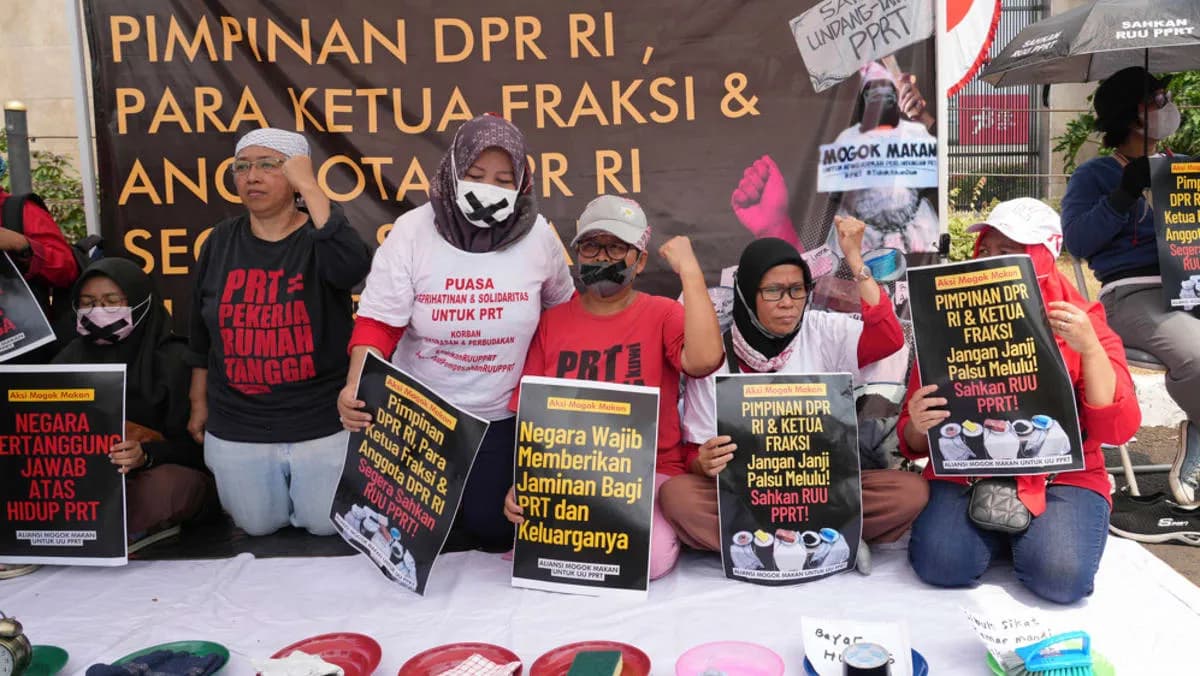
Indonesia’s parliament moved this week to close one of the country’s longest-running labour gaps, passing a law that formally recognises domestic workers and sets out new protections after more than two decades of delay. The measure matters beyond the symbolism of a late legislative win: it changes the legal status of a workforce that had often been treated as informal household help rather than as workers with enforceable rights. For a country that relies heavily on paid household labour in its cities and among middle-class families, the vote marks a notable shift in how the state defines work done inside private homes.Indonesia passes long-awaited law to protect domestic workerschannelnewsasia.com·SecondaryThe group was previously not legally classified as workers, meaning they were forced to operate in an informal and unregulated economy, exposed to exploitation and abuse. Activists hold posters as they display household items and chains to symbolise the challenges domestic workers face during a protest and hunger strike demanding the parliament to pass a bill to protect domestic workers outside the parliament in Jakarta, Indonesia on Aug 14, 2023.
The scale is large enough to give the law national significance. Indonesia has about 4.2 million domestic workers, and nearly 90% of them are women, according to the reporting that underpins the cluster. Until now, they were not legally classified as workers in the same way as employees covered by ordinary labour protections, leaving many in an informal grey zone with weak contracts or no contracts at all. That gap was not abstract. Both source reports describe a sector where long hours, low pay, weak bargaining power and exposure to exploitation had been common features rather than exceptional cases.Indonesia passes long-awaited law to protect domestic workerschannelnewsasia.com·SecondaryThe group was previously not legally classified as workers, meaning they were forced to operate in an informal and unregulated economy, exposed to exploitation and abuse. Activists hold posters as they display household items and chains to symbolise the challenges domestic workers face during a protest and hunger strike demanding the parliament to pass a bill to protect domestic workers outside the parliament in Jakarta, Indonesia on Aug 14, 2023.
Under the new law, domestic workers are to receive protections that had long been contested in parliament: health insurance, rest days and pensions are explicitly part of the new framework, while the Channel NewsAsia report also says the law provides for vocational training and unemployment benefits. It also bars the hiring of children under 18 as domestic workers and prevents placement agencies from making wage deductions that had previously reduced take-home pay. That package does not amount to a full settlement of every labour question, because supporting regulations still have to be written, but it is a meaningful change in the baseline relationship among households, agencies and workers.Indonesia passes long-awaited law to protect domestic workerschannelnewsasia.com·SecondaryThe group was previously not legally classified as workers, meaning they were forced to operate in an informal and unregulated economy, exposed to exploitation and abuse. Activists hold posters as they display household items and chains to symbolise the challenges domestic workers face during a protest and hunger strike demanding the parliament to pass a bill to protect domestic workers outside the parliament in Jakarta, Indonesia on Aug 14, 2023.
The legislative history helps explain why supporters are treating the vote as more than a routine policy update. The Domestic Workers Protection Law was first introduced in 2004 and repeatedly stalled, with discussions halted for years before the bill returned to parliament in 2020. Channel NewsAsia similarly reported that lawmakers approved the bill only after more than two decades of deliberations and multiple delays. In practical terms, that means a generation of domestic workers spent the peak years of their working lives waiting for a legal status that many other sectors took for granted.Indonesia passes long-awaited law to protect domestic workerschannelnewsasia.com·SecondaryThe group was previously not legally classified as workers, meaning they were forced to operate in an informal and unregulated economy, exposed to exploitation and abuse. Activists hold posters as they display household items and chains to symbolise the challenges domestic workers face during a protest and hunger strike demanding the parliament to pass a bill to protect domestic workers outside the parliament in Jakarta, Indonesia on Aug 14, 2023.
The political framing around the vote was broader than labour law alone. Government figures presented the measure as a way to provide legal certainty for both domestic workers and employers and to prevent discrimination, exploitation and abuse. That emphasis is worth noting because it answers a likely conservative criticism before it fully forms: the law is not being sold only as a rights charter for workers, but also as a clarifying framework for households that employ them.Domestic workers legally recognised in Indonesia after '22-year struggle'bbc.com·SecondaryIndonesia's parliament has passed a law to protect the rights of domestic workers, more than 20 years after it was first introduced. The country is home to some 4.2 million domestic workers - of which almost 90% are women. They were previously not legally classified as workers. They will now be entitled to health insurance, rest days and pensions. In other words, Jakarta is trying to regularise a large domestic labour market rather than simply moralise about it.Domestic workers legally recognised in Indonesia after '22-year struggle'bbc.com·SecondaryIndonesia's parliament has passed a law to protect the rights of domestic workers, more than 20 years after it was first introduced. The country is home to some 4.2 million domestic workers - of which almost 90% are women. They were previously not legally classified as workers. They will now be entitled to health insurance, rest days and pensions.
Supporters still argue that the moral and legal imbalance had become too obvious to ignore. The BBC and Channel NewsAsia reports both describe domestic workers as essential to the economy while remaining outside the legal protections given to recognised workers. Rights advocates cited years of mistreatment, and one group documented more than 3,300 cases of violence between 2021 and 2024, including physical and psychological abuse. Channel NewsAsia also pointed to a 2023 South Jakarta abuse case in which multiple people received prison sentences after a young domestic worker was beaten, burned with cigarettes and chained to a dog cage. Those examples help explain why campaigners treated recognition itself as a substantive reform rather than as a semantic adjustment.Indonesia passes long-awaited law to protect domestic workerschannelnewsasia.com·SecondaryThe group was previously not legally classified as workers, meaning they were forced to operate in an informal and unregulated economy, exposed to exploitation and abuse. Activists hold posters as they display household items and chains to symbolise the challenges domestic workers face during a protest and hunger strike demanding the parliament to pass a bill to protect domestic workers outside the parliament in Jakarta, Indonesia on Aug 14, 2023.
At the same time, the bill leaves unresolved questions that will matter to employers, agencies and workers over the next year. Regulators now have a 12-month window to draft the detailed implementation policies, and Channel NewsAsia reported that the legislation does not itself set a quantified minimum wage. That means the hardest disputes may simply be moving from the parliamentary stage into the regulatory stage: how inspections work in private homes, how wage disputes are handled, how agencies are supervised, and how smaller households absorb added costs. A law that looks decisive in a plenary chamber can still be diluted, delayed or unevenly enforced when it reaches ministries and local administrations.Indonesia passes long-awaited law to protect domestic workerschannelnewsasia.com·SecondaryThe group was previously not legally classified as workers, meaning they were forced to operate in an informal and unregulated economy, exposed to exploitation and abuse. Activists hold posters as they display household items and chains to symbolise the challenges domestic workers face during a protest and hunger strike demanding the parliament to pass a bill to protect domestic workers outside the parliament in Jakarta, Indonesia on Aug 14, 2023.
That implementation problem is why even friendly groups are treating the vote as a beginning rather than an endpoint. Rights advocates welcomed the law, but they also warned that public education would still be needed to explain employer responsibilities and that the broader struggle was not over. That is not an ideological flourish; it is a practical observation about the kind of sector involved. Domestic work happens inside private homes, often through personal trust networks and informal arrangements, which makes formal compliance harder to monitor than in a factory or office.Indonesia passes long-awaited law to protect domestic workerschannelnewsasia.com·SecondaryThe group was previously not legally classified as workers, meaning they were forced to operate in an informal and unregulated economy, exposed to exploitation and abuse. Activists hold posters as they display household items and chains to symbolise the challenges domestic workers face during a protest and hunger strike demanding the parliament to pass a bill to protect domestic workers outside the parliament in Jakarta, Indonesia on Aug 14, 2023.
There is also a broader political read on why the measure passed now after so many years. Channel NewsAsia reported that Law Minister Supratman Andi Agtas linked the outcome to President Prabowo Subianto’s wish to see the bill completed, and parliamentary approval was staged as a clear government success. Supporters will present that as overdue responsiveness. Skeptics may view it as a case of the political class finally embracing a reform only once it became low-cost and publicly advantageous.Domestic workers legally recognised in Indonesia after '22-year struggle'bbc.com·SecondaryIndonesia's parliament has passed a law to protect the rights of domestic workers, more than 20 years after it was first introduced. The country is home to some 4.2 million domestic workers - of which almost 90% are women. They were previously not legally classified as workers. They will now be entitled to health insurance, rest days and pensions. Both interpretations can coexist, and both matter in assessing whether the state will still prioritise enforcement once the applause fades.Domestic workers legally recognised in Indonesia after '22-year struggle'bbc.com·SecondaryIndonesia's parliament has passed a law to protect the rights of domestic workers, more than 20 years after it was first introduced. The country is home to some 4.2 million domestic workers - of which almost 90% are women. They were previously not legally classified as workers. They will now be entitled to health insurance, rest days and pensions.
What happens next will determine whether Indonesia has merely passed a celebrated bill or actually changed the working lives of millions. If the one-year rulemaking period produces clear standards, workable enforcement and credible sanctions, the law could pull a huge female-heavy workforce into a more formal and less abusive labour regime. If implementation drifts, the country may end up with a landmark statute that is cited in speeches but only patchily felt inside households. For now, the vote stands as a substantial political and legal recognition that domestic work is work, and that Indonesia’s state can no longer plausibly treat that question as unsettled.Indonesia passes long-awaited law to protect domestic workerschannelnewsasia.com·SecondaryThe group was previously not legally classified as workers, meaning they were forced to operate in an informal and unregulated economy, exposed to exploitation and abuse. Activists hold posters as they display household items and chains to symbolise the challenges domestic workers face during a protest and hunger strike demanding the parliament to pass a bill to protect domestic workers outside the parliament in Jakarta, Indonesia on Aug 14, 2023.
AI Transparency
Why this article was written and how editorial decisions were made.
Why This Topic
This is the strongest distinct publishable cluster on the board after recovery checks. It carries a 7.0 newsworthiness score, affects roughly 4.2 million workers in Southeast Asia's largest economy, and combines clear legislative action with meaningful social and economic consequences.[1][2] It also offers better perspective diversity than thinner business or market-move clusters because the source set naturally includes parliament, government, workers and rights advocates, plus unresolved implementation questions.[1][2]
Source Selection
The cluster sources are sufficient and relatively strong for this topic. BBC supplies the legislative timeline, worker scale, core entitlements and the one-year implementation window, while Channel NewsAsia adds government framing, specific welfare elements, abuse context and the absence of a quantified minimum wage.[1][2] Together they provide enough overlap for confidence and enough variation for balance. I deliberately paraphrased rather than quoted to reduce evidence-quality risk and kept numbered citations limited to these two cluster sources only.
Editorial Decisions
Straight, descriptive treatment of a labour-law change with equal weight for government framing, rights-group arguments and implementation skepticism. I avoided activist language, kept the headline factual, and treated the bill as both a rights measure and a state effort to formalise a poorly regulated labour market. All factual claims are tied to cluster sources [1][2], with no unsupported web facts added.
Reader Ratings
About the Author
Sources
- 1.channelnewsasia.comSecondary
- 2.bbc.comSecondary
Editorial Reviews
1 approved · 0 rejectedPrevious Draft Feedback (1)
• depth_and_context scored 5/3 minimum: The article excels by providing deep context, detailing the 20-year legislative history, the scale of the workforce (4.2 million), and the specific nature of the 'grey zone' employment. It successfully explains *why* this law matters beyond the immediate vote. • narrative_structure scored 4/3 minimum: The structure is strong, moving logically from the immediate event (the vote) to the background (the gap), the specifics (the protections), the history, and finally to the future challenges (implementation). It could benefit from a slightly punchier lede that immediately frames the stakes, rather than starting with the passing of the law itself. • perspective_diversity scored 4/3 minimum: The article effectively presents multiple viewpoints, including rights advocates, government figures, and skeptics regarding implementation. To reach a 5, it could more explicitly quote or elaborate on the specific concerns of a major employer association or a local government official regarding the practical costs of compliance. • analytical_value scored 5/3 minimum: The analysis is excellent, moving beyond mere reporting to discuss the political framing (regularization vs. moralizing) and the critical next steps (the regulatory phase). The concluding paragraphs synthesize these points into a strong, forward-looking assessment of the law's true impact. • filler_and_redundancy scored 5/2 minimum: The writing is highly efficient; every paragraph advances the narrative or analysis. The repetition of key facts (like the 20-year delay) is necessary for emphasis and context, not padding. • language_and_clarity scored 5/3 minimum: The prose is crisp, precise, and authoritative, avoiding clichés or overly academic jargon. The language is highly engaging while maintaining journalistic rigor, particularly in its nuanced discussion of political motivations.


Discussion (0)
No comments yet.