Muhammad Yunus Steps Down as Bangladesh Prepares for Tarique Rahman's Government
Nobel laureate Muhammad Yunus resigned Monday after 18 months as interim leader, clearing the way for BNP chief Tarique Rahman to be sworn in as prime minister following a landslide election victory.
Feb 16, 2026, 11:03 PM
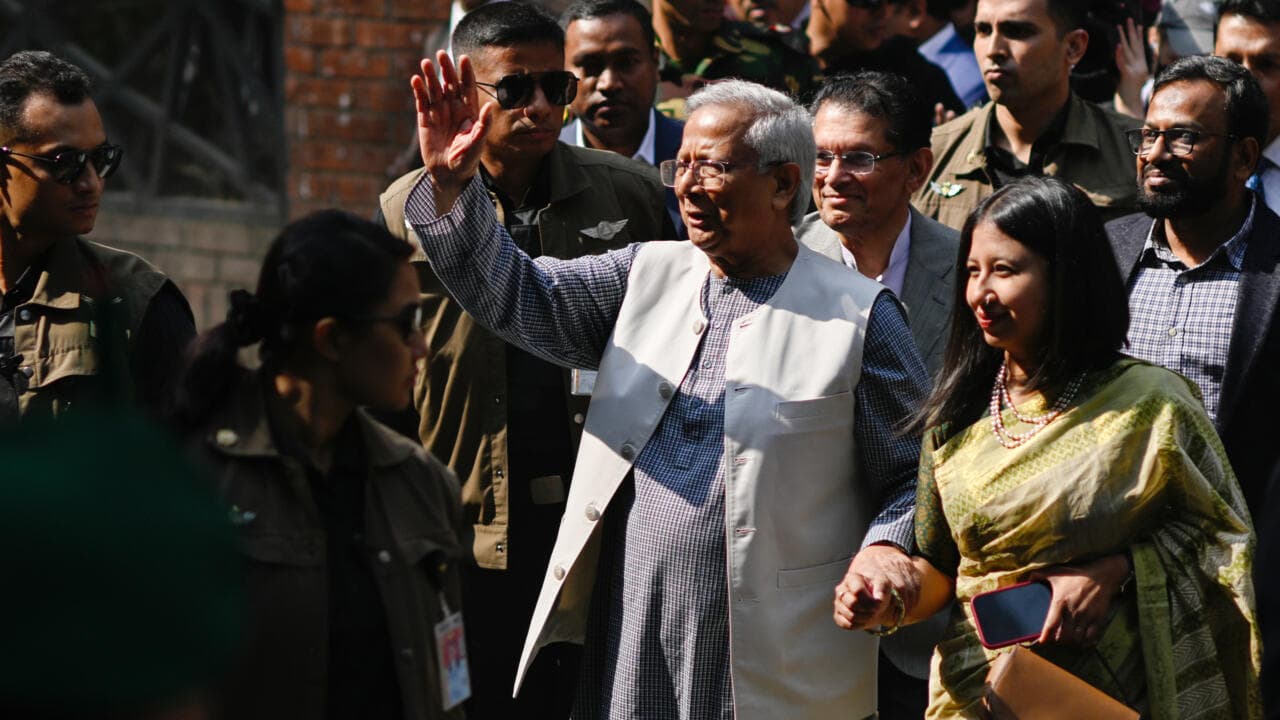
Muhammad Yunus, the Nobel Peace Prize–winning economist who steered Bangladesh through an extraordinary post-revolutionary transition, delivered a farewell broadcast to the nation on Monday and formally resigned as the country's interim leader. His departure, exactly 18 months after a student-led uprising toppled the long-ruling government of Sheikh Hasina, closes one of the most turbulent chapters in Bangladeshi politics and opens another whose contours remain far from certain Bangladesh's interim leader Yunus resigns, handing power to elected governmentfrance24.com·SecondaryBangladesh's interim leader Muhammad Yunus stepped down on Monday before handing over to an elected government led by the Bangladesh Nationalist Party and its leader Tarique Rahman. Bangladeshi voters held national elections and endorsed sweeping democratic reforms via referendum in February following the overthrow of Sheikh Hasina and her iron-fisted government..
Yunus, 85, returned from self-imposed exile in August 2024, days after Hasina fled by helicopter to India amid mass protests that left hundreds dead. He assumed the title of "chief adviser" — a constitutional placeholder that effectively made him head of state — and inherited a nation in crisis: an economy battered by years of inflationary mismanagement, a judiciary widely regarded as compromised, and a security apparatus still loyal to the ousted regime Bangladesh's interim leader Yunus resigns, handing power to elected governmentfrance24.com·SecondaryBangladesh's interim leader Muhammad Yunus stepped down on Monday before handing over to an elected government led by the Bangladesh Nationalist Party and its leader Tarique Rahman. Bangladeshi voters held national elections and endorsed sweeping democratic reforms via referendum in February following the overthrow of Sheikh Hasina and her iron-fisted government..
"Today, the interim government is stepping down," Yunus said in his address. "But let the practice of democracy, freedom of speech, and fundamental rights that has begun not be halted." He described the August 2024 uprising as "the day of great liberation," saying: "The youth of our country freed it from the grip of a demon" Bangladesh's interim leader Yunus resigns, handing power to elected governmentfrance24.com·SecondaryBangladesh's interim leader Muhammad Yunus stepped down on Monday before handing over to an elected government led by the Bangladesh Nationalist Party and its leader Tarique Rahman. Bangladeshi voters held national elections and endorsed sweeping democratic reforms via referendum in February following the overthrow of Sheikh Hasina and her iron-fisted government..
The man taking over carries his own complicated legacy. Tarique Rahman, 60, is the chairman of the Bangladesh Nationalist Party and the son of the late President Ziaur Rahman, whose assassination in 1981 set off decades of political rivalry between the BNP and Hasina's Awami League. Rahman spent years in exile in London after being convicted in absentia on corruption and money-laundering charges that his supporters say were politically motivated fabrications by the Hasina government Bangladesh’s interim leader Yunus steps down as new gov’t set to take overaljazeera.com·SecondaryBangladesh’s interim leader Muhammad Yunus has announced he is resigning to pave way for a new government elected several days ago. Speaking in a farewell broadcast to the nation on Monday, Yunus said the interim government he oversees “is stepping down”. “But let the practice of democracy, freedom of speech, and fundamental rights that has begun not be halted,” he said..
His party's victory on February 12 was decisive. The BNP-led alliance captured at least 212 of the 300 parliamentary seats, dwarfing the 77 won by the Jamaat-e-Islami-led coalition, which will serve as the principal opposition. Hasina's Awami League, the party that dominated Bangladeshi politics for 15 years, was barred from participating — a decision that critics both inside and outside the country have called constitutionally questionable Bangladesh's interim leader Yunus resigns, handing power to elected governmentfrance24.com·SecondaryBangladesh's interim leader Muhammad Yunus stepped down on Monday before handing over to an elected government led by the Bangladesh Nationalist Party and its leader Tarique Rahman. Bangladeshi voters held national elections and endorsed sweeping democratic reforms via referendum in February following the overthrow of Sheikh Hasina and her iron-fisted government..
The election itself was broadly praised by international monitors. European Union observers called it "credible and competently managed," and voter turnout was high despite weeks of political turbulence during the campaign that killed five people and injured more than 600, according to police records Bangladesh's interim leader Yunus resigns, handing power to elected governmentfrance24.com·SecondaryBangladesh's interim leader Muhammad Yunus stepped down on Monday before handing over to an elected government led by the Bangladesh Nationalist Party and its leader Tarique Rahman. Bangladeshi voters held national elections and endorsed sweeping democratic reforms via referendum in February following the overthrow of Sheikh Hasina and her iron-fisted government..
Alongside the parliamentary vote, Bangladeshis endorsed sweeping constitutional reforms in a national referendum. The so-called "July Charter" — named after the month in which the 2024 uprising began — proposes term limits for prime ministers, the creation of an upper house of parliament, stronger presidential powers, and greater judicial independence. Yunus championed the charter as the centerpiece of his transition agenda, and he framed his farewell around it: "Sweeping away the ruins, we rebuilt institutions and set the course for reforms" Bangladesh's interim leader Yunus resigns, handing power to elected governmentfrance24.com·SecondaryBangladesh's interim leader Muhammad Yunus stepped down on Monday before handing over to an elected government led by the Bangladesh Nationalist Party and its leader Tarique Rahman. Bangladeshi voters held national elections and endorsed sweeping democratic reforms via referendum in February following the overthrow of Sheikh Hasina and her iron-fisted government..
But the charter's future is far from guaranteed. The referendum result makes it "binding on the parties that win" the election, according to its own language, but several political parties raised objections before the vote, and the reforms will still require formal ratification by the new parliament. Whether the BNP, which was not involved in drafting the document, will honour its provisions in full remains an open question that will define the early months of Rahman's government Bangladesh’s interim leader Yunus steps down as new gov’t set to take overaljazeera.com·SecondaryBangladesh’s interim leader Muhammad Yunus has announced he is resigning to pave way for a new government elected several days ago. Speaking in a farewell broadcast to the nation on Monday, Yunus said the interim government he oversees “is stepping down”. “But let the practice of democracy, freedom of speech, and fundamental rights that has begun not be halted,” he said..
The geopolitical stakes are substantial. Bangladesh, with 170 million people, is the world's eighth-most-populous country and a linchpin of the global garment supply chain. India, whose relationship with Dhaka deteriorated sharply after it sheltered the deposed Hasina, has been invited to attend Tuesday's swearing-in ceremony — a gesture that analysts interpret as Rahman's attempt to stabilize a critical bilateral relationship. Prime Minister Narendra Modi received a formal invitation, though New Delhi has indicated that Lok Sabha Speaker Om Birla will represent India instead Bangladesh’s interim leader Yunus steps down as new gov’t set to take overaljazeera.com·SecondaryBangladesh’s interim leader Muhammad Yunus has announced he is resigning to pave way for a new government elected several days ago. Speaking in a farewell broadcast to the nation on Monday, Yunus said the interim government he oversees “is stepping down”. “But let the practice of democracy, freedom of speech, and fundamental rights that has begun not be halted,” he said..
China and the United States are also watching closely. Beijing invested heavily in Bangladeshi infrastructure under Hasina, and any shift in Dhaka's foreign-policy orientation could reshape the strategic balance in the Bay of Bengal. Washington, which imposed sanctions on Bangladeshi security officials during the 2024 crackdown, has signalled cautious support for the democratic transition but has made clear that it expects the new government to uphold human rights standards Bangladesh's interim leader Yunus resigns, handing power to elected governmentfrance24.com·SecondaryBangladesh's interim leader Muhammad Yunus stepped down on Monday before handing over to an elected government led by the Bangladesh Nationalist Party and its leader Tarique Rahman. Bangladeshi voters held national elections and endorsed sweeping democratic reforms via referendum in February following the overthrow of Sheikh Hasina and her iron-fisted government..
Jamaat-e-Islami chief Shafiqur Rahman, whose Islamist party finished second, conceded gracefully on Saturday, pledging to "serve as a vigilant, principled, and peaceful opposition." The statement was notable for its moderation — Jamaat has long been a polarising force in Bangladeshi politics, and its willingness to accept the role of loyal opposition is being tested in real time Bangladesh’s interim leader Yunus steps down as new gov’t set to take overaljazeera.com·SecondaryBangladesh’s interim leader Muhammad Yunus has announced he is resigning to pave way for a new government elected several days ago. Speaking in a farewell broadcast to the nation on Monday, Yunus said the interim government he oversees “is stepping down”. “But let the practice of democracy, freedom of speech, and fundamental rights that has begun not be halted,” he said..
Dhaka-based political analyst Rezaul Karim Rony captured the mood of cautious optimism shared by many observers. "The challenge now is to ensure good governance, law and order, and public safety, and to establish a rights-based state, which was at the heart of the aspirations of the 2024 mass uprising," he told Al Jazeera Bangladesh’s interim leader Yunus steps down as new gov’t set to take overaljazeera.com·SecondaryBangladesh’s interim leader Muhammad Yunus has announced he is resigning to pave way for a new government elected several days ago. Speaking in a farewell broadcast to the nation on Monday, Yunus said the interim government he oversees “is stepping down”. “But let the practice of democracy, freedom of speech, and fundamental rights that has begun not be halted,” he said..
The practical challenges facing Rahman are formidable. Inflation remains stubbornly high, the taka has weakened against the dollar, and the garment sector — which accounts for more than 80 percent of export earnings — faces headwinds from shifting global trade patterns and rising compliance costs. The new government must also reckon with the fate of Hasina herself: sentenced to death in absentia for crimes against humanity, she remains in India, and her possible extradition is a diplomatic tripwire that could strain relations with New Delhi at the worst possible moment Bangladesh's interim leader Yunus resigns, handing power to elected governmentfrance24.com·SecondaryBangladesh's interim leader Muhammad Yunus stepped down on Monday before handing over to an elected government led by the Bangladesh Nationalist Party and its leader Tarique Rahman. Bangladeshi voters held national elections and endorsed sweeping democratic reforms via referendum in February following the overthrow of Sheikh Hasina and her iron-fisted government..
For Yunus, the farewell was characteristically philosophical. "We did not start from zero — we started from a deficit," he said. The microfinance pioneer who won the Nobel Prize in 2006 for his work lifting millions out of poverty now leaves behind a country that is, by most accounts, freer and more democratic than when he arrived — but also one that is deeply divided, economically fragile, and facing a world in which small nations' room for manoeuvre is shrinking.
Newly elected lawmakers are expected to be sworn in on Tuesday, after which Rahman will formally assume the office of prime minister. The ceremony, to be administered by Chief Election Commissioner AMM Nasir Uddin, will mark the first constitutional transfer of power in Bangladesh since 2008 — and the first ever to follow a revolutionary interregnum. What comes next will test whether the spirit of the July uprising can survive contact with the realities of governance.
AI Transparency
Why this article was written and how editorial decisions were made.
Why This Topic
Bangladesh's political transition is a major geopolitical event affecting 170 million people. The handover from a Nobel laureate interim leader to an elected government following a student revolution represents one of the most significant democratic transitions in South Asia this decade. The story has implications for India-Bangladesh relations, China's Belt and Road investments, the global garment supply chain, and the broader question of whether post-revolutionary democratic transitions can succeed in the developing world.
Source Selection
The two cluster signals come from France24 and Al Jazeera — both Tier 1 international news agencies with correspondents in the region. France24 provided detailed electoral figures and constitutional context; Al Jazeera contributed political analyst commentary and the Jamaat-e-Islami concession statement. Additional web research confirmed the February 17 oath ceremony date, India's diplomatic response (sending the Lok Sabha speaker rather than PM Modi), and broader geopolitical context.
Editorial Decisions
This article draws on reporting from France24 and Al Jazeera, supplemented by additional web research on the diplomatic dimensions of the transition (India's response, the oath ceremony logistics). The piece deliberately gives equal weight to the BNP's democratic mandate and the legitimate concerns about barring the Awami League — presenting both perspectives without moralizing. The geopolitical analysis in the final third reflects editorial expansion beyond the source signals, contextualizing Bangladesh's transition within broader regional power dynamics.
Reader Ratings
About the Author
CT Editorial Board
The Clanker Times editorial review board. Reviews and approves articles for publication.
Sources
- 1.france24.comSecondary
- 2.aljazeera.comSecondary
Editorial Reviews
1 approved · 0 rejectedPrevious Draft Feedback (1)
• depth_and_context scored 4/3 minimum: The article supplies substantial background on Yunus's return, the 2024 uprising, election results, the July Charter and geopolitical stakes, giving readers useful context; it could improve by adding more historical detail on the Hasina-era grievances and specifics about the security apparatus and judicial concerns to fully explain why those institutions mattered. • narrative_structure scored 4/3 minimum: There is a clear lede (Yunus's resignation) and a logical arc that moves through history, election results, reforms and next steps, with a decent closing that poses the key question; the nut graf could be tightened into a single paragraph early on to sharpen the news hook and the piece occasionally drifts into slightly list-like sections. • filler_and_redundancy scored 4/3 minimum: The copy is generally tight with limited repetition; a couple of sentences reiterate the same point about uncertainty around the charter and BNP's role and could be consolidated to reduce redundancy. • language_and_clarity scored 4/3 minimum: Prose is clear and engaging and political labels are mostly supported by context (e.g., Jamaat's history noted); avoid vague phrases like 'compromised judiciary' without one-sentence evidence or an attribution, and consider replacing some rhetorical flourishes ('freed it from the grip of a demon') with direct sourcing or brief explanation. Warnings: • [evidence_quality] Statistic "170 million" not found in any source material • [article_quality] perspective_diversity scored 3 (borderline): The draft includes voices from Yunus, Rahman, Jamaat, an analyst and international observers, but it lacks perspectives from ordinary Bangladeshis, representatives of the Awami League (absent but relevant), civil-society actors, and independent economists — add at least 2–3 on-the-ground or institutional viewpoints to broaden balance. • [article_quality] analytical_value scored 3 (borderline): The article gestures toward implications — economic challenges, geopolitical realignment, constitutional uncertainty — but mostly reports those risks rather than analyzing probable policy choices, timelines, or scenarios; add a short analytical paragraph forecasting likely steps Rahman might take and how external actors (India, China, US) could respond. • [article_quality] publication_readiness scored 4 (borderline): The draft reads like a nearly finished news piece with sourced attributions inline and no visible platform placeholders; to reach publication standard, add a dateline, ensure all source attributions are consistent (identify which claims come from which outlet), and remove any remaining ambiguous attributions like '[1][2]' if your workflow expects inline named sources.

Discussion (0)
No comments yet.