Tencent revenue rises 9% but misses forecasts as AI spending offsets gaming gains
Tencent reported 9% first-quarter revenue growth on Wednesday but missed analyst forecasts, underscoring how stronger gaming, ads and cloud demand are still being partly absorbed by a more expensive AI buildout.[1][2]
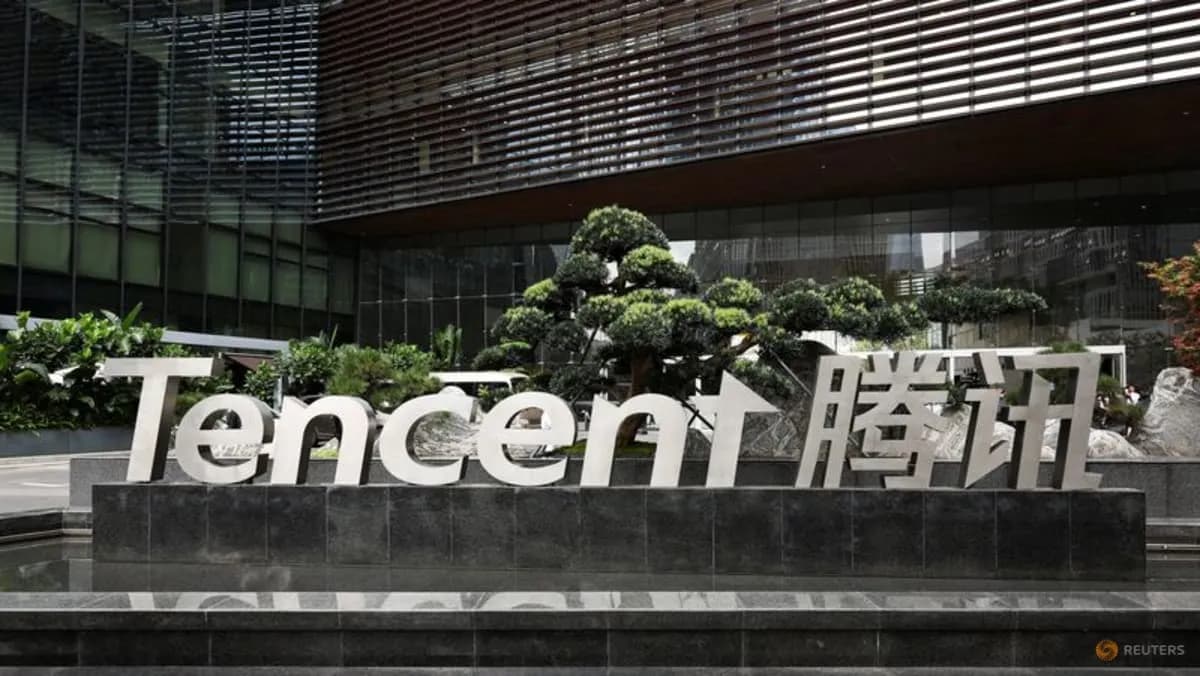
Tencent’s first-quarter report on Wednesday offered a useful split-screen of China’s tech economy: demand was plainly there, but so was the bill for staying in the race. The company said revenue rose 9% year on year to 196.5 billion yuan, yet that still came in below analyst expectations of roughly 199 billion yuan, while net profit of 58.1 billion yuan also missed estimates that had been closer to 61.42 billion yuan. For a company of Tencent’s scale, that combination matters more than a simple beat-or-miss headline. It suggests the group is still monetising huge user ecosystems in games, advertising and cloud-linked services, but it is also entering a stretch in which management is prepared to tolerate heavier near-term cost pressure in order to defend its position in artificial intelligence.Tencent profit misses forecasts as higher spend offsets gaming gainschannelnewsasia.com·SecondaryThe Tencent logo at the company's headquarters during a government‑organised media trip in Shenzhen, Guangdong province, China, on Apr 17, 2026. (Photo: REUTERS/Go Nakamura) BEIJING: Tencent Holdings reported a 9 per cent rise in first-quarter revenue to 196.5 billion yuan (US$28.94 billion) on Wednesday (May 13), but fell short of the 198.96 billion yuan forecast by analysts.
The gaming business remains the clearest proof that Tencent’s core engine still works, though not without caveats. According to the company’s results coverage, domestic gaming revenue rose 6% and international gaming revenue increased 13%, with major titles such as Honour of Kings and Peacekeeper Elite still driving engagement and Delta Force adding momentum. That is solid performance in absolute terms, especially for a company whose installed audience base is already enormous. But the more skeptical read deserves equal weight: CNBC noted that domestic games growth was slower than the comparable pace a year earlier, and Morningstar analyst Ivan Su argued that at least part of the softer impression was linked to the timing shift of Lunar New Year revenue recognition rather than a collapse in demand. In other words, bulls can point to resilience, while skeptics can still say the quarter did not show the kind of breakout acceleration that would silence questions about maturity in Tencent’s most established business.Tencent profit misses forecasts as higher spend offsets gaming gainschannelnewsasia.com·SecondaryThe Tencent logo at the company's headquarters during a government‑organised media trip in Shenzhen, Guangdong province, China, on Apr 17, 2026. (Photo: REUTERS/Go Nakamura) BEIJING: Tencent Holdings reported a 9 per cent rise in first-quarter revenue to 196.5 billion yuan (US$28.94 billion) on Wednesday (May 13), but fell short of the 198.96 billion yuan forecast by analysts.
Advertising and business services did more of the work that equity markets increasingly want to see from a modern Chinese platform giant. Tencent’s online advertising revenue rose 20% to 38.2 billion yuan, and CNBC separately highlighted that the fintech and other business services segment generated 60 billion yuan in the quarter, up from 55 billion yuan a year earlier. The company attributed part of that improvement to AI-enhanced ad targeting and to stronger cloud-services demand at home and abroad, especially where customers were buying AI-related services. That matters because it shifts the story away from the older caricature of Tencent as mostly a gaming-and-social-media conglomerate. The company is trying to show investors that the same installed base that throws off entertainment cash can also support a higher-value software and infrastructure stack, which is where the more durable margin story would have to come from if China’s platform cycle is entering a more capital-intensive phase.Tencent profit misses forecasts as higher spend offsets gaming gainschannelnewsasia.com·SecondaryThe Tencent logo at the company's headquarters during a government‑organised media trip in Shenzhen, Guangdong province, China, on Apr 17, 2026. (Photo: REUTERS/Go Nakamura) BEIJING: Tencent Holdings reported a 9 per cent rise in first-quarter revenue to 196.5 billion yuan (US$28.94 billion) on Wednesday (May 13), but fell short of the 198.96 billion yuan forecast by analysts.
That strategic push is expensive, and management is no longer pretending otherwise. The March guidance cited in current coverage already signaled that Tencent would raise AI investment this year, including spending on proprietary models, after management said export restrictions had previously constrained parts of its capex planning. Wednesday’s quarter gave investors a clearer sense of what that means in practice. The company had already spent around 79 billion yuan in capex last year versus 77 billion yuan in 2024, while first-quarter capex this year reached 31.9 billion yuan compared with 27.5 billion yuan a year earlier. Tencent also spent 1 billion yuan promoting its Yuanbao AI chatbot during the Lunar New Year period and last month unveiled Hunyuan 3.0, the latest version of its flagship large language model, after bringing in former OpenAI researcher Yao Shunyu to help lead proprietary model development.Tencent profit misses forecasts as higher spend offsets gaming gainschannelnewsasia.com·SecondaryThe Tencent logo at the company's headquarters during a government‑organised media trip in Shenzhen, Guangdong province, China, on Apr 17, 2026. (Photo: REUTERS/Go Nakamura) BEIJING: Tencent Holdings reported a 9 per cent rise in first-quarter revenue to 196.5 billion yuan (US$28.94 billion) on Wednesday (May 13), but fell short of the 198.96 billion yuan forecast by analysts. Those are not the actions of a company trying to preserve near-term earnings comfort; they are the actions of a management team acting as if compute, talent and distribution now have to be bought aggressively before rivals lock in user habits.Tencent profit misses forecasts as higher spend offsets gaming gainschannelnewsasia.com·SecondaryThe Tencent logo at the company's headquarters during a government‑organised media trip in Shenzhen, Guangdong province, China, on Apr 17, 2026. (Photo: REUTERS/Go Nakamura) BEIJING: Tencent Holdings reported a 9 per cent rise in first-quarter revenue to 196.5 billion yuan (US$28.94 billion) on Wednesday (May 13), but fell short of the 198.96 billion yuan forecast by analysts.
The company’s official line is that this heavier investment phase is manageable because the old businesses are still generating the cash flow to fund it. CNBC cited chairman and chief executive Ma Huateng saying Tencent had made early progress on new AI products while continuing to use AI to expand existing core businesses, and that the core operations were still producing the revenue and profit needed to finance future deployment. That is a credible argument, not a talking point to dismiss out of hand. Unlike weaker technology groups that must promise tomorrow’s platform upside without today’s funding base, Tencent can point to cash-generating games, advertising products and financial-services links as a real internal subsidy for experimentation. The conservative case for investors is that such self-funded expansion is preferable to the sort of speculative growth story that depends on outside capital or state-preferred narratives alone. If AI spending is going to surge anyway across Chinese tech, having an incumbent that can finance much of it from operating strength is a genuine advantage.Tencent profit misses forecasts as higher spend offsets gaming gainschannelnewsasia.com·SecondaryThe Tencent logo at the company's headquarters during a government‑organised media trip in Shenzhen, Guangdong province, China, on Apr 17, 2026. (Photo: REUTERS/Go Nakamura) BEIJING: Tencent Holdings reported a 9 per cent rise in first-quarter revenue to 196.5 billion yuan (US$28.94 billion) on Wednesday (May 13), but fell short of the 198.96 billion yuan forecast by analysts.
Still, there is a harder question behind the quarter, and it is the one the miss keeps alive: how long should investors accept lower earnings quality in exchange for strategic positioning? Revenue growth of 9% is respectable, but it is not explosive for a company that is spending at this pace, and both the revenue and profit numbers landed on the wrong side of consensus. That leaves room for a more doubtful interpretation. Perhaps Tencent is making the rational move in a competitive market; perhaps it is also being pulled into the same arms race that is pressuring rivals such as Alibaba and ByteDance, where every serious player feels obliged to spend first and prove the monetisation later. The risk in that environment is not that Tencent lacks assets. It is that even strong incumbents can overpay for speed when the strategic mood turns from disciplined investment to prestige competition. That possibility should not be ignored simply because Tencent remains one of China’s better-run internet groups.Tencent profit misses forecasts as higher spend offsets gaming gainschannelnewsasia.com·SecondaryThe Tencent logo at the company's headquarters during a government‑organised media trip in Shenzhen, Guangdong province, China, on Apr 17, 2026. (Photo: REUTERS/Go Nakamura) BEIJING: Tencent Holdings reported a 9 per cent rise in first-quarter revenue to 196.5 billion yuan (US$28.94 billion) on Wednesday (May 13), but fell short of the 198.96 billion yuan forecast by analysts.
The business-services details are where the quarter may end up being judged more favorably over time. CNBC reported that business-services revenue rose 20% year on year, helped by cloud demand and AI-related usage, and that Tencent described WorkBuddy as the most popular agentic service in China. If that traction holds, investors may eventually conclude that the cost line is less a warning sign than a transitional expense for building an enterprise AI stack with real commercial uptake. The opposing case, though, is just as real: Chinese companies have become adept at announcing tools, models and product suites before durable willingness to pay is obvious at scale. The newsroom-safe conclusion is therefore narrower than either cheerleading camp prefers. Tencent appears to be translating at least part of its AI effort into ads, cloud and enterprise demand, but the quarter does not yet prove that these gains can outrun the heavier cost base with enough consistency to restore clean earnings momentum.Tencent profit misses forecasts as higher spend offsets gaming gainschannelnewsasia.com·SecondaryThe Tencent logo at the company's headquarters during a government‑organised media trip in Shenzhen, Guangdong province, China, on Apr 17, 2026. (Photo: REUTERS/Go Nakamura) BEIJING: Tencent Holdings reported a 9 per cent rise in first-quarter revenue to 196.5 billion yuan (US$28.94 billion) on Wednesday (May 13), but fell short of the 198.96 billion yuan forecast by analysts.
There is also a political-economy layer that deserves attention even in a corporate earnings story. Tencent’s March comments about chip restrictions constraining earlier capex plans showed that this is not a purely internal management exercise; the shape of Chinese AI competition is being affected by export controls, domestic substitution pressure and the wider strategic contest over compute access. That makes Tencent’s spending decisions more than a narrow investor issue. They are part of a broader effort by major Chinese platforms to ensure they are not left dependent on slower product cycles while U.S. rivals and Chinese peers alike move faster on model development, enterprise tooling and distribution tie-ins. Supporters of aggressive spending can argue that this is exactly when a national champion-type company should lean in. Critics can reply, with equal legitimacy, that geopolitical urgency often creates convenient cover for lower profitability and less discipline. Both readings are plausible, and both belong in any honest account of what Wednesday’s results really showed.Tencent profit misses forecasts as higher spend offsets gaming gainschannelnewsasia.com·SecondaryThe Tencent logo at the company's headquarters during a government‑organised media trip in Shenzhen, Guangdong province, China, on Apr 17, 2026. (Photo: REUTERS/Go Nakamura) BEIJING: Tencent Holdings reported a 9 per cent rise in first-quarter revenue to 196.5 billion yuan (US$28.94 billion) on Wednesday (May 13), but fell short of the 198.96 billion yuan forecast by analysts.
For Tencent’s domestic political and commercial audience, the quarter is likely good enough to preserve confidence, but not strong enough to end the debate over priorities. A company posting nearly 200 billion yuan in quarterly revenue, double-digit international gaming growth and a 20% jump in advertising can plausibly tell regulators, enterprise customers and shareholders that it remains an execution heavyweight. Yet the fact that both top-line and bottom-line results missed market expectations means the burden of proof now shifts toward the next few quarters. Management will need to show that AI-led advertising gains, cloud demand and enterprise-agent products are not just promising side stories attached to a powerful legacy platform, but the basis of a more durable second growth cycle. Without that proof, investors may start to treat the spending ramp less as disciplined repositioning and more as a costly necessity that every large platform has no choice but to endure.Tencent profit misses forecasts as higher spend offsets gaming gainschannelnewsasia.com·SecondaryThe Tencent logo at the company's headquarters during a government‑organised media trip in Shenzhen, Guangdong province, China, on Apr 17, 2026. (Photo: REUTERS/Go Nakamura) BEIJING: Tencent Holdings reported a 9 per cent rise in first-quarter revenue to 196.5 billion yuan (US$28.94 billion) on Wednesday (May 13), but fell short of the 198.96 billion yuan forecast by analysts.
That is why this earnings release matters beyond one morning’s stock reaction. Tencent is trying to execute a difficult balancing act: keep mature franchises productive, defend share in a crowded AI field, and persuade the market that heavy investment today is buying practical commercial leverage rather than merely postponing margin discipline. Wednesday’s numbers did not break that case, but they did not settle it either. The company showed enough operational strength to justify continued seriousness from investors and competitors alike, yet enough pressure in profit and expectations to remind the market that the AI race is not free, even for incumbents with deep cash flow and national scale. The cleanest reading is therefore descriptive rather than celebratory: Tencent remains strong, but strength is now being tested by the cost of staying strong.Tencent profit misses forecasts as higher spend offsets gaming gainschannelnewsasia.com·SecondaryThe Tencent logo at the company's headquarters during a government‑organised media trip in Shenzhen, Guangdong province, China, on Apr 17, 2026. (Photo: REUTERS/Go Nakamura) BEIJING: Tencent Holdings reported a 9 per cent rise in first-quarter revenue to 196.5 billion yuan (US$28.94 billion) on Wednesday (May 13), but fell short of the 198.96 billion yuan forecast by analysts.
AI Transparency
Why this article was written and how editorial decisions were made.
Why This Topic
Tencent is one of China’s most consequential platform companies, so an earnings report that combines revenue growth with a forecast miss and a visibly heavier AI spending cycle is more than routine corporate news. The cluster sits at the intersection of gaming, cloud, advertising, China tech competition and AI capital allocation. It is also timely, fresh and distinct from our recent CT Editorial Board publishes. The story gives readers a concrete way to understand how the AI race is affecting real margins, capex and investor expectations inside a major incumbent rather than a startup pitch deck.
Source Selection
The source base is strong for a same-day business analysis: the Reuters-syndicated CNA report supplies the core earnings figures, capex history, AI-spend details and management context, while CNBC adds analyst-expectation framing, segment detail and an external Morningstar interpretation. The overlap on the headline facts reduces single-source fragility, and the differences between the two reports are useful rather than contradictory. I avoided unsupported web claims and kept numbered citations tied to the cluster’s two real attached sources.
Editorial Decisions
Neutral, descriptive framing. Balanced the company’s own case for higher AI spending against investor skepticism about margin pressure and competitive overspending. Avoided moralizing and avoided activist or nationalist framing while still treating geopolitical chip restrictions as relevant context.
Reader Ratings
About the Author
Sources
- 1.channelnewsasia.comSecondary
- 2.cnbc.comSecondary
Editorial Reviews
1 approved · 0 rejectedPrevious Draft Feedback (1)
• depth_and_context scored 5/3 minimum: The article excels by framing the earnings report within the broader context of China's tech economy, geopolitical pressures (export controls), and the global AI arms race. It doesn't just report numbers; it explains *why* those numbers matter for Tencent's strategic positioning. • narrative_structure scored 4/3 minimum: The structure is highly effective, moving logically from the initial financial miss (the hook) to specific business segments (gaming, advertising), then escalating to the core strategic tension (AI spending vs. profitability). It builds a clear, compelling argument, though the conclusion is slightly repetitive. • perspective_diversity scored 5/3 minimum: The piece masterfully incorporates multiple viewpoints: the 'bulls' (resilience/growth), the 'skeptics' (maturity/slower growth), the market consensus (analyst expectations), and the geopolitical view (export controls/national competition). This balance is crucial for a nuanced financial analysis. • analytical_value scored 5/3 minimum: The analysis is consistently high-level and insightful, moving beyond simple reporting to interpret the implications of the data. It frames the spending as a 'difficult balancing act' and discusses the shift from 'disciplined investment' to 'prestige competition,' providing genuine forward-looking value. • filler_and_redundancy scored 5/2 minimum: The writing is extremely dense with information, but every paragraph advances the core argument or introduces a new layer of complexity (e.g., moving from revenue to capex to geopolitical risk). There is no noticeable padding or repetition of ideas without adding new nuance. • language_and_clarity scored 5/3 minimum: The language is crisp, sophisticated, and highly precise, using strong journalistic phrasing ('split-screen,' 'executing a difficult balancing act'). It avoids generic AI-speak and instead focuses on describing the specific economic tensions and strategic choices, maintaining a professional, authoritative tone.



Discussion (0)
No comments yet.