Tunisia suspends veteran rights league as Saied government widens pressure on civil society
Tunisian authorities have ordered a one-month suspension of the Tunisian League for Human Rights, deepening a broader confrontation between President Kais Saied’s government and critics who say civil society, media and opposition activity are being squeezed.[1][2]
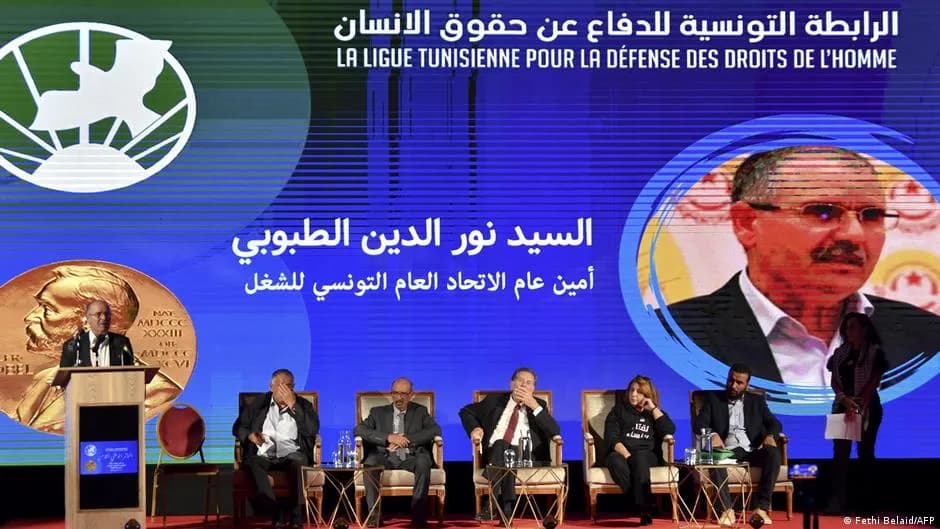
Tunisia’s authorities have ordered a one-month suspension of the Tunisian League for Human Rights, one of the country’s best-known civic institutions and one of the four groups in the National Dialogue Quartet that received the 2015 Nobel Peace Prize. The move lands at a moment when President Kais Saied’s political order is already under scrutiny over its treatment of critics, NGOs and independent media, and it gives new force to a question hanging over Tunisian politics since 2021: whether the state now sees autonomous civil society less as a partner in stability than as a rival center of legitimacy.Tunisia suspends rights group amid widening repressiondw.com·SecondaryA Tunisian rights group that was a co-winner of the 2015 Nobel Peace Prize has been told to cease activities for a month by authorities. The suspension of the Human Rights League (LTDH) comes amid warnings from rights organizations that the country has been sliding closer to authoritarian rule since President Kais Saied seized additional powers in 2021. LDTH was founded in 1976, making it one of the oldest rights groups in the Arab world and Africa.
The immediate measure is narrow in form but broad in meaning. The league said late Friday that the suspension was a serious and arbitrary attack on freedom of association and on one of Tunisia’s democratic gains, and it said it would challenge the decision in court while continuing to defend victims of rights abuses without discrimination.Tunisia suspends rights group amid widening repressiondw.com·SecondaryA Tunisian rights group that was a co-winner of the 2015 Nobel Peace Prize has been told to cease activities for a month by authorities. The suspension of the Human Rights League (LTDH) comes amid warnings from rights organizations that the country has been sliding closer to authoritarian rule since President Kais Saied seized additional powers in 2021. LDTH was founded in 1976, making it one of the oldest rights groups in the Arab world and Africa. Deutsche Welle, citing the broader debate inside Tunisia, said the order fits a wider pattern in which critics argue the country has moved closer to authoritarian rule since Saied seized additional powers in 2021.Tunisia suspends one of Africa’s oldest rights group as crackdown widensapnews.com·SecondaryTunisian President Kais Saied attends a signing ceremony in Beijing, May 31, 2024. (Tingshu Wang/Pool Photo via AP, File) TUNIS, Tunisia (AP) — Authorities in Tunisia have ordered a one-month suspension of the Tunisian League for Human Rights, one of the oldest rights groups in Africa and the Arab world and part of the National Dialogue Quartet awarded the 2015 Nobel Peace Prize, in the latest move raising concerns over a widening crackdown on civil society.
For the government and its supporters, the dispute is framed differently. Saied has repeatedly argued that foreign funding can become a channel for outside influence and domestic destabilization, and he has used that argument to portray parts of civil society and some political activists as too closely tied to foreign agendas. He has also denied seeking dictatorship, insisting that freedoms remain guaranteed in Tunisia and that no one is above the law regardless of name or status. That official line matters because it shows the state is not presenting this campaign as naked repression, but as a sovereignty and rule-of-law argument aimed at a public weary of elite dysfunction after the post-Arab Spring years.Tunisia suspends rights group amid widening repressiondw.com·SecondaryA Tunisian rights group that was a co-winner of the 2015 Nobel Peace Prize has been told to cease activities for a month by authorities. The suspension of the Human Rights League (LTDH) comes amid warnings from rights organizations that the country has been sliding closer to authoritarian rule since President Kais Saied seized additional powers in 2021. LDTH was founded in 1976, making it one of the oldest rights groups in the Arab world and Africa.
Critics, however, see the suspension as one more step in a sequence rather than a stand-alone administrative dispute. AP reported that Tunisian courts last year ordered multiple prominent NGOs to halt activities for a month, including organizations focused on migrants’ rights and women’s rights. The same report said journalist Zied El-Heni was placed under 48-hour detention over a Facebook post, while former Tunisian journalists’ union president Mohamed Yassine Jlassi said hundreds of people were being detained over speech-related cases, including social-media posts.Tunisia suspends rights group amid widening repressiondw.com·SecondaryA Tunisian rights group that was a co-winner of the 2015 Nobel Peace Prize has been told to cease activities for a month by authorities. The suspension of the Human Rights League (LTDH) comes amid warnings from rights organizations that the country has been sliding closer to authoritarian rule since President Kais Saied seized additional powers in 2021. LDTH was founded in 1976, making it one of the oldest rights groups in the Arab world and Africa. He described a climate in which journalism, civil-society work and political opposition had all been increasingly criminalized.Tunisia suspends rights group amid widening repressiondw.com·SecondaryA Tunisian rights group that was a co-winner of the 2015 Nobel Peace Prize has been told to cease activities for a month by authorities. The suspension of the Human Rights League (LTDH) comes amid warnings from rights organizations that the country has been sliding closer to authoritarian rule since President Kais Saied seized additional powers in 2021. LDTH was founded in 1976, making it one of the oldest rights groups in the Arab world and Africa.
That accumulation of cases is why the league’s suspension resonates beyond the organization itself. The Tunisian League for Human Rights is not a fringe advocacy shop created in the past few years; AP described it as one of the oldest rights groups in Africa and the Arab world, while DW said it was founded in 1976 and had long been a central force in Tunisian rights advocacy. When a government moves against an institution with that kind of history, the signal received by smaller associations, editors and opposition figures is usually larger than the formal wording of the order itself.Tunisia suspends rights group amid widening repressiondw.com·SecondaryA Tunisian rights group that was a co-winner of the 2015 Nobel Peace Prize has been told to cease activities for a month by authorities. The suspension of the Human Rights League (LTDH) comes amid warnings from rights organizations that the country has been sliding closer to authoritarian rule since President Kais Saied seized additional powers in 2021. LDTH was founded in 1976, making it one of the oldest rights groups in the Arab world and Africa.
There is also a more practical political point beneath the symbolism. AP said the league had already been barred for months from visiting prisons in several cities to inspect conditions, and it said the outlet Inkyfada now faces a May 11 court hearing as authorities pursue the dissolution of the association that publishes it. Taken together, those steps suggest pressure is being applied not only to speech in the abstract but also to the organizations that document detention conditions, publish reporting and provide the institutional memory that keeps abuses from disappearing into routine bureaucracy.Tunisia suspends rights group amid widening repressiondw.com·SecondaryA Tunisian rights group that was a co-winner of the 2015 Nobel Peace Prize has been told to cease activities for a month by authorities. The suspension of the Human Rights League (LTDH) comes amid warnings from rights organizations that the country has been sliding closer to authoritarian rule since President Kais Saied seized additional powers in 2021. LDTH was founded in 1976, making it one of the oldest rights groups in the Arab world and Africa.
Saied still has an argument that will find an audience, especially among Tunisians who believed the old party system and donor-backed activist class failed to deliver security, growth or clean government after 2011. His case is that the state must reassert authority, police foreign influence and prevent politics from being captured by networks that answer first to ideological allies or overseas funders. In that reading, restrictions on NGOs are not an attack on Tunisia but an attempt to restore national control after years in which formal democracy did not produce effective government.Tunisia suspends one of Africa’s oldest rights group as crackdown widensapnews.com·SecondaryTunisian President Kais Saied attends a signing ceremony in Beijing, May 31, 2024. (Tingshu Wang/Pool Photo via AP, File) TUNIS, Tunisia (AP) — Authorities in Tunisia have ordered a one-month suspension of the Tunisian League for Human Rights, one of the oldest rights groups in Africa and the Arab world and part of the National Dialogue Quartet awarded the 2015 Nobel Peace Prize, in the latest move raising concerns over a widening crackdown on civil society. Even many Western accounts of Tunisia’s slide have sometimes understated how much public frustration with stagnation helped create the opening Saied used.Tunisia suspends one of Africa’s oldest rights group as crackdown widensapnews.com·SecondaryTunisian President Kais Saied attends a signing ceremony in Beijing, May 31, 2024. (Tingshu Wang/Pool Photo via AP, File) TUNIS, Tunisia (AP) — Authorities in Tunisia have ordered a one-month suspension of the Tunisian League for Human Rights, one of the oldest rights groups in Africa and the Arab world and part of the National Dialogue Quartet awarded the 2015 Nobel Peace Prize, in the latest move raising concerns over a widening crackdown on civil society.
But the counterargument remains strong because the pattern described by both reports reaches well beyond one disputed funding debate. AP linked the latest step to arrests, speech prosecutions and suspensions of other groups, while DW placed it inside a longer arc of decree rule and shrinking space for opposition, media and civil society since 2021. Once a state starts defining broad sectors of independent life as potential foreign manipulation, the legal distinction between genuine security enforcement and political control can become very thin. That is especially true when the institutions being targeted are watchdogs, journalists’ organizations and rights groups rather than armed actors or covert political fronts.Tunisia suspends rights group amid widening repressiondw.com·SecondaryA Tunisian rights group that was a co-winner of the 2015 Nobel Peace Prize has been told to cease activities for a month by authorities. The suspension of the Human Rights League (LTDH) comes amid warnings from rights organizations that the country has been sliding closer to authoritarian rule since President Kais Saied seized additional powers in 2021. LDTH was founded in 1976, making it one of the oldest rights groups in the Arab world and Africa.
What happens next will matter more than the wording of official statements. The league says it will fight the suspension in court, and the coming weeks should show whether the measure remains a temporary sanction or becomes part of a more durable system for disciplining inconvenient institutions. If courts uphold the state’s approach and related cases against independent associations continue to multiply, Tunisia will look less like a democracy in correction and more like a presidency building a controlled civic sphere around itself. If the suspension is reversed or narrowed, Saied’s government could still argue it is enforcing rules without permanently closing the political space.Tunisia suspends one of Africa’s oldest rights group as crackdown widensapnews.com·SecondaryTunisian President Kais Saied attends a signing ceremony in Beijing, May 31, 2024. (Tingshu Wang/Pool Photo via AP, File) TUNIS, Tunisia (AP) — Authorities in Tunisia have ordered a one-month suspension of the Tunisian League for Human Rights, one of the oldest rights groups in Africa and the Arab world and part of the National Dialogue Quartet awarded the 2015 Nobel Peace Prize, in the latest move raising concerns over a widening crackdown on civil society.
For outside observers, the temptation will be to flatten the story into a simple democracy-versus-autocracy morality play. The harder and more useful reading is that Tunisia is now testing whether a state can centralize power in the name of order without steadily criminalizing the institutions that once mediated public life. Saturday’s dispute over the rights league does not settle that question, but it offers another concrete measure of where the balance is moving, and for the moment that balance appears to be shifting toward the presidency rather than toward independent civic power.Tunisia suspends rights group amid widening repressiondw.com·SecondaryA Tunisian rights group that was a co-winner of the 2015 Nobel Peace Prize has been told to cease activities for a month by authorities. The suspension of the Human Rights League (LTDH) comes amid warnings from rights organizations that the country has been sliding closer to authoritarian rule since President Kais Saied seized additional powers in 2021. LDTH was founded in 1976, making it one of the oldest rights groups in the Arab world and Africa.
AI Transparency
Why this article was written and how editorial decisions were made.
Why This Topic
This cluster is clearly newsworthy because it captures a concrete state action against a historic Tunisian rights body and links it to the wider post-2021 struggle over political authority, civil society and media freedom. It is fresher and more consequential than the thin market or earnings items on the board, and it offers enough genuine tension to meet the editorial requirement for balanced treatment: the presidency’s sovereignty and anti-foreign-funding case versus the rights community’s warning that Tunisia is criminalizing independent civic life.
Source Selection
The cluster sources are strong enough to support a long-form but tightly sourced piece. AP provides the clearest factual backbone on the suspension, the league’s response, the parallel NGO restrictions, the detention of journalist Zied El-Heni and the quotes describing the broader repression pattern. Deutsche Welle adds the official defense from Saied, the foreign-funding rationale, the 1976 founding context and the post-2021 framing. Using only these two source strands keeps citations clean and avoids importing unsupported claims from outside reporting.
Editorial Decisions
Balanced framing. Lead with the suspension itself, then give Saied’s sovereignty and anti-foreign-funding rationale real weight before laying out the civil-liberties critique. Avoid moralizing language such as dictatorship unless attributed. Keep the headline descriptive and the analysis skeptical of all institutional narratives, including Western shorthand about Tunisia.
Reader Ratings
About the Author
Sources
- 1.dw.comSecondary
- 2.apnews.comSecondary
Editorial Reviews
1 approved · 0 rejectedPrevious Draft Feedback (3)
• depth_and_context scored 5/3 minimum: The article excels by providing extensive background, detailing the history of the League, the context of the 2021 power shift, and the pattern of recent crackdowns. It moves far beyond merely stating the suspension occurred. • narrative_structure scored 4/3 minimum: The structure is strong, starting with a clear hook (the suspension) and building logically through the government's defense, the critics' counter-arguments, and concluding with a forward-looking assessment. It could benefit from a slightly punchier nut graf to synthesize the core tension immediately after the lede. • perspective_diversity scored 5/3 minimum: The piece masterfully presents multiple, competing viewpoints: the League's reaction, the government's sovereignty argument, and the critics' view of systemic repression. This balance is crucial to its journalistic strength. • analytical_value scored 5/3 minimum: The analysis is consistently high, interpreting the suspension not as an isolated event but as a test of state power versus civil society. It offers nuanced implications for Tunisia's future governance model. • filler_and_redundancy scored 5/2 minimum: The writing is dense with information but highly efficient; every paragraph advances the argument or provides necessary context. There is no discernible padding or repetition that inflates the word count without adding substance. • language_and_clarity scored 4/3 minimum: The prose is sophisticated, precise, and engaging, avoiding clichés. The only minor area for improvement is occasionally relying on citation markers [1][2] which, while necessary for the draft, slightly interrupts the flow of reading.
1 gate errors: • [image_relevance] Image alt_accuracy scored 1/3 minimum: The alt text is highly inaccurate because it places President Saied in Beijing, which is not depicted in the image. The image appears to be an indoor event in Tunisia, featuring multiple individuals.
1 gate errors: • [image_relevance] Image alt_accuracy scored 1/3 minimum: The alt text is highly inaccurate because it places President Saied in Beijing, which is not depicted in the image. The image appears to be an indoor event in Tunisia, featuring multiple individuals.

Discussion (0)
No comments yet.