Asha Bhosle dies at 92, closing a long chapter in Bollywood's playback era
Asha Bhosle, the Indian playback singer whose catalogue stretched across more than seven decades and roughly 12,000 songs, died in Mumbai on Sunday at 92, prompting tributes from officials, musicians and fans while reviving debate over the scale of her legacy.[1][2][3]
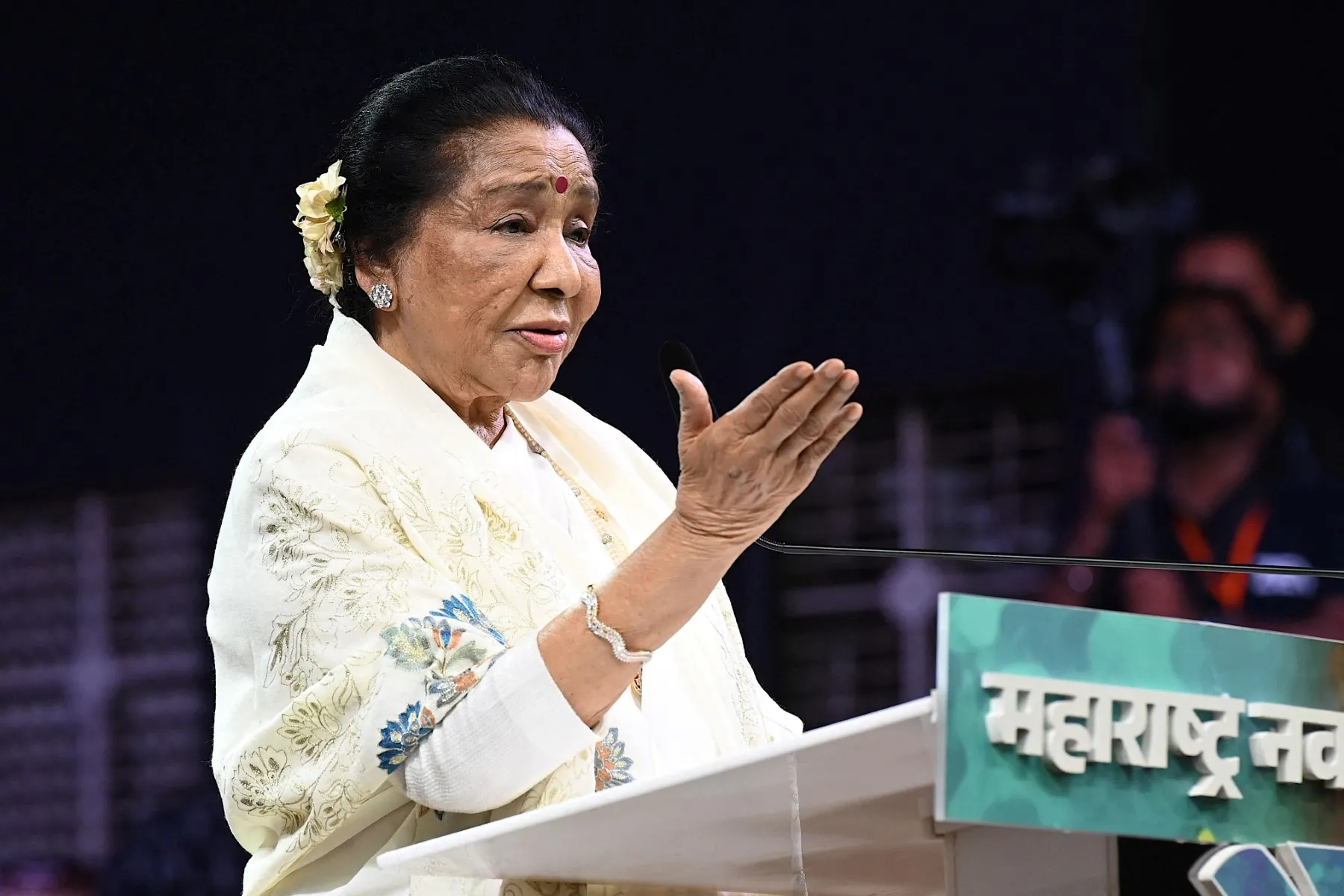
Asha Bhosle, one of the central voices of Hindi film music and one of the most recognisable singers in modern Indian popular culture, died in Mumbai on Sunday at the age of 92 after being admitted to Breach Candy Hospital with exhaustion and a chest infection, according to family members and hospital reporting carried across multiple outlets. By Sunday afternoon in India, the immediate facts of her death had hardened into a national obituary: her son Anand Bhosle said the family would hold her last rites on Monday at Shivaji Park, while other local reports said mourners would also be able to pay respects at her residence before the cremation. The timing gave the story both the force of breaking news and the slower weight of cultural reckoning, because Bhosle was not simply a famous singer but a figure through whom several generations of Indians had heard cinema, romance, modernity and social change.
The official account of her final illness was broadly consistent even where details varied at the margins. AP and ABC, citing physician Pratit Samdani, reported that she died of multiple organ failure at the Mumbai hospital, while Al Jazeera, the Guardian and Channel NewsAsia said she had been hospitalised with extreme exhaustion and a chest infection before her death was announced. Deutsche Welle also reported that her granddaughter Zanai Bhosle had earlier asked for privacy after the hospital admission and later cited the same doctor as confirming Bhosle's death. The practical point for editors and readers was less the precise medical phrasing than the broader consensus that the singer had deteriorated quickly over the previous day and that the family moved with unusual speed from privacy requests to funeral arrangements, a sign that the situation had turned definitive by Sunday.
Her death matters in India because Bhosle's career sat at the intersection of film, radio, television and live performance for roughly three quarters of a century. Several sources in the cluster place her output at about 12,000 songs, while Deutsche Welle notes that Guinness formally recognised her in 2011 as the most-recorded artist in music history with more than 11,000 songs, underscoring both her volume and the difficulty of pinning an exact lifetime total to a career so large. She was born on 8 September 1933 into the Mangeshkar family, learned music through her father Dinanath Mangeshkar, and came into professional singing early after the family relocated to Bombay, later Mumbai, following his death. That family context is indispensable because it explains both her deep grounding in classical and film traditions and the comparison that followed her for decades with her elder sister Lata Mangeshkar, whose own stature in Indian music was immense.
What separated Bhosle from many peers was not only durability but range. AP, BBC and Variety all describe her as unusually versatile, able to move from romantic ballads to cabaret-style numbers, ghazals, folk material, pop-inflected tracks and more experimental film compositions without losing the character of her voice. That versatility had an institutional consequence inside Bollywood: composers could use Bhosle where they wanted glamour, mischief, sensuality, rhythmic play or urban edge, whereas more orthodox listeners often associated her sister with a different register of refinement and devotional seriousness. The contrast was never absolute, but it became one of the organising myths of Hindi film music, and Bhosle benefited from it by turning what could have been a shadow career into a parallel empire.
The standard list of milestones only partly captures how broad that empire became. Variety's obituary, which offers the fullest career sweep in the cluster, traces a line from her early post-war recording work to landmark partnerships with composer Rahul Dev Burman and later to international crossover projects with Boy George, Michael Stipe, the Kronos Quartet and artists sampling or celebrating her work beyond India. BBC adds that the Cornershop tribute Brimful of Asha helped encode her name in British pop consciousness, while DW and Guardian reporting highlight that she remained active in old age, including public performances, new collaborations and media appearances well into her eighties and nineties. Awards followed that longevity: multiple National Film Awards, the Dadasaheb Phalke honour, the Padma Vibhushan and two Grammy nominations all appear across the reporting set, confirming that her standing was not just commercial but institutional.
Still, the easiest obituary line—that Bhosle was universally adored and simply above dispute—misses part of the story. BBC and Variety both point to the fact that she built her own lane partly by taking on material that more conservative or image-conscious singers of an earlier period often avoided, especially Western-influenced numbers and cabaret songs that carried a more overtly modern, playful or provocative energy. Admirers treated that as evidence of artistic freedom and technical nerve. Critics, particularly from more traditional corners of the culture industry and its audience, long saw that repertoire as less elevated than the high prestige attached to classical or devotional singing, and public fascination with supposed rivalry inside the Mangeshkar family sometimes reduced her achievements to family drama rather than craft. In that sense, Sunday's tributes also worked as a corrective, because they placed her not on the margin of the canon but in its centre.
Government and establishment reaction came quickly and predictably, but it still mattered because it confirmed how fully Bhosle's career had moved from entertainment into national heritage. Prime Minister Narendra Modi said he was deeply saddened and described her voice and career as part of India's cultural inheritance, language echoed in reports from Al Jazeera, AP, Channel NewsAsia and Variety. Those tributes were sincere, but they also served a political function that often appears when India loses a cultural giant: the state wraps a mass-market artist into a shared national story that is broad enough to cross party, language and class lines. That framing is not false—Bhosle plainly was a national figure—but it can flatten the scrappier truth that she became indispensable by pushing beyond the neat boundaries of taste that institutions later claim to have always celebrated.Legendary Indian singer Asha Bhosle dies aged 92theguardian.com·SecondaryTwo-time grammy nominee was one of Bollywood’s most versatile and celebrated voices The Indian singer Asha Bhosle, whose voice defined Bollywood music through the 1970s and 80s, has died aged 92, her family said. The two-time Grammy nominee had been admitted to hospital in Mumbai with complaints of “extreme exhaustion” and chest infection. “My mother passed away today (Sunday). Her last rites will be held tomorrow at Shivaji Park in Mumbai,” her son Anand Bhosle told reporters.
There is also a business and industry angle to her death that goes beyond sentiment. Playback singing helped build the commercial grammar of Indian cinema, where actors appeared on screen but songs were often carried by specialist voices that audiences learned to identify as stars in their own right. Bhosle belonged to the cohort that turned that system into a durable mass-market machine, and her catalogue became intellectual property long before the current streaming era made archives newly valuable. Every obituary therefore doubles as a reminder that modern Bollywood was built not only by visible actors and directors but by off-screen voices who defined tone, memory and repeat value across decades of film consumption. Her death closes one more direct human link to that industrial model even as the songs themselves continue to circulate.
What happens next is straightforward in practical terms and more contested in cultural terms. The family is expected to carry out the funeral rites in Mumbai on Monday, after public respects are paid, while broadcasters, newspapers and streaming platforms will spend the next several days curating the familiar canon of Bhosle songs and collaborations. The harder question is how her place in history is finally described: as the second great singer of the Mangeshkar household, as Bollywood's supreme stylist of versatility, or as one of the very few recording artists anywhere whose voice can plausibly be said to have accompanied the private lives of a nation for generations. Sunday's news does not settle that argument. It simply guarantees that India and its diaspora will conduct it at full volume, with official homage, fan devotion and old critical debates all arriving at once.
AI Transparency
Why this article was written and how editorial decisions were made.
Why This Topic
This cluster is the strongest distinct story on the board because it combines immediate breaking-news value with unusually broad cultural relevance. Asha Bhosle's death is not a niche entertainment item: it reaches politics, media, diaspora identity and the economics of Indian cinema. The cluster has strong source diversity, clear verification on death and funeral arrangements, and enough career depth to support a substantial obituary without padding. It is also clearly different from the recent CT Editorial Board run of politics and business stories, so it adds topical variety without sacrificing newsworthiness.
Source Selection
The source mix is strong for an obituary-style breaking story. AP/ABC provide the cleanest hard-news spine on death confirmation and medical detail. Al Jazeera, Guardian and CNA reinforce the family announcement and immediate funeral logistics. BBC, DW and Variety broaden the career frame, especially on repertoire, awards, global collaborations and the recurring debate over Bhosle's place relative to Lata Mangeshkar and to more conservative musical hierarchies. I kept numbered citations tied to cluster sources only and avoided unsupported web-search additions except as background orientation for funeral timing.
Editorial Decisions
Write this as a major cultural obituary with hard-news discipline rather than fan tribute. Keep the headline descriptive. Give the official reaction its due, but do not let government praise dominate the piece. Include the more sceptical view that institutions often canonise artists after earlier generations treated parts of their repertoire as lower prestige. Avoid direct quotes in the body because evidence_quality is brittle; paraphrase attributed views instead.
Reader Ratings
About the Author
Sources
- 1.variety.comSecondary
- 2.channelnewsasia.comSecondary
- 3.abcnews.comUnverified
- 4.theguardian.comSecondary
- 5.aljazeera.comSecondary
- 6.apnews.comSecondary
- 7.dw.comSecondary
- 8.bbc.comSecondary
Editorial Reviews
1 approved · 0 rejectedPrevious Draft Feedback (1)
• depth_and_context scored 5/3 minimum: The article excels by providing deep context, tracing Bhosle's career through film, radio, and international collaborations. It doesn't just report the death; it situates her within the history of Indian popular culture and the Mangeshkar legacy. • narrative_structure scored 4/3 minimum: The structure is strong, moving logically from the immediate news hook (the death) to the historical context, the critical reception, and concluding with a thoughtful, open-ended question. It could benefit from a slightly punchier nut graf to explicitly state the article's central thesis earlier on. • perspective_diversity scored 4/3 minimum: The article successfully incorporates multiple viewpoints, including family reports, mainstream media coverage, critical reception (traditional vs. modern), and state/political reaction. To reach a 5, it could more explicitly integrate a viewpoint from a contemporary, non-establishment cultural critic or musicologist. • analytical_value scored 5/3 minimum: The analysis is excellent, moving beyond mere reporting to discuss the *function* of her career—how she built a 'parallel empire' and how her death is being politically framed. The discussion of her role in building the 'commercial grammar' of Bollywood is particularly insightful. • filler_and_redundancy scored 5/2 minimum: The writing is highly efficient; every paragraph advances the narrative or analysis. The citation markers are ignored, and the repetition of facts is used for necessary reinforcement of scope, not padding. • language_and_clarity scored 4/3 minimum: The prose is sophisticated, engaging, and precise, avoiding clichés and passive voice. The only minor area for improvement is ensuring that when discussing 'traditional' vs. 'modern' music, the article consistently describes the *policies* or *styles* (e.g., 'devotional classical' vs. 'cabaret-influenced pop') rather than relying on loaded labels like 'provocative energy.'



Discussion (0)
No comments yet.