Australia and Japan formalise Mogami warship programme with first contracts for three frigates
Australia and Japan have signed the first contracts in a 10 billion Australian dollar frigate programme, locking in three Japanese-built Mogami-class ships and a later shift to onshore production in Western Australia.[1][2][3]
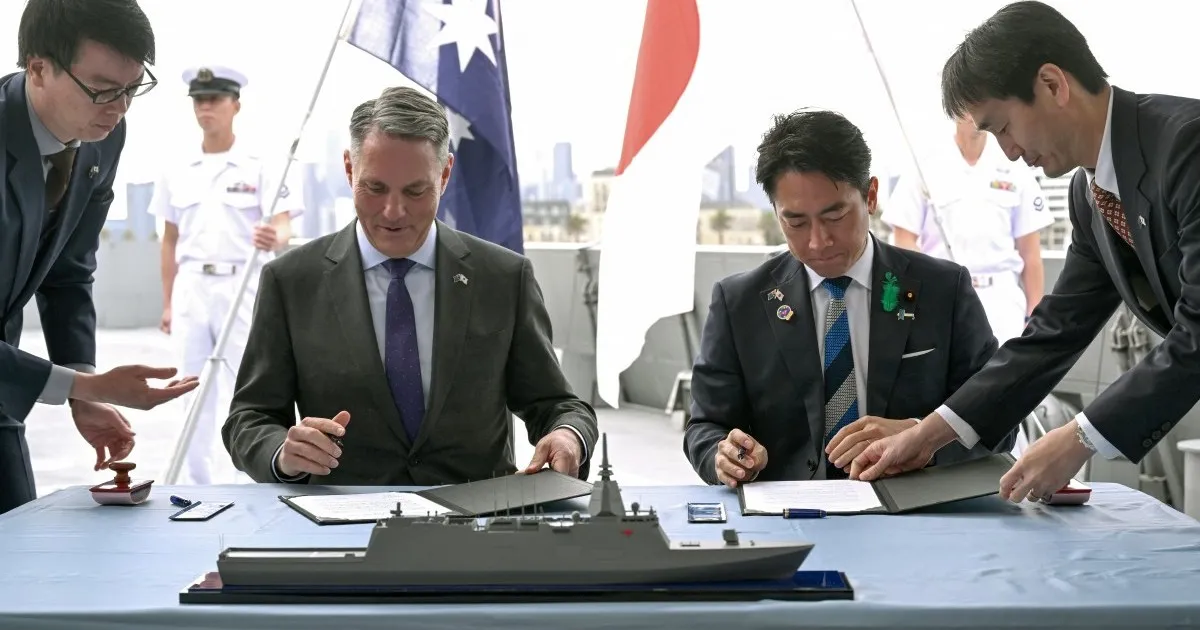
Australia and Japan have moved their tightening defence relationship from strategy papers to signed industrial contracts, formalising the first stage of a fleet renewal programme that will place Japanese-designed Mogami-class frigates in Australian service before the decade ends. On Saturday in Melbourne, Australian Defence Minister Richard Marles and Japanese Defence Minister Shinjiro Koizumi presided over the signing for the first three ships, the opening tranche of an 11-vessel programme that Canberra says is central to replacing its ageing Anzac-class frigates and rebuilding naval capacity on a faster timetable than usual.
The headline number varies depending on currency conversion and what costs are included, but the core programme is commonly described as about A$10 billion, or roughly US$6 billion to US$7 billion, over the next decade. Cluster reporting agrees on the main structure: Mitsubishi Heavy Industries will build the first three frigates in Japan, while the remaining eight are intended to be built in Western Australia by Austal after the programme transitions to local production. The first Japanese-built ship is scheduled for delivery in 2029 and entry into service in 2030, giving Australia a relatively near-term path to recapitalising a fleet that officials say has become more important than at any point in decades.Australia and Japan sign contracts for $7bn warships dealaljazeera.com·SecondaryAustralia and Japan have signed contracts for the first three of 11 warships set to be delivered to the Australian navy under a landmark $7bn defence deal, as the two close US allies in the Asia Pacific region deepen defence cooperation. Australia’s Defence Minister Richard Marles and Japanese Defence Minister Koizumi Shinjiro made the announcement in Melbourne on Saturday at the signing ceremony for the Mogami-class warships.
The operational case for the deal is straightforward. Australia says the new ships are meant to secure maritime trade routes and the country’s northern approaches as part of a larger surface combatant fleet. Reporting across the cluster describes the Mogami design as a stealth frigate able to carry anti-ship and surface-to-air missiles, operate a helicopter, and perform anti-submarine, surface-strike and air-defence roles. One selling point repeatedly highlighted by Japanese and Australian officials is manpower efficiency: AP reported that the design can operate with about 90 crew, roughly half the complement of Australia’s current Anzac-class ships, a significant advantage for a navy that has struggled with recruitment and crewing pressure.Australia, Japan ink multibillion dollar warship dealchannelnewsasia.com·SecondaryJapan agreed on Saturday (Apr 18) on a deal to provide Australia's navy with the first of almost a dozen stealth frigates. Japan’s Maritime Self-Defense Force, JS Kumano, a Mogami-class frigate is seen in Yokosuka, south of Tokyo, on April 23, 2025.(Kyodo News via AP) SYDNEY: Japan agreed on Saturday (Apr 18) on a deal to provide Australia's navy with the first of almost a dozen stealth frigates, part of a wider military build up by Canberra aimed at boosting its long-range firepower to deter...
The political meaning of the agreement is broader than the hardware. Marles said the frigates would help deliver a “larger and more lethal” fleet and welcomed Japan’s easing of defence-export restrictions with trusted partners. Koizumi described the contracts as a step toward lifting bilateral defence cooperation to a greater height, while Al Jazeera and CNA both situated the deal inside a wider pattern of Australian and Japanese coordination among close United States allies in the Indo-Pacific. The arrangement also gives Japan one of its biggest defence export successes since the country loosened its long-standing restrictions on overseas military sales in 2014.Australia and Japan sign contracts for $7bn warships dealaljazeera.com·SecondaryAustralia and Japan have signed contracts for the first three of 11 warships set to be delivered to the Australian navy under a landmark $7bn defence deal, as the two close US allies in the Asia Pacific region deepen defence cooperation. Australia’s Defence Minister Richard Marles and Japanese Defence Minister Koizumi Shinjiro made the announcement in Melbourne on Saturday at the signing ceremony for the Mogami-class warships.
That strategic framing matters because Canberra and Tokyo are not presenting this as a routine procurement exercise. Australian reporting around the ceremony emphasised that ministers want a more seamless defence-industrial base between the two countries, not just a buyer-seller relationship. Reuters separately reported that the ships are expected to help defend the Indian and Pacific Ocean approaches where China’s military footprint has expanded, which explains why many supporters in both capitals see the programme less as a narrow navy purchase than as part of a broader deterrence architecture in Asia. Reuters also noted that the August 2025 decision to choose Mitsubishi over Germany’s Thyssenkrupp anchored Japan’s wider move away from a more constrained postwar posture and toward deeper security partnerships beyond the US alliance system.
Supporters therefore have a clear case. They argue Australia needs ships quickly, needs vessels that can be crewed with fewer sailors, and needs reliable industrial partners if it wants to expand its major warship fleet from 11 to 26 over the coming decade. They also point to the industrial upside: the first three hulls are supposed to arrive quickly from Japan, while the later transfer of construction to Henderson is intended to sustain Australian shipbuilding into the 2030s. From that perspective, the programme marries urgency with local industry, giving Canberra near-term capability without giving up the political promise of sovereign production capacity later.
Sceptics, though, have room to question both the cost narrative and the strategic assumptions. The cluster reporting itself already shows how elastic the pricing language has become, with references to A$10 billion, US$6 billion, US$6.5 billion and US$7 billion depending on source and exchange rate. More importantly, external reporting in Australia has pointed to a bigger long-run number once infrastructure and Henderson redevelopment are counted, raising the familiar concern that large defence programmes are sold politically on one figure and defended later on another. There is also the execution risk embedded in the structure of the deal: building three ships in Japan is one thing, but transferring a sophisticated frigate line into Australia without delay, cost creep or workforce bottlenecks is a harder test.
There is a second line of criticism as well, and it is geopolitical rather than budgetary. Supporters describe the agreement as prudent deterrence in a harsher region; critics see another step in an accelerating regional naval competition that makes East Asia and the wider Indo-Pacific more tense, not less. Japan has openly expanded security cooperation beyond its treaty relationship with Washington, while Australia is enlarging military spending and surface combatant ambitions at the same time.Australia and Japan sign contracts for $7bn warships dealaljazeera.com·SecondaryAustralia and Japan have signed contracts for the first three of 11 warships set to be delivered to the Australian navy under a landmark $7bn defence deal, as the two close US allies in the Asia Pacific region deepen defence cooperation. Australia’s Defence Minister Richard Marles and Japanese Defence Minister Koizumi Shinjiro made the announcement in Melbourne on Saturday at the signing ceremony for the Mogami-class warships. Even if Canberra and Tokyo frame the programme as defensive, neighbours will judge it through the lens of power balances, export-control loosening and alliance politics. That does not negate the rationale for the deal, but it does mean the strategic story is not as simple as two democracies buying better ships.
What happens next is more important than the ceremony itself. The contracts have been signed, but the real measures of success will be whether Mitsubishi can deliver on time, whether the Henderson transition actually occurs at scale, and whether Australia can absorb the ships into a fleet structure that has often been revised on paper faster than it has been built in steel. For now, the deal marks a notable convergence of Australian rearmament, Japanese defence industrial ambition and a regional security climate that is pushing US allies toward deeper bilateral ties. It is a concrete milestone, not just because of the three frigates now under contract, but because it shows how procurement, industrial policy and Indo-Pacific deterrence are being fused into a single project.
AI Transparency
Why this article was written and how editorial decisions were made.
Why This Topic
This is the strongest distinct top-story candidate in the current board because it combines hard state action, money, military capability and alliance politics, while avoiding overlap with the HiPP recall and other recently published CT pieces. The signed contracts turn an abstract procurement plan into a concrete geopolitical and industrial milestone, and the story has natural international relevance far beyond defence specialists because it touches trade routes, Indo-Pacific power balances and Japan’s export posture.
Source Selection
The cluster offers enough source diversity to support a solid synthesis without leaning on a single national narrative: Al Jazeera supplies the broad regional-security frame and industrial split, CNA supplies the acquisition-speed and fleet-expansion details, and AP provides the most concrete operational specifics on delivery timing, crew size and capabilities. I used web reporting only for background framing and not as numbered citation support, keeping factual citations anchored to the cluster’s source set.
Editorial Decisions
Lead with the contract milestone, then widen to industrial and strategic meaning. Keep the tone descriptive and sceptical rather than triumphalist. Give equal weight to the supporters’ deterrence-and-speed argument and to concerns about cost elasticity, execution risk and regional militarisation. Avoid loaded language about China or pacifism; frame those as strategic interpretations, not settled truths.
Reader Ratings
About the Author
Sources
- 1.aljazeera.comSecondary
- 2.abcnews.comUnverified
- 3.channelnewsasia.comSecondary
- 4.apnews.comSecondary
- 5.investing.comSecondary
Editorial Reviews
1 approved · 0 rejectedPrevious Draft Feedback (1)
• depth_and_context scored 4/3 minimum: The article provides good context by explaining the need to replace aging frigates and situating the deal within the broader Indo-Pacific security architecture. To improve, it could dedicate a paragraph detailing the specific operational differences between the Anzac-class and the Mogami-class beyond just crew size, offering a deeper technical comparison. • narrative_structure scored 4/3 minimum: The structure is strong, moving logically from the announcement (lede) to the operational case, political implications, and finally to counterarguments and future outlook. The conclusion effectively synthesizes the main points, though the transition into the 'Sceptics' section could be slightly smoother. • perspective_diversity scored 5/3 minimum: The article excels here by presenting multiple viewpoints: the official narrative (Australia/Japan), the industrial/economic view, the supportive analysis (deterrence), and the critical counterpoints (cost, geopolitical tension). This balance is excellent. • analytical_value scored 4/3 minimum: The piece moves beyond mere reporting by analyzing the deal's implications for industrial policy and regional power dynamics. To reach a 5, it should more explicitly analyze the *consequences* of Japan loosening its export restrictions, linking it directly to broader Japanese foreign policy shifts beyond just the US alliance. • filler_and_redundancy scored 5/2 minimum: The article is highly efficient; every paragraph advances the narrative or analysis. The repetition of key figures or concepts (like the A$10 billion cost or the strategic importance) is necessary for reinforcement, not padding. • language_and_clarity scored 4/3 minimum: The writing is crisp, professional, and highly engaging. The language is precise, avoiding generic AI-speak or excessive hedging. A minor improvement would be to ensure that when discussing geopolitical tensions, the language remains descriptive of *actions* (e.g., 'increased military spending') rather than relying on loaded labels like 'aggressive' or 'revisionist' without immediate, concrete evidence.


Discussion (0)
No comments yet.