Automakers map new US investment plans while waiting for clearer tariff and trade rules
Major carmakers say they are prepared to expand US production and invest billions more, but executives at the New York Auto Show say they still need clearer rules on tariffs and the future of the USMCA before finalizing where to build and source vehicles.[2]
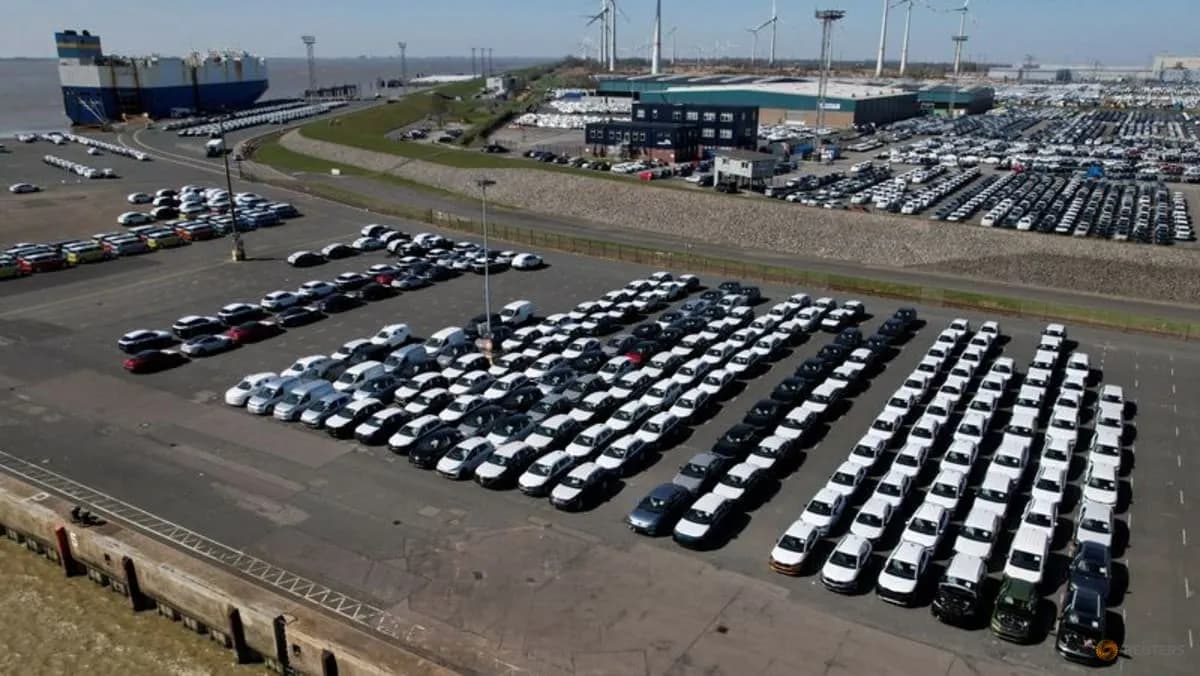
At the New York Auto Show this week, the auto industry delivered a message that Washington is likely to welcome in part and dislike in part: major manufacturers are prepared to spend heavily in the United States, but they are not ready to make every final commitment until the tariff regime and the future of the United States-Mexico-Canada Agreement become clearer.Automakers plan billions in US investments but seek clear trade ruleschannelnewsasia.com·SecondaryDrone view shows Volkswagen Group cars bound for cargo ship export to the United States at the seaport of Emden near the estuary, where the River Ems flows into the North Sea, in Emden, Germany, April 2, 2025. REUTERS/Erol Dogrudogan NEW YORK, April 1 : Global automakers plan billions of dollars in new U.S. investments to boost production and avoid President Donald Trump's tariffs, but they are awaiting clarity on the status of a North American free trade agreement and future vehicle duties. What is emerging is not a simple story of companies resisting American production. It is a more complicated negotiation in which global carmakers are signaling that they can build more in the US, hire more in the US and localize more supply chains in the US, while also warning that policy ambiguity raises costs and slows the actual decisions that turn rhetoric into factories, tooling and vehicle programs.Automakers plan billions in US investments but seek clear trade ruleschannelnewsasia.com·SecondaryDrone view shows Volkswagen Group cars bound for cargo ship export to the United States at the seaport of Emden near the estuary, where the River Ems flows into the North Sea, in Emden, Germany, April 2, 2025. REUTERS/Erol Dogrudogan NEW YORK, April 1 : Global automakers plan billions of dollars in new U.S. investments to boost production and avoid President Donald Trump's tariffs, but they are awaiting clarity on the status of a North American free trade agreement and future vehicle duties.
The basic facts are substantial enough on their own. Reuters reported that Toyota has announced plans to invest $10 billion in the United States over the next five years, though only about $2 billion has been specified in detail so far. Hyundai has announced a $26 billion US investment plan running through 2028. The same report said Hyundai believes early confirmation of a USMCA extension could unlock more than $20 billion in additional American investment, while Nissan is increasing production in Tennessee and plans to bring a new Rogue hybrid to that plant next year.Automakers plan billions in US investments but seek clear trade ruleschannelnewsasia.com·SecondaryDrone view shows Volkswagen Group cars bound for cargo ship export to the United States at the seaport of Emden near the estuary, where the River Ems flows into the North Sea, in Emden, Germany, April 2, 2025. REUTERS/Erol Dogrudogan NEW YORK, April 1 : Global automakers plan billions of dollars in new U.S. investments to boost production and avoid President Donald Trump's tariffs, but they are awaiting clarity on the status of a North American free trade agreement and future vehicle duties. Volkswagen, for its part, used the show to unveil a new Atlas SUV version produced in Tennessee, underscoring the broader industry effort to demonstrate an American manufacturing footprint even while trade rules remain unsettled.Automakers plan billions in US investments but seek clear trade ruleschannelnewsasia.com·SecondaryDrone view shows Volkswagen Group cars bound for cargo ship export to the United States at the seaport of Emden near the estuary, where the River Ems flows into the North Sea, in Emden, Germany, April 2, 2025. REUTERS/Erol Dogrudogan NEW YORK, April 1 : Global automakers plan billions of dollars in new U.S. investments to boost production and avoid President Donald Trump's tariffs, but they are awaiting clarity on the status of a North American free trade agreement and future vehicle duties.
The pressure point is not whether the industry can invest in the United States. It is whether companies can do so on terms that allow them to preserve margins, keep affordable models in the lineup and maintain North American supply chains that were built over years around cross-border production. Reuters said automakers have urged the Trump administration to extend the USMCA, which faces a review this year, because the industry regards the agreement as crucial to American auto production rather than a side issue. That matters because the current political pitch from Washington is straightforward: higher tariff walls should push more assembly, sourcing and jobs back onto US soil.Automakers plan billions in US investments but seek clear trade ruleschannelnewsasia.com·SecondaryDrone view shows Volkswagen Group cars bound for cargo ship export to the United States at the seaport of Emden near the estuary, where the River Ems flows into the North Sea, in Emden, Germany, April 2, 2025. REUTERS/Erol Dogrudogan NEW YORK, April 1 : Global automakers plan billions of dollars in new U.S. investments to boost production and avoid President Donald Trump's tariffs, but they are awaiting clarity on the status of a North American free trade agreement and future vehicle duties. The industry response is also straightforward, though less convenient for tariff advocates: investment can move toward the US, but the pace, scale and product mix depend on whether the policy environment looks durable rather than improvised.Automakers plan billions in US investments but seek clear trade ruleschannelnewsasia.com·SecondaryDrone view shows Volkswagen Group cars bound for cargo ship export to the United States at the seaport of Emden near the estuary, where the River Ems flows into the North Sea, in Emden, Germany, April 2, 2025. REUTERS/Erol Dogrudogan NEW YORK, April 1 : Global automakers plan billions of dollars in new U.S. investments to boost production and avoid President Donald Trump's tariffs, but they are awaiting clarity on the status of a North American free trade agreement and future vehicle duties.
Toyota's position captures that tension well. A senior Toyota executive told Reuters that decisions about where to build and what to build remain in flux, and specifically tied that uncertainty to a 25 percent USMCA tariff environment. Paraphrased in practical terms, Toyota is not saying the money is off the table. It is saying capital allocation becomes harder when executives cannot model the long-term cost of assembling in one country, sourcing from another and selling across the region under rules that may tighten further.Automakers plan billions in US investments but seek clear trade ruleschannelnewsasia.com·SecondaryDrone view shows Volkswagen Group cars bound for cargo ship export to the United States at the seaport of Emden near the estuary, where the River Ems flows into the North Sea, in Emden, Germany, April 2, 2025. REUTERS/Erol Dogrudogan NEW YORK, April 1 : Global automakers plan billions of dollars in new U.S. investments to boost production and avoid President Donald Trump's tariffs, but they are awaiting clarity on the status of a North American free trade agreement and future vehicle duties. For investors and policymakers alike, that distinction is important. Announced investment totals can create the impression that the policy debate is settled, yet the details in Reuters' reporting suggest the opposite: the biggest strategic choices are still being held open while companies wait to see whether the trade framework stabilizes.Automakers plan billions in US investments but seek clear trade ruleschannelnewsasia.com·SecondaryDrone view shows Volkswagen Group cars bound for cargo ship export to the United States at the seaport of Emden near the estuary, where the River Ems flows into the North Sea, in Emden, Germany, April 2, 2025. REUTERS/Erol Dogrudogan NEW YORK, April 1 : Global automakers plan billions of dollars in new U.S. investments to boost production and avoid President Donald Trump's tariffs, but they are awaiting clarity on the status of a North American free trade agreement and future vehicle duties.
Hyundai's comments point in a similar direction, though with a more openly expansionary tone. Reuters reported that chief executive Jose Munoz said Hyundai wants 80 percent of the vehicles it sells in the United States to be produced in America and wants to increase US production from 800,000 vehicles to 1.2 million. On one reading, that is evidence that tariff pressure is working by accelerating localization. On another, it is evidence that even a company willing to invest aggressively still wants the legal and commercial certainty of an extended USMCA before moving faster. Reuters also said Hyundai had previously told the Trump administration that uncertainty around the agreement was delaying investment decisions, and that early confirmation would speed job creation, site selection and technology development.Automakers plan billions in US investments but seek clear trade ruleschannelnewsasia.com·SecondaryDrone view shows Volkswagen Group cars bound for cargo ship export to the United States at the seaport of Emden near the estuary, where the River Ems flows into the North Sea, in Emden, Germany, April 2, 2025. REUTERS/Erol Dogrudogan NEW YORK, April 1 : Global automakers plan billions of dollars in new U.S. investments to boost production and avoid President Donald Trump's tariffs, but they are awaiting clarity on the status of a North American free trade agreement and future vehicle duties. That combination of eagerness and caution is probably the clearest guide to how boardrooms are thinking right now.Automakers plan billions in US investments but seek clear trade ruleschannelnewsasia.com·SecondaryDrone view shows Volkswagen Group cars bound for cargo ship export to the United States at the seaport of Emden near the estuary, where the River Ems flows into the North Sea, in Emden, Germany, April 2, 2025. REUTERS/Erol Dogrudogan NEW YORK, April 1 : Global automakers plan billions of dollars in new U.S. investments to boost production and avoid President Donald Trump's tariffs, but they are awaiting clarity on the status of a North American free trade agreement and future vehicle duties.
Nissan adds another piece to the picture, especially around lower-priced vehicles. Reuters reported that Nissan Americas chairman Christian Meunier said the company's lowest-cost US-market models are built in Mexico and that producing very affordable cars in the United States is difficult because of labor costs. That is not just a Nissan problem. It is one of the central trade-offs inside the broader tariff debate: if Washington pushes too hard and too abruptly for full domestic relocation of production, some companies may comply on premium and mid-market models while finding it far harder to preserve entry-level affordability. Supporters of tougher trade enforcement argue that the country should accept that adjustment cost in exchange for more domestic capacity and less dependence on foreign production.Automakers plan billions in US investments but seek clear trade ruleschannelnewsasia.com·SecondaryDrone view shows Volkswagen Group cars bound for cargo ship export to the United States at the seaport of Emden near the estuary, where the River Ems flows into the North Sea, in Emden, Germany, April 2, 2025. REUTERS/Erol Dogrudogan NEW YORK, April 1 : Global automakers plan billions of dollars in new U.S. investments to boost production and avoid President Donald Trump's tariffs, but they are awaiting clarity on the status of a North American free trade agreement and future vehicle duties. Critics counter that consumers could end up paying more while companies still hedge their bets until the rules become predictable.Automakers plan billions in US investments but seek clear trade ruleschannelnewsasia.com·SecondaryDrone view shows Volkswagen Group cars bound for cargo ship export to the United States at the seaport of Emden near the estuary, where the River Ems flows into the North Sea, in Emden, Germany, April 2, 2025. REUTERS/Erol Dogrudogan NEW YORK, April 1 : Global automakers plan billions of dollars in new U.S. investments to boost production and avoid President Donald Trump's tariffs, but they are awaiting clarity on the status of a North American free trade agreement and future vehicle duties.
Volkswagen's comments, as reported by Reuters, reinforce the industry's preference for stability over spectacle. The head of Volkswagen Group of America said investment volumes, product lead times and supply-chain planning all depend on a stable backdrop. That sounds obvious, but it is the kind of operational point that gets lost when tariff policy is discussed mainly as a test of political resolve. Carmaking is a long-cycle business. Plants are not switched on overnight, supplier networks are not rebuilt in a quarter and model programs are not costed on the assumption that major trade rules will stay fluid indefinitely.Automakers plan billions in US investments but seek clear trade ruleschannelnewsasia.com·SecondaryDrone view shows Volkswagen Group cars bound for cargo ship export to the United States at the seaport of Emden near the estuary, where the River Ems flows into the North Sea, in Emden, Germany, April 2, 2025. REUTERS/Erol Dogrudogan NEW YORK, April 1 : Global automakers plan billions of dollars in new U.S. investments to boost production and avoid President Donald Trump's tariffs, but they are awaiting clarity on the status of a North American free trade agreement and future vehicle duties. Even companies that broadly accept the direction of more US production are signaling that the route there matters almost as much as the destination.Automakers plan billions in US investments but seek clear trade ruleschannelnewsasia.com·SecondaryDrone view shows Volkswagen Group cars bound for cargo ship export to the United States at the seaport of Emden near the estuary, where the River Ems flows into the North Sea, in Emden, Germany, April 2, 2025. REUTERS/Erol Dogrudogan NEW YORK, April 1 : Global automakers plan billions of dollars in new U.S. investments to boost production and avoid President Donald Trump's tariffs, but they are awaiting clarity on the status of a North American free trade agreement and future vehicle duties.
There is also a political layer here that deserves equal weight. The Trump administration's argument is that leverage works, and the investment figures cited by Reuters give that argument some ammunition. If global manufacturers are now advertising big US spending plans, tariff supporters can plausibly say the threat of duties has changed corporate behavior and forced the industry to take domestic production more seriously. Many conservative voters will see that as a policy success, especially after years in which both parties talked about reindustrialization while supply chains kept stretching outward.Automakers plan billions in US investments but seek clear trade ruleschannelnewsasia.com·SecondaryDrone view shows Volkswagen Group cars bound for cargo ship export to the United States at the seaport of Emden near the estuary, where the River Ems flows into the North Sea, in Emden, Germany, April 2, 2025. REUTERS/Erol Dogrudogan NEW YORK, April 1 : Global automakers plan billions of dollars in new U.S. investments to boost production and avoid President Donald Trump's tariffs, but they are awaiting clarity on the status of a North American free trade agreement and future vehicle duties. From that perspective, executive complaints about uncertainty may sound less like a principled warning and more like the usual corporate demand for maximum flexibility.Automakers plan billions in US investments but seek clear trade ruleschannelnewsasia.com·SecondaryDrone view shows Volkswagen Group cars bound for cargo ship export to the United States at the seaport of Emden near the estuary, where the River Ems flows into the North Sea, in Emden, Germany, April 2, 2025. REUTERS/Erol Dogrudogan NEW YORK, April 1 : Global automakers plan billions of dollars in new U.S. investments to boost production and avoid President Donald Trump's tariffs, but they are awaiting clarity on the status of a North American free trade agreement and future vehicle duties.
But the opposing case is not merely ideological either. Automakers are not asking for deregulation in the abstract; according to Reuters they are asking for clarity on a trade agreement that underpins North American production itself. There is a meaningful difference between using tariffs as negotiating leverage and leaving companies uncertain about the long-term rules of the game while they commit billions of dollars to plants that may take years to reach full output. If Washington wants more factories, more parts localization and more engineering tied to American sites, it may eventually need to offer a clearer settlement rather than perpetual brinkmanship.Automakers plan billions in US investments but seek clear trade ruleschannelnewsasia.com·SecondaryDrone view shows Volkswagen Group cars bound for cargo ship export to the United States at the seaport of Emden near the estuary, where the River Ems flows into the North Sea, in Emden, Germany, April 2, 2025. REUTERS/Erol Dogrudogan NEW YORK, April 1 : Global automakers plan billions of dollars in new U.S. investments to boost production and avoid President Donald Trump's tariffs, but they are awaiting clarity on the status of a North American free trade agreement and future vehicle duties. Otherwise, some of the announced investment may arrive more slowly than headline figures imply, and some lower-cost vehicle capacity may remain difficult to relocate from Mexico to the United States on commercially viable terms.Automakers plan billions in US investments but seek clear trade ruleschannelnewsasia.com·SecondaryDrone view shows Volkswagen Group cars bound for cargo ship export to the United States at the seaport of Emden near the estuary, where the River Ems flows into the North Sea, in Emden, Germany, April 2, 2025. REUTERS/Erol Dogrudogan NEW YORK, April 1 : Global automakers plan billions of dollars in new U.S. investments to boost production and avoid President Donald Trump's tariffs, but they are awaiting clarity on the status of a North American free trade agreement and future vehicle duties.
What happens next is likely to depend less on one auto-show cycle than on whether the administration converts pressure into a durable framework. Reuters' reporting suggests the industry is already adjusting, but also that executives are still planning around open questions rather than settled rules. That makes this a revealing test of Trump-era industrial policy in its current form. If clearer trade terms emerge, the White House will be able to claim that hard bargaining brought capital and production home. If uncertainty persists, automakers may keep announcing large American ambitions while spacing out the real decisions, protecting optionality and passing some of the cost burden downstream.Automakers plan billions in US investments but seek clear trade ruleschannelnewsasia.com·SecondaryDrone view shows Volkswagen Group cars bound for cargo ship export to the United States at the seaport of Emden near the estuary, where the River Ems flows into the North Sea, in Emden, Germany, April 2, 2025. REUTERS/Erol Dogrudogan NEW YORK, April 1 : Global automakers plan billions of dollars in new U.S. investments to boost production and avoid President Donald Trump's tariffs, but they are awaiting clarity on the status of a North American free trade agreement and future vehicle duties. For workers, suppliers and car buyers, the stakes are not abstract. They will show up in where factories expand, which models stay affordable and how much of North America's auto map is redrawn in the next several years.Automakers plan billions in US investments but seek clear trade ruleschannelnewsasia.com·SecondaryDrone view shows Volkswagen Group cars bound for cargo ship export to the United States at the seaport of Emden near the estuary, where the River Ems flows into the North Sea, in Emden, Germany, April 2, 2025. REUTERS/Erol Dogrudogan NEW YORK, April 1 : Global automakers plan billions of dollars in new U.S. investments to boost production and avoid President Donald Trump's tariffs, but they are awaiting clarity on the status of a North American free trade agreement and future vehicle duties.
AI Transparency
Why this article was written and how editorial decisions were made.
Why This Topic
This cluster is the strongest non-duplicative top-board story because it sits at the intersection of tariffs, industrial policy, auto manufacturing and North American trade architecture. It is more consequential than a celebrity or narrow stock story and materially different from the recent Oracle and Nvidia AI-capex coverage. The story also has natural tension: Washington can claim tariffs are driving localization, while manufacturers say policy ambiguity still blocks final commitments. That gives the article clear economic stakes, political stakes and downstream consumer implications.
Source Selection
The cluster has one substantive Reuters-derived signal with enough detail, named executives, concrete dollar figures and explicit explanations of the industry's position to support a full article. Because evidence_quality is brittle, I stayed close to the signal, paraphrased all remarks and used cluster-only citations for factual claims. I also verified a live landscape Reuters/CNA image that is directly tied to the story and avoids generic logo art. External web search was used only to confirm broader pickup and recency, not to introduce uncited facts into the body.
Editorial Decisions
Descriptive, non-moralizing trade-policy framing. Give equal weight to the Trump administration's leverage argument and to automakers' request for predictability. Avoid activist or culture-war framing. Emphasize industrial planning, affordability and supply-chain consequences rather than praise or condemnation.
Reader Ratings
About the Author
Sources
- 1.i-invdn-com.investing.comSecondary
- 2.channelnewsasia.comSecondary
Editorial Reviews
1 approved · 0 rejectedPrevious Draft Feedback (1)
Warnings: • [article_quality] Gate check failed: Service request failed. Status: 502 (Bad Gateway) • [image_relevance] Image relevance check failed: Service request failed. Status: 502 (Bad Gateway)


Discussion (0)
No comments yet.