Beirut airport stays open under Israeli bombardment as Lebanon tries to keep its last major gateway running
Beirut's airport stayed open on Friday even as Israeli strikes hit nearby southern suburbs, leaving Lebanon's only international passenger hub running on reduced traffic, U.S.-backed coordination and a calculation by all sides that shutting it would deepen the crisis.[1][2]
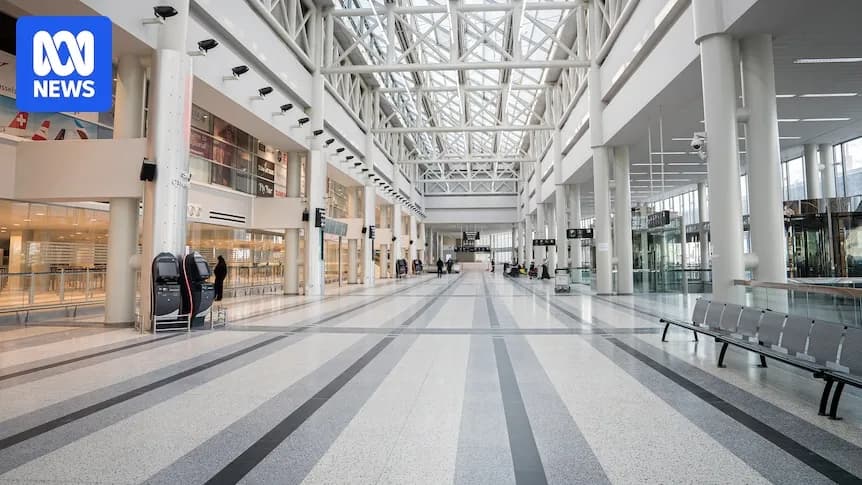
Smoke still hung near Beirut's southern suburbs on Friday as commercial aircraft continued to take off and land at Rafic Hariri International Airport, the country's only international passenger gateway, even after Israeli strikes and evacuation warnings pushed fighting close to the facility. The image is striking because the airport sits on the edge of the same southern belt that Israel has been hitting since Hezbollah, backed by Iran, fired rockets at Israel last month and pulled Lebanon deeper into the regional war. What might have looked from abroad like an inevitable closure has instead become a test of whether a state under heavy military pressure can keep a basic civilian artery functioning without pretending the surrounding danger is not real.Planes fly from Beirut airport despite Israeli bombingfrance24.com·SecondaryDespite Israeli airstrikes in the area, Beirut airport is running. Kept open through close coordination and international guarantees, it is operating at reduced capacity. Issued on: 11/04/2026 - 17:47Modified: 11/04/2026 - 22:08 Smoke from an Israeli strike still lingered in the air as a plane from Lebanon's national carrier took off from Beirut airport, which has stayed open despite the latest war between Israel and Hezbollah.
Lebanese aviation officials say the airport has remained open because the risk is being managed rather than ignored. Mohammed Aziz, who heads Lebanon's civil aviation authority, said the operating decision has rested on repeated assessments and on information coming mainly through the U.S. embassy, while Lebanese officials also received additional assurances this week that the airport itself would be spared. That matters because Thursday's Israeli warning covered large parts of southern Beirut, including the main road leading to the airport and adjacent areas, a move that easily could have triggered a wider panic or a shutdown order. So far, however, Israel has not struck the airport itself, suggesting that even during a hard campaign against Hezbollah there are still lines that both military planners and outside intermediaries want to avoid crossing.Planes fly from Beirut airport despite Israeli bombingfrance24.com·SecondaryDespite Israeli airstrikes in the area, Beirut airport is running. Kept open through close coordination and international guarantees, it is operating at reduced capacity. Issued on: 11/04/2026 - 17:47Modified: 11/04/2026 - 22:08 Smoke from an Israeli strike still lingered in the air as a plane from Lebanon's national carrier took off from Beirut airport, which has stayed open despite the latest war between Israel and Hezbollah.
The operational picture is functional but obviously degraded. Departure boards are described as heavily red with cancellations, most foreign airlines have suspended service, and Middle East Airlines has been left carrying much of the burden with a sharply reduced schedule. Aziz said the airport is seeing less than half of its usual traffic for this time of year, while one example in the reporting showed MEA flying only three daily services to Turkey instead of the normal eleven. That is not business as usual; it is a wartime holding pattern in which continuity itself becomes the headline.Planes fly from Beirut airport despite Israeli bombingfrance24.com·SecondaryDespite Israeli airstrikes in the area, Beirut airport is running. Kept open through close coordination and international guarantees, it is operating at reduced capacity. Issued on: 11/04/2026 - 17:47Modified: 11/04/2026 - 22:08 Smoke from an Israeli strike still lingered in the air as a plane from Lebanon's national carrier took off from Beirut airport, which has stayed open despite the latest war between Israel and Hezbollah.
Inside the terminal, the scenes described by reporters point to a country running an emergency version of normal life. The usually crowded departures hall had only a few dozen travellers, porters were sitting on empty baggage carts, and soldiers were watching the entrance while passengers focused less on destination choices than on whether their flight would still leave. One Lebanese-Australian traveller heading to Sydney via Cairo summed up the mood by worrying primarily about cancellation rather than bombardment, which says something about how quickly people in conflict zones can begin treating extraordinary risk as a background condition. That does not mean the danger is small; it means the threshold for what counts as routine has been pushed far upward.Planes fly from Beirut airport despite Israeli bombingfrance24.com·SecondaryDespite Israeli airstrikes in the area, Beirut airport is running. Kept open through close coordination and international guarantees, it is operating at reduced capacity. Issued on: 11/04/2026 - 17:47Modified: 11/04/2026 - 22:08 Smoke from an Israeli strike still lingered in the air as a plane from Lebanon's national carrier took off from Beirut airport, which has stayed open despite the latest war between Israel and Hezbollah.
The airport's survival also depends on precise technical coordination in the sky. An MEA pilot told AFP that commercial aircraft and Israeli military aircraft, including drones, are flying at the same time but along separate air corridors, with airliners keeping their transponders on so their positions are clear. The same account said American officials are acting as the main intermediaries to manage traffic and reduce the chance of miscalculation. Lebanese officials say only two or three landings have been delayed because of Israeli military activity, which is a narrow margin for error when civilian aviation and live combat are occupying the same airspace.Planes fly from Beirut airport despite Israeli bombingfrance24.com·SecondaryDespite Israeli airstrikes in the area, Beirut airport is running. Kept open through close coordination and international guarantees, it is operating at reduced capacity. Issued on: 11/04/2026 - 17:47Modified: 11/04/2026 - 22:08 Smoke from an Israeli strike still lingered in the air as a plane from Lebanon's national carrier took off from Beirut airport, which has stayed open despite the latest war between Israel and Hezbollah.
From the Israeli side, the argument is straightforward even if the consequences are grim. Israel says it is striking Hezbollah positions and infrastructure after rocket fire from Lebanon, and the fact that it issued warnings for nearby districts rather than bombing the airport itself indicates that it is trying, at least for now, to preserve space between attacks on Hezbollah strongholds and a direct hit on a strategic civilian facility. Supporters of Israel's campaign would say that allowing flights to continue while maintaining pressure on Hezbollah shows a degree of discrimination and restraint that is often absent from broader political denunciations of the war. Critics will answer that an airport ringed by strikes, cancellations and evacuation notices is already living under coercion, and that the difference between formal closure and practical paralysis can narrow quickly if the bombardment expands.Planes fly from Beirut airport despite Israeli bombingfrance24.com·SecondaryDespite Israeli airstrikes in the area, Beirut airport is running. Kept open through close coordination and international guarantees, it is operating at reduced capacity. Issued on: 11/04/2026 - 17:47Modified: 11/04/2026 - 22:08 Smoke from an Israeli strike still lingered in the air as a plane from Lebanon's national carrier took off from Beirut airport, which has stayed open despite the latest war between Israel and Hezbollah.
Lebanon's case is equally clear and deserves to be stated on its own terms. For Beirut, the airport is not just another transport node; it is the state's main civilian connection to the outside world, a channel for families, business traffic, diplomatic movement and, when necessary, aid and emergency logistics. Jalal Haidar, the airport's chief operating officer, said the facility, its surroundings and the airspace remain safe enough to keep operating, and he framed continued service as part of a determination to keep Lebanon connected. That language is not mere public relations when the alternative would be a deeper sense of isolation in a country that has repeatedly had to function through war, state weakness and economic strain.Planes fly from Beirut airport despite Israeli bombingfrance24.com·SecondaryDespite Israeli airstrikes in the area, Beirut airport is running. Kept open through close coordination and international guarantees, it is operating at reduced capacity. Issued on: 11/04/2026 - 17:47Modified: 11/04/2026 - 22:08 Smoke from an Israeli strike still lingered in the air as a plane from Lebanon's national carrier took off from Beirut airport, which has stayed open despite the latest war between Israel and Hezbollah.
There is also a deeper strategic point here. The airport remained open during the full Israel-Hezbollah war in 2024, and Lebanese officials are explicitly drawing on that experience again now. That continuity suggests both institutional learning and a harsh regional reality: actors around this conflict increasingly seem to accept a model in which civilian systems keep operating in diminished form as long as they can be managed, monitored and politically tolerated. In one sense that reflects resilience; in another it reflects how normalized managed-risk warfare has become across the Levant.Planes fly from Beirut airport despite Israeli bombingfrance24.com·SecondaryDespite Israeli airstrikes in the area, Beirut airport is running. Kept open through close coordination and international guarantees, it is operating at reduced capacity. Issued on: 11/04/2026 - 17:47Modified: 11/04/2026 - 22:08 Smoke from an Israeli strike still lingered in the air as a plane from Lebanon's national carrier took off from Beirut airport, which has stayed open despite the latest war between Israel and Hezbollah.
What happens next depends less on airport management than on military choices beyond the perimeter. If Israel keeps confining its attacks to Hezbollah-linked areas around the airport while intermediaries preserve the flight corridors, Beirut can probably continue this reduced but symbolically vital operation. If the strike pattern widens, if a warning covers the runways themselves, or if foreign carriers judge the risk intolerable for longer, the airport could shift from fragile continuity to abrupt shutdown with very little notice. For now the stronger reading is that Beirut airport is open, but only in the modern Middle Eastern sense of open: functioning, visible, proud, useful and never far from the edge of forced closure.Planes fly from Beirut airport despite Israeli bombingfrance24.com·SecondaryDespite Israeli airstrikes in the area, Beirut airport is running. Kept open through close coordination and international guarantees, it is operating at reduced capacity. Issued on: 11/04/2026 - 17:47Modified: 11/04/2026 - 22:08 Smoke from an Israeli strike still lingered in the air as a plane from Lebanon's national carrier took off from Beirut airport, which has stayed open despite the latest war between Israel and Hezbollah.
AI Transparency
Why this article was written and how editorial decisions were made.
Why This Topic
This is the strongest distinct top-story candidate on the board because it combines active war, civilian infrastructure, aviation safety, regional diplomacy and state resilience in one highly visual, immediately consequential development. The airport is Lebanon's only international passenger facility, so its continued operation changes the practical meaning of the conflict for civilians, airlines, diplomats and aid flows. It is also meaningfully different from recent CT coverage on Russia-Ukraine, North Korea-China, AI infrastructure and domestic U.S. politics.
Source Selection
The cluster signals are thin in domain diversity but unusually rich in operational detail: they identify the airport's status, the nearby strike geography, the evacuation-warning perimeter, traffic reductions, specific flight-frequency cuts, U.S.-linked deconfliction, and comments from the civil aviation authority, an airline pilot, a diplomatic source and the airport's chief operating officer. Because evidence_quality is strict, the article sticks closely to those signal-backed facts for numbered citations and uses external reading only as unnumbered contextual orientation.
Editorial Decisions
Lead with the operational paradox: a civilian airport still functioning beside active Israeli strikes. Keep the tone restrained and descriptive, avoid moralizing language, give Israeli security logic and Lebanese civilian-state logic comparable space, and stress that 'open' here means reduced wartime operation rather than normal traffic. All numbered citations are limited to the cluster signals.
Reader Ratings
About the Author
Sources
- 1.france24.comSecondary
- 2.france24.comSecondary
Editorial Reviews
1 approved · 0 rejectedPrevious Draft Feedback (1)
• depth_and_context scored 4/3 minimum: The article does a good job establishing the immediate context (strikes, warnings) and the historical context (previous conflicts). To improve, it could more deeply explain the specific economic or geopolitical stakes of the airport's continued operation for Lebanon's overall stability, beyond just 'business traffic.' • narrative_structure scored 4/3 minimum: The structure is strong, moving logically from the immediate scene to operational details, stakeholder arguments, and finally to future implications. The lede is engaging, but the transition into the 'Lebanon's case' section feels slightly abrupt and could benefit from a stronger connective sentence. • perspective_diversity scored 4/3 minimum: The article successfully presents multiple viewpoints (Israeli rationale, Lebanese officials, international intermediaries, critics). It could strengthen this by including a direct quote or perspective from a neutral, non-governmental observer (e.g., an international aid worker or UN official) to balance the military/political narratives. • analytical_value scored 5/3 minimum: The analysis is excellent, moving beyond mere reporting to discuss the 'modern Middle Eastern sense of open' and the normalization of managed-risk warfare. This provides significant interpretive value and forward-looking insight. • filler_and_redundancy scored 5/2 minimum: The article is tightly written; every paragraph advances the narrative or analysis. There is no noticeable padding or repetition that detracts from the core reporting. • language_and_clarity scored 4/3 minimum: The writing is crisp and highly engaging, using strong imagery. The language is precise, though the phrase 'wartime holding pattern' is slightly cliché and could be replaced with more unique phrasing to elevate the prose further. Warnings: • [source_diversity] Single-source story — consider adding corroborating sources



Discussion (0)
No comments yet.