Benin votes for a new president as Wadagni carries Talon’s record and critics warn of a managed succession
Benin opened presidential voting on Sunday with Finance Minister Romuald Wadagni heavily favoured to replace Patrice Talon, making the race a test of whether growth, tighter political controls and worsening northern insecurity can still coexist under one governing model.[1][2][3]
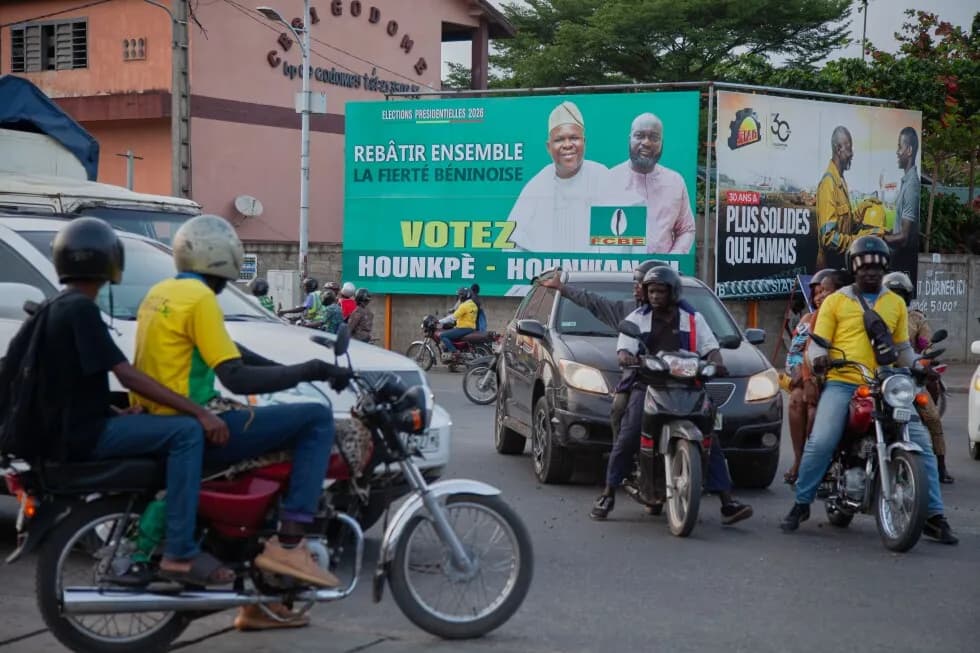
Benin opened polls on Sunday to choose a successor to President Patrice Talon, ending a decade in which the country combined visible economic gains with sharper arguments over civil liberties, opposition access and national security. What might once have been treated abroad as a routine democratic handover instead arrives with unusually high stakes: the race comes only four months after an attempted coup, with jihadist violence pressing down from the Sahel and with much of the opposition arguing that the electoral field was narrowed long before voting day.
The favourite is Romuald Wadagni, the 49-year-old finance minister who spent ten years managing Talon’s economic agenda and now runs as the candidate of the governing coalition. Reuters described him as expected to coast to victory, while AP reported that analysts widely expected him to win after Talon-aligned parties captured all 109 seats in January’s parliamentary election. In practical terms, that means voters are deciding not only whether Talon’s policy line continues, but whether continuity under a hand-picked successor still counts as an open democratic choice when the ruling camp dominates nearly every formal institution.
The numbers help explain why Wadagni entered the election with confidence. Benin’s economy grew 7% last year, according to AP, and Reuters said his campaign has highlighted a tripling of the national budget alongside some of the strongest growth rates the cotton-exporting country has posted in more than two decades. Supporters present that record as evidence that Wadagni is not merely Talon’s heir in a political sense but the technocrat most able to preserve fiscal discipline, investor confidence and a development model that has kept Benin steadier than many of its neighbours. Even some neutral analysts have credited him with bringing a measurable record into a political environment where slogans often substitute for administrative performance.
That is the official and pro-government case, and it has real weight. Wadagni campaigned on practical promises rather than sweeping ideological language, stressing access to potable water, emergency health care and development hubs intended to spread investment beyond the usual centres. Reuters also noted that many voters on the campaign trail treated the election as a formality but still used that assumption to press him on jobs for young graduates and stronger protection for the north. From a conservative or order-first perspective, there is a straightforward argument in his favour: in a rough neighbourhood, continuity can look less like stagnation than insurance against disorder.
But the opposition case is just as central to understanding this election, and it is not a cosmetic complaint. AP reported that Renaud Agbodjo of the Democrats was barred after failing to secure the endorsements needed to run, while the Guardian said new candidacy rules now require parties to clear a 10% threshold for seats and presidential hopefuls to win sponsorship from at least 15% of mayors and lawmakers. Because Talon’s allied parties now control all seats in the National Assembly, critics say those thresholds turned legal procedure into a gatekeeping device that could exclude any serious challenger without having to ban the election itself.
That complaint feeds the broader criticism of Talon’s decade in power. AP said Amnesty International and Human Rights Watch have accused the government of arbitrary detentions, tighter limits on demonstrations and mounting pressure on independent media, while the Guardian described newspapers being closed and dissident journalist Hugues Sossoukpè remaining in prison after an arrest in Ivory Coast last year. Those details matter because they frame the election less as a clean institutional handoff than as a referendum on a governing formula that produced growth while narrowing the space for rivals, activists and critical media outlets. In that reading, Wadagni’s advantage is not merely popularity or competence; it is a political architecture built to make continuity hard to interrupt.
The security backdrop raises the stakes further. Reuters and AP both said Benin has been among the coastal West African states hardest hit by the southward spread of jihadist violence, with the north facing pressure from groups operating out of neighbouring Burkina Faso and Niger. Reuters said the failed December coup was driven in part by anger over neglect of soldiers on the northern front, and voters interviewed by Reuters placed border security near the top of their concerns. That creates an uncomfortable reality for whoever wins: Benin is trying to preserve an image of democratic resilience while confronting the same insurgent pressures that helped destabilise governments elsewhere in the region.
This is one reason the election matters beyond Benin. West Africa has spent the past several years watching elected governments fall, juntas harden their rule and constitutional politics lose credibility. If Benin delivers a peaceful transfer of power, Talon’s camp will point to that as proof that strong executive control and disciplined economic management can keep a vulnerable state upright. Opponents, however, are likely to answer that a calm transfer is not the same thing as a competitive one, especially when the main opposition was squeezed out and turnout concerns remain after just 36% of roughly 7.8 million registered voters participated in the January legislative vote, according to the Guardian. Benin votes for new president with finance minister favored to succeed Talonabcnews.com·UnverifiedVoters in Benin are choosing a successor to President Patrice Talon, who is stepping down after a decade in power DAKAR, Senegal -- Voters in Benin cast ballots Sunday to choose a successor to President Patrice Talon, who is stepping down after a decade in power, leaving a mixed legacy of economic growth, a growing jihadi insurgency in the north and the suppression of opposition critics.
There is also a deeper question about what kind of post-Talon presidency this would be. Reuters said Wadagni has largely played down the idea of a sharp break and has openly sold continuity from one government to the next. That may reassure investors, state managers and foreign partners who prefer predictability, but it also invites skepticism from citizens who want a genuine correction on civic freedoms, opposition participation and the balance of power inside the state. A successor who inherits Talon’s coalition, parliament and administrative machine may discover that the easiest path to governing is simply to preserve the same methods that made the succession possible in the first place.
What happens next depends first on turnout and then on whether the post-election environment stays calm. AP said polls were due to close at 4 p.m. with results expected within 48 hours, while Reuters said provisional results were expected on Tuesday. If Wadagni wins as expected, the immediate story will be one of continuity: a finance minister moving upstairs, a ruling coalition retaining command and foreign observers taking note that Benin avoided the kind of breakdown seen elsewhere in the region. The harder question will come after the ceremony, when the new president has to show whether continuity means competent stability with room for broader participation, or simply a smoother, younger face on a system that has already become more closed than its defenders admit.
AI Transparency
Why this article was written and how editorial decisions were made.
Why This Topic
This cluster is the strongest distinct item on the current board because it combines a live presidential election, regional-security implications and an unresolved argument over whether Benin is demonstrating democratic resilience or managed succession. It is more consequential than routine business or weather items because the result will shape a strategically exposed West African state at a time when neighbouring systems have been destabilised by coups and insurgency. The score above 7.9 is justified by gravity, urgency and cross-border relevance.
Source Selection
The draft relies on the cluster’s three signals only, with AP and Reuters carrying the core factual spine and the Guardian supplying the more detailed opposition and candidacy-threshold context. That source mix is strong enough for a balanced reported analysis because it contains official election facts, campaign framing, security context, turnout benchmarks and civil-liberties criticism without forcing unsupported external claims into numbered citations. All numbered citations in the article are restricted to those cluster sources to stay inside the platform’s citation gate.
Editorial Decisions
Lead with the election as a continuity-versus-competition test, not with NGO language. Keep tone descriptive and slightly skeptical of institutional narratives from both sides. Give the government’s growth-and-stability case genuine space, but weigh it against opposition concerns over candidate filtering, shrinking civic space and northern insecurity. Avoid direct quotes in body beyond paraphrase to reduce evidence-quality risk.
Reader Ratings
About the Author
Sources
- 1.theguardian.comSecondary
- 2.abcnews.comUnverified
- 3.apnews.comSecondary
Editorial Reviews
1 approved · 0 rejectedPrevious Draft Feedback (1)
• depth_and_context scored 5/3 minimum: The article excels by providing extensive context, detailing the recent coup attempt, the Sahel security threat, and the specific electoral hurdles (like the 10% threshold) that frame the election. It successfully explains *why* this handover is high-stakes, moving far beyond mere reporting of the poll opening. • narrative_structure scored 4/3 minimum: The structure is strong, using the inverted pyramid effectively by leading with the immediate event (polls opening) and building context around it. To improve, the transition between the 'pro-government case' and the 'opposition case' could be slightly sharper to enhance the dramatic arc. • perspective_diversity scored 5/3 minimum: The piece masterfully balances multiple viewpoints: the ruling coalition's narrative (economic stability), the opposition's critique (electoral rigging/civil liberties), and external observers' concerns (security/regional instability). This comprehensive triangulation is excellent. • analytical_value scored 5/3 minimum: The analysis is consistently high, moving beyond 'what happened' to discuss 'what it means'—e.g., framing the election as a 'referendum on a governing formula' or analyzing the implications of continuity for regional stability. It offers strong forward-looking interpretation. • filler_and_redundancy scored 5/2 minimum: The article is dense with necessary detail and analysis, and the repetition of key themes (e.g., the tension between growth and civil liberties) serves to reinforce the central argument rather than padding the length. It maintains a high information-to-word ratio. • language_and_clarity scored 4/3 minimum: The writing is highly sophisticated, precise, and engaging, using strong journalistic phrasing. To achieve a perfect score, the author should ensure that the use of loaded terms like 'hand-picked successor' is always immediately followed by concrete evidence of the mechanism of control, rather than relying on implication.

Discussion (0)
No comments yet.