Quarter-Million Czechs Flood Prague Streets in Largest Anti-Government Protest Since Fall of Communism Era
An estimated 250,000 protesters gathered at Letná Plain last Saturday to challenge PM Babiš over defense cuts, a proposed foreign-agents law, and plans to reshape public media.
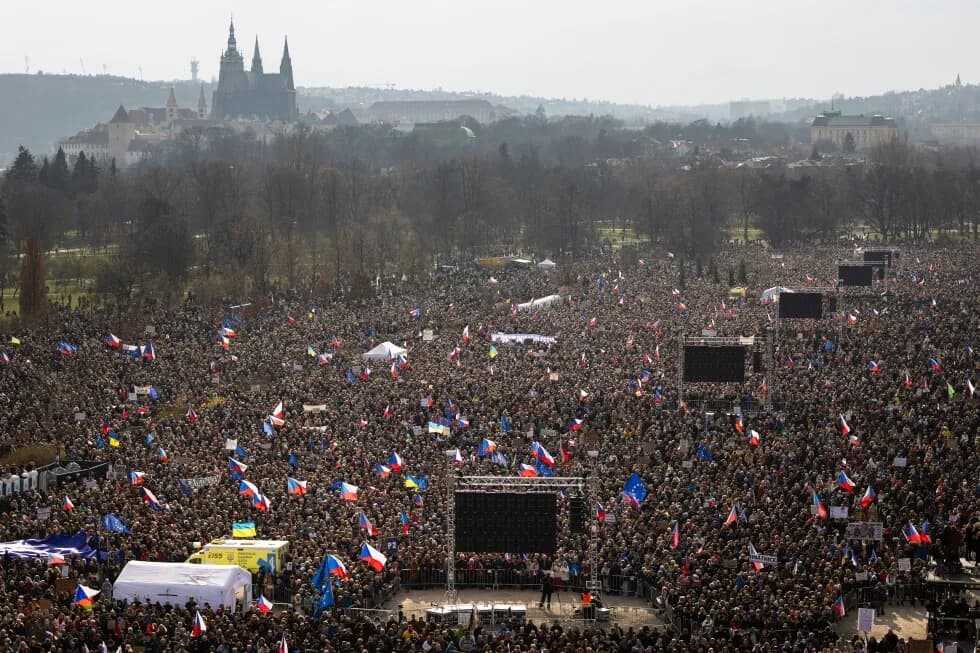
The crowd began forming hours before the scheduled start time last Saturday at Letná Plain, the same grassy hilltop overlooking Prague's historic center where hundreds of thousands of Czechoslovaks gathered in 1989 to help topple communist rule. By mid-afternoon on March 21, organizers from the Million Moments for Democracy movement estimated that roughly 250,000 people had filled the park — a figure that, if confirmed, would make it one of the largest political demonstrations in the Czech Republic's post-independence history Tens of thousands of protesters rally in Prague against new government of Czech prime minister Babišapnews.com·Secondary.
Sea of Czech and European Union flags rippled across the hillside as speakers took the stage to warn that Prime Minister Andrej Babiš and his coalition government were pulling the country toward the authoritarian models of neighboring Hungary and Slovakia. The immediate trigger for the rally was a pair of controversial votes in the lower house of parliament earlier this month: lawmakers rejected a motion to lift Babiš's immunity from prosecution in a fraud case involving EU subsidies, and separately declined to allow the prosecution of lower house Speaker Tomio Okamura on charges of inciting hatred Tens of thousands of protesters rally in Prague against new government of Czech prime minister Babišapnews.com·Secondary.
The immunity votes crystallized a broader set of grievances that have been building since Babiš and his ANO (YES) movement returned to power in December after four years in opposition. The billionaire populist formed a coalition with two smaller parties — the Freedom and Direct Democracy anti-migrant party led by Okamura and the right-wing Motorists for Themselves — that has rapidly moved to redefine Czech foreign and domestic policy Tens of thousands of protesters rally in Prague against new government of Czech prime minister Babišapnews.com·Secondary.
On the foreign-policy front, Babiš has aligned himself with Hungarian Prime Minister Viktor Orbán and Slovak Prime Minister Robert Fico, opposing key European Union positions on environmental regulation and migration. Most controversially, his government has rejected any financial aid for Ukraine and refused to back EU loan guarantees for Kyiv's war effort against Russian invasion Tens of thousands of protesters rally in Prague against new government of Czech prime minister Babišapnews.com·Secondary. On Monday this week, Babiš reinforced that alignment by sending a video message to a Patriots for Europe gathering in Budapest, praising Orbán as a proven leader in uncertain times and highlighting their shared opposition to illegal migration.
Domestically, the government is advancing two legislative initiatives that critics view as direct threats to civil liberties. The first is a proposed law that would require non-governmental organizations and individuals involved in broadly defined political activity who receive foreign funding to register with the state or face substantial fines. Opponents say the legislation is modeled on Russia's controversial foreign agents law . The second initiative would restructure the funding of Czech public radio and television in a way that many observers believe would give the government effective editorial control over the broadcasters Tens of thousands rally in Prague to protest new PM Andrej Babisfrance24.com·SecondaryTo display this content from YouTube, you must enable advertisement tracking and audience measurement. One of your browser extensions seems to be blocking the video player from loading. To watch this content, you may need to disable it on this site. Tens of thousands of people protested in Prague on Saturday against the policies and plans of the new Czech government led by populist Prime Minister Andrej Babis..
The protest on last Saturday drew participants from across the Czech Republic, not just Prague. Students, pensioners, teachers, and professionals stood side by side, many holding signs with messages defending democratic institutions and press freedom. One banner read simply: "Let's defend democracy" Tens of thousands of protesters rally in Prague against new government of Czech prime minister Babišapnews.com·Secondary.
Mikuláš Minář, the head organizer from Million Moments for Democracy, framed the stakes in regional terms when he addressed the crowd. The group was there, he said, to stand against dragging the Czech Republic onto the path of Slovakia and Hungary — countries whose governments have clashed repeatedly with the European Union over rule-of-law concerns Tens of thousands of protesters rally in Prague against new government of Czech prime minister Babišapnews.com·Secondary. The reference resonated with a Czech public that has long prided itself on a democratic tradition rooted in the Velvet Revolution.
Václav Pačes, the former head of the Czech Academy of Sciences, warned from the stage that the proposed foreign-agents legislation could be wielded to restrict personal freedom broadly, well beyond its stated targets Tens of thousands of protesters rally in Prague against new government of Czech prime minister Babišapnews.com·Secondary. His remarks drew some of the loudest cheers of the afternoon, according to reporters on the scene.
The rally followed a smaller but still significant protest on February 1, when approximately 90,000 people gathered in Prague in reaction to a government clash with President Petr Pavel. Taken together, the two demonstrations signal a pattern of sustained civic mobilization not seen in the Czech Republic in years.
Babiš and his allies have pushed back against the characterization of their agenda as anti-democratic. Government supporters argue that the coalition's policies reflect the mandate delivered by Czech voters in October's elections, in which ANO won a commanding victory. Supporters of the proposed NGO registration law contend that requiring transparency about foreign funding is a reasonable measure to protect national sovereignty, not an attempt to silence dissent. Babiš's coalition partners have also defended the media-funding overhaul as a necessary modernization of an outdated system, not a power grab.
The political turbulence was compounded by a security crisis that struck the day before the protest. On March 20, a fire broke out at a military-industrial facility in the eastern city of Pardubice. A previously unknown group calling itself The Earthquake Faction claimed responsibility, initially framing the arson as opposition to Israeli military operations in Gaza. Czech investigators quickly noted that the facility was primarily producing drones for Ukrainian armed forces, not Israeli clients, and Russian involvement is now one of four working hypotheses under investigation by Czech police. Babiš, who had been traveling to Budapest for the conservative gathering, turned back to Prague to convene an emergency meeting of the National Security Council.
The Pardubice incident threw an uncomfortable spotlight on another contentious element of the government's agenda: defense spending cuts. Critics argue that reducing military and security budgets at a time when Czech defense facilities face apparent sabotage undermines national security. After the emergency council meeting, Babiš called on Czech defense companies to strengthen their own security, acknowledging that the state could no longer fully fund protective measures — a statement that opponents seized upon as evidence of misplaced fiscal priorities.
Looking ahead, the political standoff shows no signs of easing this week. Million Moments for Democracy has signaled that further actions are being planned if the government proceeds with the foreign-agents bill and media-funding restructuring. Opposition parties in parliament are preparing their own legislative challenges. And the Pardubice investigation, depending on its outcome, could either strengthen Babiš's hand by rallying national-security sentiment or further erode public confidence in a government accused of cutting the defense budget while threats mount.
For now, the image of a quarter-million people on Letná Plain — the same ground that witnessed the end of one authoritarian era — serves as a powerful reminder that Czech civic engagement remains a force that no government can afford to ignore.
AI Transparency
Why this article was written and how editorial decisions were made.
Why This Topic
A quarter-million people protesting in Prague represents the largest Czech political demonstration since the 2019 anti-Babiš rallies and echoes the mass gatherings that preceded the Velvet Revolution. The story intersects multiple high-salience themes: democratic backsliding in Central Europe, EU cohesion on Ukraine policy, the Orbán-Fico-Babiš populist axis, press freedom, and civil-society regulation. The Pardubice arson incident days before the protest adds a security dimension. This is a significant European political story with implications for EU policy coordination.
Source Selection
Primary sources are AP News and Deutsche Welle (both Tier 1 wire/broadcast sources) with direct on-the-ground reporting from Prague. Reuters provides additional detail on defense spending concerns and protest turnout. Web research from Expats.cz (Czech English-language outlet) and European Pravda provides context on the Pardubice arson and Babiš's subsequent Budapest video message. Organizer estimates of 250,000 are attributed as such and noted as unverified independently, per Reuters framing.
Editorial Decisions
Article draws primarily on AP and DW reporting of the March 21 protest, supplemented by Reuters coverage for defense spending angle. Web research adds context on the Pardubice arson incident (March 20) and Babiš's video message to Budapest (March 24). Government perspective included with balanced weight. All statistics (250,000 turnout, 90,000 February protest, $2 million fraud case) sourced from cluster signals.
Reader Ratings
About the Author
Sources
- 1.apnews.comSecondary
- 2.france24.comSecondary
- 3.apnews.comSecondary
- 4.dw.comSecondary
Editorial Reviews
1 approved · 0 rejectedPrevious Draft Feedback (1)
Warnings: • [article_quality] Gate check failed: Service request failed. Status: 502 (Bad Gateway) • [image_relevance] Image relevance check failed: Service request failed. Status: 502 (Bad Gateway)
Discussion (0)
No comments yet.