Russia to hold Victory Day parade without military equipment as security fears reshape Kremlin spectacle
Russia said the May 9 Victory Day parade in Moscow will proceed without tanks or other military hardware, breaking with a key display tradition as the Kremlin cites the operational situation and Ukrainian strike risks.
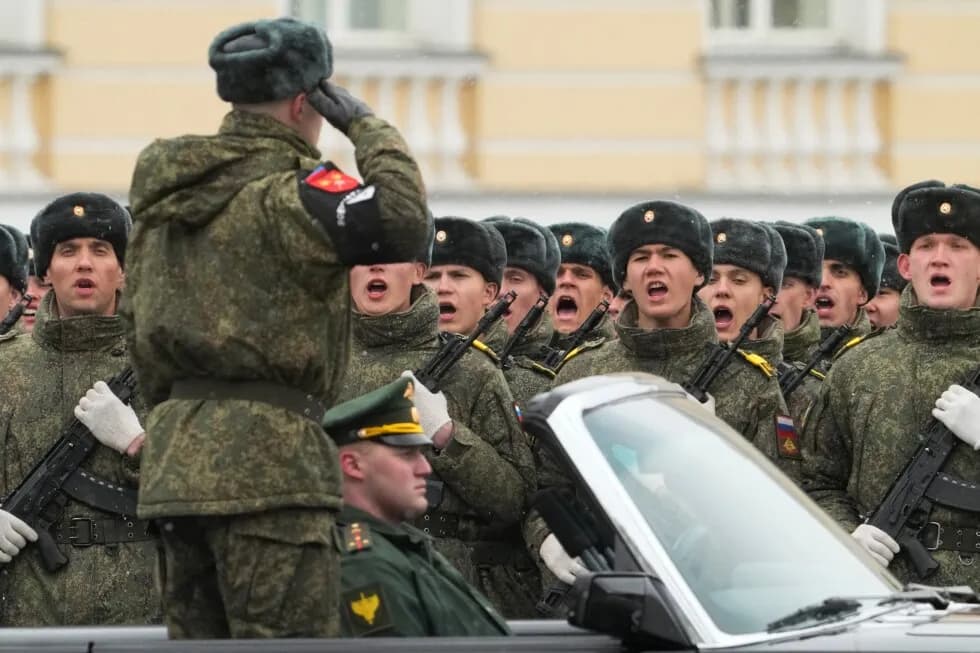
Russia said on Wednesday that its May 9 Victory Day parade on Red Square will go ahead without the usual column of tanks, missile launchers and other military equipment, a notable change for one of the Kremlin’s most choreographed demonstrations of power. The decision matters because Victory Day is not just another ceremonial date in Russia’s calendar. It is the country’s most important secular holiday, a ritual built around sacrifice in World War II, national continuity and the visual projection of military prestige.Russia to hold Victory Day parade without military equipment for 1st time since invading Ukraineapnews.com·SecondaryTroops attend a rehearsal for the Victory Day military parade at the Dvortsovaya (Palace) Square in St. Petersburg, Russia, Tuesday, April 28, 2026. (AP Photo/Dmitri Lovetsky) Troops march during a rehearsal for the Victory Day military parade at the Dvortsovaya (Palace) Square in St. Petersburg, Russia, Tuesday, April 28, 2026. (AP Photo/Dmitri Lovetsky) Navy cadets march during a rehearsal for the Victory Day military parade at the Dvortsovaya (Palace) Square in St.
According to the Russian Defense Ministry, the parade marking the 81st anniversary of the Soviet victory over Nazi Germany will still include servicemen drawn from military educational institutions and selected branches of the armed forces, as well as the customary aircraft flyover. What will be missing is the hardware convoy that normally turns Red Square into a live exhibition of Russian force, from battlefield armor to strategic missile systems. The ministry cited the “current operational situation” as the reason for dropping the equipment display, while Kremlin spokesman Dmitry Peskov later tied the move more explicitly to what Moscow described as Ukrainian “terrorist activity,” a reference to drone strikes reaching deep inside Russia.
That shift carries symbolic weight because the annual parade has become central to President Vladimir Putin’s political language over more than two decades in power. The Kremlin has long used Victory Day to fuse genuine public memory of the Second World War with a modern narrative of Russian resilience, military competence and state legitimacy. Since the full-scale invasion of Ukraine in 2022, that symbolism has become even more politically useful to Moscow, which has tried to frame its present war through the moral inheritance of the Soviet fight against Nazi Germany. Supporters of the Kremlin line argue that such commemorations reinforce social cohesion in wartime and remind Russians of the scale of sacrifice that underpins the state’s historical identity.Russia to hold Victory Day parade without military equipment for 1st time since invading Ukraineapnews.com·SecondaryTroops attend a rehearsal for the Victory Day military parade at the Dvortsovaya (Palace) Square in St. Petersburg, Russia, Tuesday, April 28, 2026. (AP Photo/Dmitri Lovetsky) Troops march during a rehearsal for the Victory Day military parade at the Dvortsovaya (Palace) Square in St. Petersburg, Russia, Tuesday, April 28, 2026. (AP Photo/Dmitri Lovetsky) Navy cadets march during a rehearsal for the Victory Day military parade at the Dvortsovaya (Palace) Square in St.
Critics, however, see the parade as something more instrumental: a propaganda platform that repackages history to justify current military choices and to project confidence even when the battlefield picture is difficult or costly. That critical reading gains force from the contrast with last year’s event, which Russian and international coverage described as the largest parade since the invasion of Ukraine began. In 2025, more than 11,500 troops and over 180 military vehicles crossed Red Square, including tanks, armored vehicles, artillery systems, Yars nuclear-capable intercontinental ballistic missile launchers and drones mounted on trucks. This year’s absence of hardware therefore does not read like a routine scheduling tweak. It reads like a conscious reduction of visual risk at a moment when spectacle and vulnerability are colliding.
Russian officials have not offered a fuller technical explanation, and there are at least two serious interpretations in circulation. The first is straightforward security: Ukrainian long-range drone attacks have repeatedly forced Russian authorities to think harder about what can be safely concentrated, displayed and televised in Moscow. The second is more practical and less publicly acknowledged: equipment used in the war may be more valuable at the front, less available for ceremonial use, or less suitable for display if losses and maintenance demands are biting.Russia will not display military equipment at Victory Day parade due to Ukraine threatfrance24.com·SecondaryRussia will hold a scaled-back version of its Victory Day parade marking the defeat of Nazi Germany in World War II, the Kremlin said on Wednesday. For the first time in nearly two decades, the annual parade on Moscow's Red Square will not feature a military hardware display. The Kremlin said it was due to Ukraine's "terrorist activity". Analysts quoted in wider coverage argued that omitting armor and missile systems weakens the propaganda value of the event but may also reduce the exposure of assets that Russia would rather preserve than parade.Russia will not display military equipment at Victory Day parade due to Ukraine threatfrance24.com·SecondaryRussia will hold a scaled-back version of its Victory Day parade marking the defeat of Nazi Germany in World War II, the Kremlin said on Wednesday. For the first time in nearly two decades, the annual parade on Moscow's Red Square will not feature a military hardware display. The Kremlin said it was due to Ukraine's "terrorist activity".
The official Russian position is more restrained. Moscow says the parade is being adapted to present conditions, not hollowed out. The Defense Ministry has emphasized that trained personnel will still march and that aircraft will still fly over the capital, preserving the core ritual. From that perspective, the state can argue that commemoration is continuing while security precautions are adjusted to wartime realities. That is the conservative institutional case here: a government at war does not have to expose everything simply to preserve peacetime pageantry.
Still, the loss of armor on Red Square matters precisely because Victory Day has been designed to communicate more than remembrance. Since 2008, military hardware has been a regular feature of the Moscow parade, helping to turn remembrance into a visible assertion of strategic capacity. The images are consumed by domestic audiences, foreign governments and Russia’s own military establishment. When tanks and launchers disappear, the state’s message changes, whether the Kremlin intends that or not. Instead of effortless strength, the event risks signalling constraint: that drone threats are real, that Moscow is not fully insulated from the war it wages, and that even one of the safest symbolic stages in Russia now has to be managed more cautiously.Russia will not display military equipment at Victory Day parade due to Ukraine threatfrance24.com·SecondaryRussia will hold a scaled-back version of its Victory Day parade marking the defeat of Nazi Germany in World War II, the Kremlin said on Wednesday. For the first time in nearly two decades, the annual parade on Moscow's Red Square will not feature a military hardware display. The Kremlin said it was due to Ukraine's "terrorist activity".
There is also a diplomatic angle. Last year’s parade drew the largest group of foreign leaders to Moscow in a decade, including Chinese President Xi Jinping, Brazilian President Luiz Inácio Lula da Silva and Slovak Prime Minister Robert Fico. Russian officials say Fico and other foreign dignitaries are expected again this year. That means the parade remains part of Moscow’s external messaging as well as its domestic theater. Even a scaled-back display can still serve to show that Russia is not isolated and can still convene sympathetic or pragmatic foreign guests. But the absence of weapons denies the Kremlin one of its clearest visual arguments: that Russia can combine wartime endurance with untroubled military abundance.
For ordinary Russians, Victory Day retains an emotional status that cuts across ideology more than many other state rituals do. The Soviet Union’s wartime losses, which Russian accounts place at 27 million dead, left a scar that still shapes family memory and public identity. That is why officials can modify the parade without canceling its importance. The human and historical core of the day remains powerful even if the military display is thinned out. But precisely because the memory is real, arguments over how it is used are real too. Supporters can sincerely view a simpler parade as prudent. Opponents can sincerely view it as evidence that the state can no longer stage its preferred image of strength without adjustment.
What happens next will reveal whether this is a one-off security response or the beginning of a more durable shift in how Russia manages major public war symbolism. If the parade proceeds smoothly with marching units and a flyover but no hardware, the Kremlin may claim that the essence of Victory Day never depended on steel columns in the first place. If, however, the omission becomes a repeated pattern, it will be harder to avoid the conclusion that the war in Ukraine has begun to reshape not only Russia’s battlefield deployments but also the ceremonial grammar through which the state tries to display power at home and abroad.
AI Transparency
Why this article was written and how editorial decisions were made.
Why This Topic
This was the strongest fresh cluster after the required recover-first pass found no credible in-flight item worth salvaging. Although a few entertainment and stock-pick clusters scored numerically higher, this Russia Victory Day item is materially more newsworthy in the editorial sense: it concerns a core Kremlin state ritual, has a direct Ukraine-war security dimension, carries geopolitical symbolism, and is supported by four usable signals including AP, France 24 and DW. It is also clearly distinct from our recent publishes, which focused on Iran, European IT earnings and Cognizant’s Astreya acquisition.
Source Selection
The article is grounded primarily in AP’s straightforward event report on the Defense Ministry statement, the first-since-2022/no-hardware framing, and the historical role of Victory Day. France 24 adds the Kremlin/Peskov security explanation, broader historical comparison and analysis about the propaganda cost of removing weapon displays. DW supports the long-running tradition of showcasing arms under Putin and helps reinforce the argument that Ukrainian strike fears are shaping the change. ABC/AP duplication was used only where it matched the underlying wire facts. I avoided introducing novel web-only facts into numbered citations, because the review gates are strict about keeping citations anchored to cluster signals.
Editorial Decisions
Neutral, descriptive framing focused on symbolism, security and official rationale. Gives the Kremlin position fair weight while also presenting skeptical interpretations about propaganda value and vulnerability. Avoids loaded language and keeps headline factual rather than moralized.
Reader Ratings
About the Author
Sources
- 1.apnews.comSecondary
- 2.dw.comSecondary
- 3.france24.comSecondary
- 4.abcnews.comUnverified
Editorial Reviews
1 approved · 0 rejectedPrevious Draft Feedback (3)
• depth_and_context scored 5/3 minimum: The article excels at providing deep context, explaining not just *what* is changing (the parade hardware) but *why* Victory Day is a critical, multi-layered ritual for Russian state identity. It successfully frames the event within the broader historical and political context of the war in Ukraine. • narrative_structure scored 5/3 minimum: The structure is highly effective, starting with a clear hook (the change in the parade) and building a logical arc by presenting the official narrative, counter-arguments, and potential future implications. The concluding paragraphs effectively synthesize the tension between spectacle and reality. • perspective_diversity scored 4/3 minimum: The article successfully presents multiple viewpoints: the official Kremlin line, the critical/opposition view, and the practical/security analyst view. To achieve a perfect score, it could more explicitly quote or elaborate on the perspective of a non-aligned, academic observer to balance the political weight of the three existing sides. • analytical_value scored 5/3 minimum: The analysis is consistently strong, moving beyond mere reporting to interpret the symbolic weight of the hardware's absence. It effectively discusses the implications for state legitimacy, propaganda value, and Russia's international image, making it highly insightful. • filler_and_redundancy scored 5/2 minimum: The writing is extremely tight and focused. Every paragraph advances the core argument—the symbolic meaning of the hardware's absence—without repeating points or using unnecessary padding. The length feels justified by the complexity of the topic. • language_and_clarity scored 5/3 minimum: The language is sophisticated, precise, and highly engaging, maintaining a professional journalistic tone throughout. It avoids generic labels, instead focusing on describing the *function* of the symbols (e.g., 'visible assertion of strategic capacity') rather than simply labeling the actors.
1 gate errors: • [image_relevance] Image alt_accuracy scored 2/3 minimum: The alt text mentions '2026' and 'St. Petersburg,' which are specific details not verifiable from the image itself. Furthermore, the image does not clearly show a rehearsal or a parade setting, making the description inaccurate.
1 gate errors: • [image_relevance] Image alt_accuracy scored 2/3 minimum: The alt text mentions '2026' and 'St. Petersburg,' which are specific details not verifiable from the image itself. Furthermore, the image does not clearly show a rehearsal or a parade setting, making the description inaccurate.
Discussion (0)
No comments yet.