SK Group Chairman Warns Global Chip Wafer Shortage Will Persist Until 2030 as AI Demand Outstrips Supply
SK Group Chairman Chey Tae-won said on Monday the semiconductor wafer deficit could last four to five more years, with supply falling more than 20 percent short of demand driven by artificial intelligence.
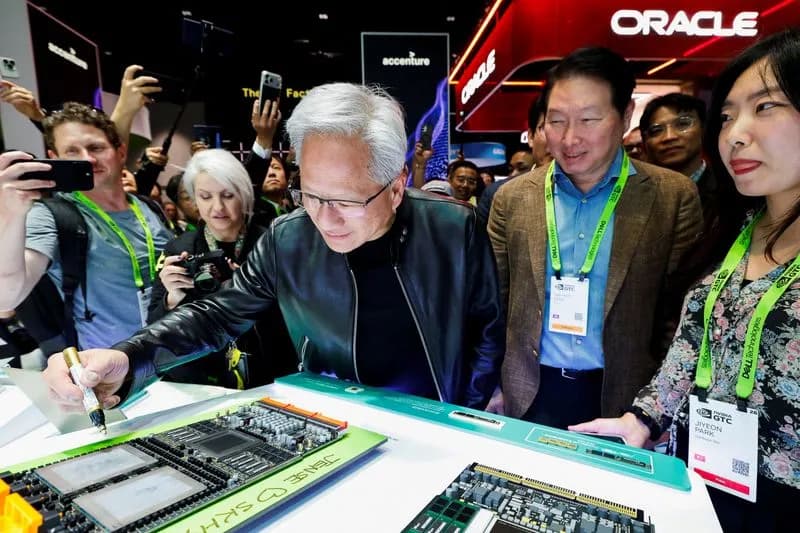
SAN JOSE, California — The head of South Korea's SK Group delivered one of the starkest warnings yet about the global semiconductor supply chain on Monday, telling reporters at Nvidia's GTC conference that the worldwide shortage of chip wafers is unlikely to ease before 2030.
SK Group Chairman Chey Tae-won, whose conglomerate controls SK Hynix — the world's largest supplier of high-bandwidth memory chips — said demand fueled by artificial intelligence continues to overwhelm the industry's ability to produce enough silicon wafers SK Group chairman says wafer shortage to last until 2030, trying to stabilise memory priceschannelnewsasia.com·SecondaryNVIDIA CEO Jensen Huang and SK Group Chairman Chey Tae-won attend the NVIDIA GTC global AI conference in San Jose, California, U.S. March 16, 2026. REUTERS/Fred Greaves SAN JOSE, California, March 16 : South Korea's SK Group Chairman Chey Tae-won said on Monday the global chip wafer shortage is likely to persist until 2030, as demand driven by artificial intelligence continues to outpace supply.. The remarks came on the sidelines of the annual gathering in San Jose, California, where chipmakers, cloud providers and AI developers converge to map the future of computing hardware.
A Deficit Measured in Years, Not Quarters
Chey framed the shortage not as a temporary dip but as a structural gap that will take years to close. He estimated the current wafer supply deficit exceeds 20 percent and said it will take at least four to five years to build enough new capacity to meet demand SK Group chairman says wafer shortage to last until 2030, trying to stabilise memory priceschannelnewsasia.com·SecondaryNVIDIA CEO Jensen Huang and SK Group Chairman Chey Tae-won attend the NVIDIA GTC global AI conference in San Jose, California, U.S. March 16, 2026. REUTERS/Fred Greaves SAN JOSE, California, March 16 : South Korea's SK Group Chairman Chey Tae-won said on Monday the global chip wafer shortage is likely to persist until 2030, as demand driven by artificial intelligence continues to outpace supply.. That timeline pushes any meaningful relief into 2030 at the earliest — a horizon far beyond the cyclical swings the memory industry has historically experienced.
The bottleneck traces directly to the explosive growth in high-bandwidth memory, or HBM, the specialized chips that power AI training clusters and inference servers. Chey explained that manufacturing HBM requires far more wafer material than conventional memory products, compounding the supply pressure SK Group chairman says wafer shortage to last until 2030, trying to stabilise memory priceschannelnewsasia.com·SecondaryNVIDIA CEO Jensen Huang and SK Group Chairman Chey Tae-won attend the NVIDIA GTC global AI conference in San Jose, California, U.S. March 16, 2026. REUTERS/Fred Greaves SAN JOSE, California, March 16 : South Korea's SK Group Chairman Chey Tae-won said on Monday the global chip wafer shortage is likely to persist until 2030, as demand driven by artificial intelligence continues to outpace supply.. SK Hynix commands a 57 percent share of the global HBM market and holds 32 percent of overall DRAM production, making it the second-largest DRAM producer worldwide according to industry tracker Counterpoint SK Group chairman says wafer shortage to last until 2030, trying to stabilise memory priceschannelnewsasia.com·SecondaryNVIDIA CEO Jensen Huang and SK Group Chairman Chey Tae-won attend the NVIDIA GTC global AI conference in San Jose, California, U.S. March 16, 2026. REUTERS/Fred Greaves SAN JOSE, California, March 16 : South Korea's SK Group Chairman Chey Tae-won said on Monday the global chip wafer shortage is likely to persist until 2030, as demand driven by artificial intelligence continues to outpace supply..
As the dominant HBM supplier to Nvidia — whose graphics processors underpin the vast majority of AI training infrastructure globally — SK Hynix sits at the epicenter of the shortage. Every new generation of Nvidia accelerators demands more memory bandwidth and, by extension, more wafers.
DRAM Price Stabilization and a Potential US Listing
Chey signaled that SK Hynix is preparing a strategy to stabilize DRAM chip prices, though he declined to reveal details at the conference. He indicated the company's chief executive would soon announce a new plan addressing pricing stability SK Group chairman says wafer shortage to last until 2030, trying to stabilise memory priceschannelnewsasia.com·SecondaryNVIDIA CEO Jensen Huang and SK Group Chairman Chey Tae-won attend the NVIDIA GTC global AI conference in San Jose, California, U.S. March 16, 2026. REUTERS/Fred Greaves SAN JOSE, California, March 16 : South Korea's SK Group Chairman Chey Tae-won said on Monday the global chip wafer shortage is likely to persist until 2030, as demand driven by artificial intelligence continues to outpace supply.. The comments suggest SK Hynix recognizes that the structural shortage, if left unmanaged, could drive volatility that hurts both producers and the downstream companies that depend on steady memory supply.
In a separate disclosure, Chey said SK Hynix is reviewing a potential listing of American Depositary Receipts in the United States SK Group chairman says wafer shortage to last until 2030, trying to stabilise memory priceschannelnewsasia.com·SecondaryNVIDIA CEO Jensen Huang and SK Group Chairman Chey Tae-won attend the NVIDIA GTC global AI conference in San Jose, California, U.S. March 16, 2026. REUTERS/Fred Greaves SAN JOSE, California, March 16 : South Korea's SK Group Chairman Chey Tae-won said on Monday the global chip wafer shortage is likely to persist until 2030, as demand driven by artificial intelligence continues to outpace supply.. Such a move would broaden the company's shareholder base beyond South Korea, giving American and international institutional investors direct access to one of the most strategically important semiconductor firms in the world. For a company whose products are essential to Nvidia, Microsoft, Google, Amazon and every other major AI platform operator, a US listing could unlock significant capital market advantages.
Chey also noted that escalating tensions in the Middle East have created difficulties for the group through higher energy prices, prompting SK to explore alternative energy sources SK Group chairman says wafer shortage to last until 2030, trying to stabilise memory priceschannelnewsasia.com·SecondaryNVIDIA CEO Jensen Huang and SK Group Chairman Chey Tae-won attend the NVIDIA GTC global AI conference in San Jose, California, U.S. March 16, 2026. REUTERS/Fred Greaves SAN JOSE, California, March 16 : South Korea's SK Group Chairman Chey Tae-won said on Monday the global chip wafer shortage is likely to persist until 2030, as demand driven by artificial intelligence continues to outpace supply.. Energy costs are a critical factor for semiconductor manufacturing, which requires enormous amounts of electricity and ultra-pure water.
Expansion Plans Focus on South Korea
When asked about expanding manufacturing overseas to ease the shortage, Chey indicated that SK Hynix would focus on building new fabrication facilities in South Korea for the time being. Industry reporting from the conference indicated the chairman cited energy supply and water access as the primary constraints on overseas expansion, rather than funding or government incentives. The remark underscores a reality that chipmakers worldwide are grappling with: building advanced semiconductor factories is no longer primarily a question of capital, but of securing the physical infrastructure to keep them running.
SK Hynix is already investing heavily in domestic capacity. The company's new fabrication complex in Yongin, south of Seoul, represents one of the largest semiconductor construction projects in the world. Samsung Electronics and Micron Technology are pursuing parallel expansions, but industry analysts note that even these combined efforts may not fully close the supply gap within the decade.
Industry Analysts See a Structural Shift
The semiconductor industry has long been characterized by boom-and-bust memory cycles, but several analysts who commented on Chey's remarks this week argued that the current situation represents something fundamentally different. Rather than a cyclical imbalance driven by overbuilding or demand drops, the shortage reflects a permanent reallocation of manufacturing capacity toward AI-specific products.
Memory vendors are increasingly locking in multi-year supply agreements for HBM, committing future production well in advance — a pattern more typical of strategic resource markets than of the historically volatile memory sector. Industry research published earlier this year projected that 2026 DRAM and NAND flash supply growth would come in well below historical averages, as Samsung, SK Hynix and Micron redirect cleanroom space toward higher-margin AI products.
The result is a two-tier market emerging across the enterprise landscape. Hyperscale cloud operators and sovereign AI infrastructure projects can secure supply early through long-term contracts, while mid-market enterprises face delayed access, reduced configuration options and higher costs. For companies planning server refreshes, AI pilots or data center expansions, the message from San Jose this week was sobering: memory constraints are not going away soon, and pricing will reflect that reality.
What Happens Next
SK Hynix shares rose 3.5 percent on Tuesday morning in Seoul following Chey's comments, outpacing the benchmark KOSPI index, which gained 3 percent SK Group chairman says wafer shortage to last until 2030, trying to stabilise memory priceschannelnewsasia.com·SecondaryNVIDIA CEO Jensen Huang and SK Group Chairman Chey Tae-won attend the NVIDIA GTC global AI conference in San Jose, California, U.S. March 16, 2026. REUTERS/Fred Greaves SAN JOSE, California, March 16 : South Korea's SK Group Chairman Chey Tae-won said on Monday the global chip wafer shortage is likely to persist until 2030, as demand driven by artificial intelligence continues to outpace supply.. The market reaction suggests investors view the prolonged shortage as favorable for SK Hynix's pricing power, even as it presents headwinds for the broader technology ecosystem.
The coming months will bring two developments worth watching closely. First, the promised DRAM price stabilization plan from SK Hynix's chief executive could reshape expectations across the memory market. Second, any concrete steps toward a US ADR listing would represent a significant strategic shift for a company that has remained primarily listed in Seoul.
For the global technology industry, Chey's warning carries implications that extend well beyond memory chips. If wafer supply remains constrained through 2030, the downstream effects will ripple through server pricing, cloud computing costs, smartphone production and the pace of AI deployment itself. The era of cheap, abundant memory may be over — replaced by a new reality in which access to advanced semiconductor capacity is as much a strategic asset as the software that runs on it.
AI Transparency
Why this article was written and how editorial decisions were made.
Why This Topic
The SK Group chairman's warning that chip wafer shortages will persist until 2030 is a top-tier technology and business story with far-reaching implications. SK Hynix is the world's dominant HBM supplier and Nvidia's primary memory partner — making this effectively a forecast about the entire AI hardware supply chain. The 20-percent supply deficit figure, combined with the four-to-five-year build-out timeline, gives enterprises, investors and policymakers a concrete planning horizon. The story also includes a potential US ADR listing and DRAM price stabilization strategy, adding market-moving dimensions beyond the core supply warning.
Source Selection
Primary sourcing is a Reuters wire report published via Channel News Asia on March 16-17, 2026, providing direct quotes from SK Group Chairman Chey Tae-won at Nvidia GTC in San Jose. Reuters is a Tier 1 wire service with established credibility for corporate and financial reporting. Additional context was drawn from TrendForce industry analysis and Computerworld reporting, both of which cite Reuters as the original source for Chey's remarks. Analyst perspectives from Greyhound Research, Gartner and IDC provide independent expert assessment of the supply shortage timeline.
Editorial Decisions
This article is based on remarks SK Group Chairman Chey Tae-won made to reporters on the sidelines of Nvidia GTC 2026 in San Jose on Monday, March 16. The primary source is Reuters reporting via CNA. Industry analyst commentary from Greyhound Research, Gartner and IDC is referenced for context on the structural nature of the shortage. Statistics on market share (HBM 57%, DRAM 32%) are attributed to Counterpoint as cited in the source material.
Reader Ratings
About the Author
Sources
- 1.channelnewsasia.comSecondary
- 2.channelnewsasia.comSecondary
- 3.i-invdn-com.investing.comSecondary
Editorial Reviews
1 approved · 0 rejectedPrevious Draft Feedback (1)
• depth_and_context scored 4/3 minimum: The article provides good background on the semiconductor supply chain, SK Hynix's role, and the impact of AI. However, it could benefit from briefly explaining the geopolitical factors (e.g., US-China tensions) influencing wafer manufacturing locations and potentially impacting supply chain resilience. • narrative_structure scored 5/3 minimum: The article has a clear lede, a well-defined nut graf, a logical flow, and a strong closing that summarizes the implications. The use of subheadings effectively breaks down the information and guides the reader. • analytical_value scored 4/3 minimum: The article goes beyond simply reporting facts and offers analysis of the structural shift in the semiconductor industry, the emergence of a two-tier market, and the implications for the broader technology ecosystem. It could strengthen this by exploring potential long-term consequences for innovation and competition. • filler_and_redundancy scored 3/2 minimum: While generally well-written, there's some minor redundancy in reiterating SK Hynix's market share and dominance in multiple paragraphs. Condense these points into a single, impactful statement early on to improve flow and conciseness. • language_and_clarity scored 4/3 minimum: The writing is generally clear and precise, although some technical jargon (e.g., 'DRAM,' 'NAND flash') might be overwhelming for a general audience. Consider adding brief explanations or linking to resources for readers unfamiliar with these terms. Avoid using vague terms like 'major AI platform operators' - be more specific. Warnings: • [article_quality] perspective_diversity scored 3 (borderline): While the article primarily relays Chey's statements, it includes quotes from industry analysts and mentions the impact on various stakeholders (cloud operators, mid-market enterprises). To improve, it could incorporate perspectives from companies *affected* by the shortage, such as those struggling to secure wafers or facing increased costs.


Discussion (0)
No comments yet.