South Africa police chief appears in court over disputed health-services contract
South Africa's police commissioner Fannie Masemola appeared in court on Tuesday over allegations tied to a 360 million-rand police health-services contract, opening a fresh test of how President Cyril Ramaphosa handles corruption claims at the top of the security apparatus.[1][2][3]
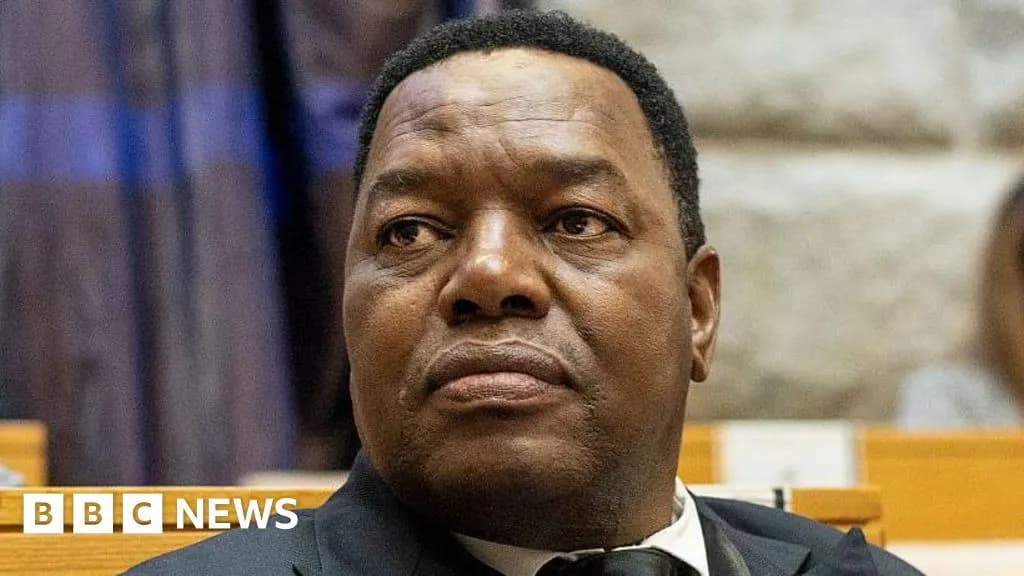
South Africa's national police commissioner, Fannie Masemola, appeared before the Pretoria Magistrate's Court on Tuesday in a case tied to an allegedly irregular 360 million-rand, or about $21 million, contract for health and well-being services for police officers. The appearance turns a long-running corruption controversy inside the South African Police Service into a direct institutional test for a government that has promised cleaner administration while still relying on senior officials who remain in office during investigations.
Masemola faces four counts under the Public Finance Management Act, the law that governs how public money and state contracts are handled in South Africa. Prosecutors and investigators are not accusing him, at least at this stage, of personally pocketing the contract proceeds; the core allegation is that he failed in the oversight duties attached to his office as accounting officer for the police service. That distinction matters politically because it lets his defenders frame the case as a dispute over managerial responsibility and procedure, while his critics will see it as further evidence that corruption inside the police ran high enough to reach the top command structure.
The contract at the center of the case was awarded in 2024 to Medicare24 Tshwane District, a company linked to businessman Vusimuzi Matlala, also known as Cat Matlala, and was meant to provide health-related services to police personnel. The deal was later cancelled, and the fallout widened well beyond one supplier after investigators and public inquiries began examining whether senior police officers colluded with contractors and whether bribes helped shape the tender process. AP reported that at least 12 other senior officers have already been arrested and charged, while the BBC said Masemola is expected to be joined to a broader case involving 16 other accused, including Matlala and several senior officers.
Tuesday's court appearance did not produce a plea from Masemola. He was formally charged after being summoned earlier this month, and the matter was postponed to 13 May, when his case is expected to proceed alongside the wider prosecution. If convicted on the counts now before the court, AP said he could face a fine or up to five years in prison. Even at this early stage, the optics are damaging: South Africa's serving police chief is now defending his own conduct in a criminal courtroom while still formally heading the service that is supposed to enforce the law.
Masemola has rejected the allegations and told reporters after the hearing that he believes he is not guilty and has done nothing wrong. He also played down demands that he step aside, saying the decision on his future rests with President Cyril Ramaphosa and that he was continuing with his duties. That line will resonate with those who argue that South Africa should not normalize removing officeholders before a full legal process is complete, especially in a country where politically charged prosecutions and factional fights have often overlapped.
The opposing case is equally straightforward. South Africa has spent years trying to show that its anti-corruption drive can reach politically connected figures rather than only lower-level offenders. In that context, allowing the national police commissioner to remain in office while facing criminal charges tied to contract oversight risks feeding the public view that one standard applies to ordinary officials and another to the people at the top of the state security hierarchy. The fact that the case sits alongside a broader commission of inquiry and parliamentary scrutiny only raises the stakes for the presidency.
Ramaphosa's office has so far taken a careful institutional line, saying the president has noted the charges and will address the matter in accordance with the law. That wording is politically cautious and legally defensible, but it also postpones the real decision: whether South Africa's reform message is better served by keeping a sitting commissioner in place until guilt is proven, or by temporarily removing him in order to protect the credibility of the police service while the courts do their work. Neither option is cost-free. A suspension could look like executive interference if done clumsily; inaction could look like tolerance for a compromised command structure.
The case also lands in a police service already under unusual pressure. The allegations around the Medicare24 contract have fed a larger inquiry established by Ramaphosa last year to examine claims of corruption inside the force. South African lawmakers have separately examined parts of the scandal. That means Masemola's hearing is not an isolated embarrassment but part of a wider reckoning over whether the country's police leadership can convincingly claim to be restoring order while its own procurement culture is under criminal and political review.
History makes the symbolism worse. The BBC noted that Masemola is the third South African police chief to face a criminal investigation while in office. One predecessor, Jackie Selebi, was ultimately convicted and imprisoned after a bribery case, while another, Khomotso Phahlane, also faced corruption cases that remained entangled in court after charges were first withdrawn and later revived.South Africa's police boss charged in connection with controversial health contractbbc.com·SecondarySouth Africa's police chief has been formally charged with failing in his duties to provide proper oversight in his role following a health contract that has become the subject of a criminal investigation. General Fannie Masemola, 62, was summoned to court over his alleged part in the awarding of a controversial $21m (£15.5m) tender, which has since been cancelled. South Africans therefore have reason to treat official assurances cautiously: this is no longer a one-off scandal, but part of a recurring pattern in which the office charged with policing corruption repeatedly ends up touched by it.South Africa's police boss charged in connection with controversial health contractbbc.com·SecondarySouth Africa's police chief has been formally charged with failing in his duties to provide proper oversight in his role following a health contract that has become the subject of a criminal investigation. General Fannie Masemola, 62, was summoned to court over his alleged part in the awarding of a controversial $21m (£15.5m) tender, which has since been cancelled.
What happens next is likely to matter as much as the legal merits of the four counts. Prosecutors still have to show that failures of oversight crossed the threshold into criminal liability, and Masemola will argue that the tender scandal should not be collapsed into personal guilt before the evidence is tested in court. But the broader political question is already live. If the government wants to persuade voters and investors that South Africa's institutions can discipline themselves, it will have to show that due process is real, that accountability reaches the top, and that anti-corruption language is not just for speeches after the fact.
AI Transparency
Why this article was written and how editorial decisions were made.
Why This Topic
This is the strongest distinct story on the board because it combines immediate timeliness, clear public-interest stakes and a high-level rule-of-law question. A sitting national police commissioner appearing in court over a multimillion-dollar state contract is materially more consequential than an analyst market note and more news-driven than the broader China-chips feature. The story also gives room for balanced treatment of due process versus institutional credibility, which fits the CT Editorial Board mandate.
Source Selection
The cluster has three aligned, current sources with strong factual overlap: BBC for the legal framing and historical context, AP for the formal charges, contract value, possible penalty and presidency response, and ABC's AP pickup as a confirming cross-check. I kept numbered citations tied strictly to those attached signals and avoided unsupported outside details from follow-up reporting. The sourcing is therefore strong enough for a legally sensitive accountability story without leaning on speculative commentary.
Editorial Decisions
This piece treats the case as both a legal proceeding and an institutional test. The tone stays descriptive and skeptical without presuming guilt. It gives Masemola's denial and due-process case genuine space, while also explaining why critics see continued tenure as a credibility problem for a police service already under corruption scrutiny. No loaded framing, no activist language, and no unsupported embellishment beyond the cluster record.
Reader Ratings
About the Author
Sources
- 1.bbc.comSecondary
- 2.apnews.comSecondary
- 3.abcnews.comUnverified
Editorial Reviews
1 approved · 0 rejectedPrevious Draft Feedback (1)
• depth_and_context scored 4/3 minimum: The article does a good job of situating the case within the broader context of South Africa's anti-corruption efforts and the history of police leadership scandals. To improve, it could briefly explain the specific legal mechanism or implications of the Public Finance Management Act (PFMA) failure in this context, rather than just naming the act. • narrative_structure scored 4/3 minimum: The structure is strong, moving logically from the immediate event (the court appearance) to the legal details, the political implications, and finally to historical context and future outlook. The lede is effective, immediately establishing the stakes. • analytical_value scored 5/3 minimum: This is the article's strongest point; it consistently interprets the legal and political significance of the events, moving beyond mere reporting to analyze the implications for governance and institutional credibility. No remediation is needed. • filler_and_redundancy scored 5/2 minimum: The writing is dense with necessary context and analysis, and the repetition of key facts (like the charges or the political tension) serves to reinforce the stakes rather than padding the length. The article is highly efficient. • language_and_clarity scored 4/3 minimum: The prose is highly professional, precise, and engaging, avoiding clichés and passive voice overuse. To reach a 5, the author should ensure that when discussing the 'reform message,' they attribute the source of this 'message' more clearly (e.g., 'according to government officials' or 'as stated by the Presidency'). Warnings: • [article_quality] perspective_diversity scored 3 (borderline): The article effectively presents the opposing views (critics vs. defenders) regarding Masemola's role. However, it could strengthen this by including a direct quote or perspective from a key anti-corruption watchdog or civil society group to balance the government/legal framing.


Discussion (0)
No comments yet.