South African court sentences Julius Malema to five years over 2018 rifle incident
A court in KuGompo City sentenced EFF leader Julius Malema to five years over a 2018 rally shooting incident, with his lawyers immediately seeking leave to appeal.
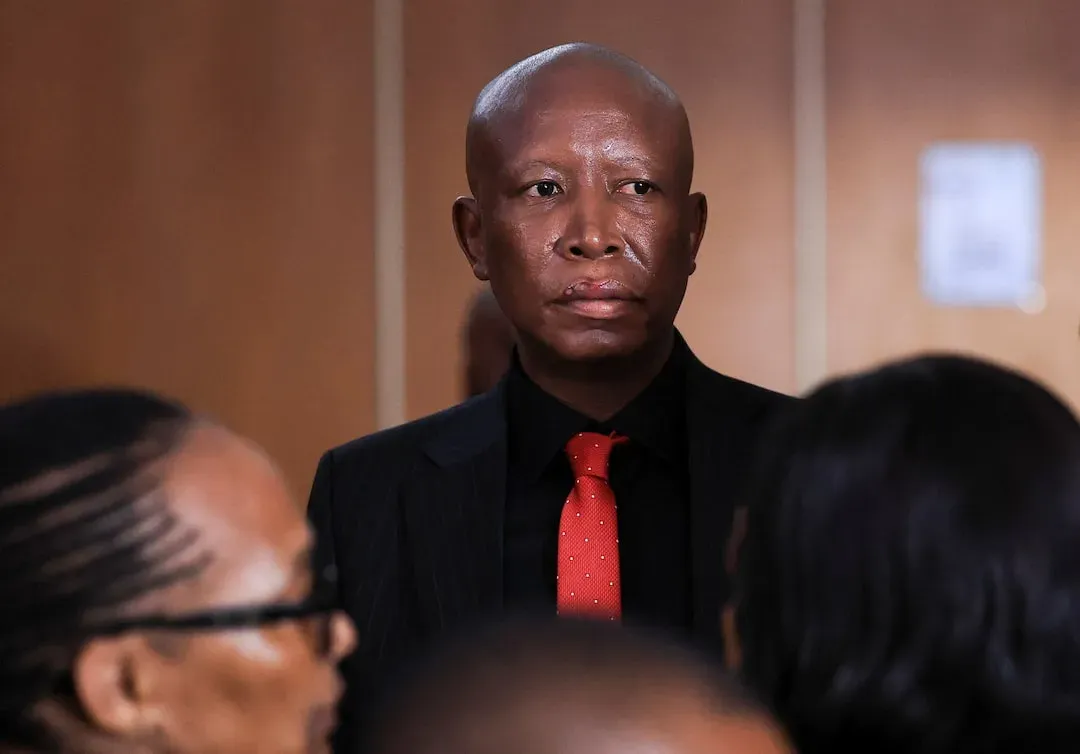
Julius Malema walked into court on Thursday as one of South Africa’s most recognisable opposition figures and walked out facing a five-year prison sentence that could, if upheld on appeal, reshape both his political future and the balance of South African opposition politics. The East London Regional Court in KuGompo City, where Magistrate Twanet Olivier delivered sentence, was not ruling on a fresh accusation but on a long-running case arising from a 2018 Economic Freedom Fighters anniversary rally at which Malema was filmed firing a semi-automatic rifle into the air.
The court’s decision followed Malema’s conviction last year on multiple firearm-related counts, including unlawful possession of a firearm and ammunition, discharging a firearm in a public place and reckless endangerment. Prosecutors argued that the video showed a deliberate breach of gun laws rather than a harmless spectacle for supporters, while Malema’s side maintained that the act was celebratory, that the weapon was not his, and that the case had political overtones because it grew from a complaint lodged by AfriForum, an Afrikaner civil-rights lobby group that has repeatedly clashed with him and his party.
Olivier’s remarks made clear that the court wanted to underline the public-safety dimension rather than treat the episode as theatrical politics. Reuters, the BBC and AP all reported her conclusion that the shooting was not an impulsive flourish but a central moment of the event, and AP quoted her warning that South Africans regularly hear of stray gunfire injuring or killing bystanders, making claims of “celebratory shots” a poor answer to the risks involved. That framing matters because it places the judgment inside a wider South African debate over law enforcement, public order and whether politically connected figures are ever really held to the same standard as ordinary citizens.
Malema’s legal team moved quickly. Within minutes of sentence, his lawyers applied for leave to appeal, according to Reuters, the BBC and Al Jazeera, a procedural step that could delay any immediate prison term and postpone the larger constitutional and parliamentary questions hanging over the case. Those questions are not trivial. A sentence of more than 12 months, if it survives the appeals process, could disqualify Malema from serving as a member of parliament, depriving the Economic Freedom Fighters of its most effective campaigner and its dominant public voice. Reuters noted that the EFF is the fourth-largest party in parliament, with support concentrated among younger voters angered by persistent racial inequality and slow economic change more than three decades after the end of apartheid.South African politician Julius Malema given five-year jail term for gun offencetheguardian.com·SecondaryLeader of leftwing Economic Freedom Fighters was convicted last year for firing rifle in the air at 2018 rally The South African leftwing politician Julius Malema has been sentenced to five years in prison for firing a rifle in the air at a political rally in 2018. Lawyers for the leader of the Economic Freedom Fighters, South Africa’s fourth largest political party, immediately sought leave to appeal. Legal arguments are ongoing.
That political context explains why the case has never been viewed as a routine firearm prosecution. Malema remains one of the country’s most polarising politicians: admired by supporters as a blunt spokesman for radical economic redistribution and black political assertion, and regarded by critics as a demagogue who courts instability, racial tension and spectacle. The EFF has built much of its identity around his confrontational style, his calls for expropriation of white-owned land without compensation and the nationalisation of mines and banks, and his claim that South Africa’s post-apartheid settlement has left economic power too concentrated in old hands. For supporters gathered outside court in red party colours, the sentencing was therefore not just a legal setback but a test of whether an establishment they distrust is trying to sideline their movement through the courts.A court in South Africa has sentenced opposition politician Julius Malema to five years in prison over a 2018 rally firearms incidentdw.com·SecondarySouth African opposition politician Julius Malema was sentenced on Thursday to five years in prison for firing a rifle into the air at a political rally in 2018. The case stems from an incident at an Economic Freedom Fighters political rally that year. Malema was convicted in October of unlawfully possessing a firearm and firing a weapon in a public place. Prosecutors said he discharged a rifle into the air during the rally.
The EFF and Malema have leaned into that interpretation for months. Al Jazeera reported that party supporters threatened protests if their leader were jailed, and Reuters noted that Malema had pleaded not guilty and continued to cast the proceedings as part of a politically loaded fight rather than a neutral application of criminal law. BBC reporting recalled his declaration after the conviction last October that prison or even death should be understood as part of a political struggle, language designed to place the case inside a broader revolutionary narrative rather than a narrow legal one. That rhetoric appeals to supporters who see state institutions as inconsistent, but it also reinforces the prosecution’s argument that this was not an accidental lapse but an act performed with full awareness of its symbolic force.A court in South Africa has sentenced opposition politician Julius Malema to five years in prison over a 2018 rally firearms incidentdw.com·SecondarySouth African opposition politician Julius Malema was sentenced on Thursday to five years in prison for firing a rifle into the air at a political rally in 2018. The case stems from an incident at an Economic Freedom Fighters political rally that year. Malema was convicted in October of unlawfully possessing a firearm and firing a weapon in a public place. Prosecutors said he discharged a rifle into the air during the rally.
Critics of Malema, meanwhile, will see Thursday’s ruling as overdue proof that prominence does not excuse conduct that would expose ordinary South Africans to immediate arrest. AP’s account underscored the magistrate’s stress on the country’s ongoing problem with random gunfire and public endangerment. From that perspective, the court was not criminalising politics; it was policing conduct. AfriForum’s involvement will remain controversial, especially given its history of conflict with Malema over race, speech and land, but the court explicitly sought to separate the complainant’s politics from the judge’s reasoning. Olivier said, in essence, that a person had been convicted for actions on a particular day, not a political party for its ideology. South African politician Julius Malema jailed for 5 years for firing rifle shots at rallyabcnews.com·UnverifiedA South African opposition party leader, Julius Malema, has been sentenced to five years in prison for breaking firearm laws JOHANNESBURG -- A South African opposition party leader, Julius Malema, was sentenced to five years imprisonment on Thursday, after he was convicted of breaking firearm laws by firing a rifle at a political rally in 2018.
There is also a broader institutional angle. South Africa’s democracy has often been tested by the question of whether courts can act independently when cases involve powerful figures, especially those able to mobilise crowds and frame prosecution as persecution. For the judiciary, a soft sentence might have invited charges of weakness; for Malema’s supporters, a prison term confirms suspicion of selective enforcement. Both readings can coexist. It is entirely possible for the state to have a legally solid case and for political actors to exploit it for factional gain. That is why appeals will matter so much. Higher courts will not only examine the sentence’s legal basis; they will also be deciding, indirectly, how much room South African politics leaves for performative militancy before it collides with criminal liability.
The case also lands at a moment when Malema’s image extends beyond domestic politics. AP noted that he featured in a video shown by U.S. President Donald Trump during a tense White House meeting with South African President Cyril Ramaphosa last year, a reminder that Malema’s incendiary public persona has become a reference point in international arguments about South Africa, race and political violence. That global notoriety strengthens his reach but increases the stakes when domestic courts move against him. Any eventual imprisonment would be read not just as a local legal outcome, but as a test of how the post-apartheid state handles one of its loudest anti-establishment figures.South African politician Julius Malema given five-year jail term for gun offencetheguardian.com·SecondaryLeader of leftwing Economic Freedom Fighters was convicted last year for firing rifle in the air at 2018 rally The South African leftwing politician Julius Malema has been sentenced to five years in prison for firing a rifle in the air at a political rally in 2018. Lawyers for the leader of the Economic Freedom Fighters, South Africa’s fourth largest political party, immediately sought leave to appeal. Legal arguments are ongoing.
For now, the immediate reality is narrower and more uncertain. Malema has been sentenced, not politically erased. His appeal bid means the prison term is unlikely to be the final word, and South African politics has a long history of dramatic courtroom moments that later mutate into years of litigation and campaigning. Yet Thursday’s judgment still marks a serious turning point. It puts legal jeopardy where political theatre once dominated, forces the EFF to contemplate a future in which its founder could be sidelined, and reminds South Africans that the line between symbolic provocation and punishable conduct is not always drawn by the crowd at a rally but by the bench in a courtroom.
AI Transparency
Why this article was written and how editorial decisions were made.
Why This Topic
This is a major political-law story in South Africa because it concerns one of the country’s best-known opposition leaders, a prison sentence that could affect parliamentary eligibility, and a dispute that touches race, public order, populist politics and judicial independence. It is fresher and more consequential than a standard celebrity or crime brief, and it has clear international reader value because Malema has become a globally recognised figure in debates over South African politics.
Source Selection
The source base combines Reuters, BBC, Al Jazeera and AP, giving a mix of wire reporting, broadcaster reporting and international analysis. Across those four outlets, the core facts align on the sentence, the 2018 incident, the counts involved, the immediate appeal move and the possible consequences for Malema’s parliamentary status. Using multiple independent reports also helps balance the court’s reasoning with Malema’s own defence and the EFF’s political interpretation of the case.
Editorial Decisions
Descriptive headline. Balanced framing: legal basis of sentence, Malema/EFF claim of politicisation, and court/public-safety rationale all included. Avoided loaded descriptors beyond source-attributed ideological labels where essential for context.
Reader Ratings
About the Author
Sources
- 1.theguardian.comSecondary
- 2.dw.comSecondary
- 3.abcnews.comUnverified
- 4.dw.comSecondary
- 5.apnews.comSecondary
- 6.bbc.comSecondary
- 7.aljazeera.comSecondary
Editorial Reviews
1 approved · 0 rejectedPrevious Draft Feedback (4)
• depth_and_context scored 5/3 minimum: The article excels by providing extensive background, detailing the 2018 incident, the nature of the charges, and the broader political context (EFF's identity, post-apartheid tensions). It clearly explains *why* this case matters beyond the immediate sentence. • narrative_structure scored 4/3 minimum: The structure is strong, moving logically from the immediate event (the sentence) to the background, the political implications, and finally to the broader institutional and international context. It could benefit from a slightly punchier nut graf to synthesize the core conflict earlier, but the overall arc is very effective. • perspective_diversity scored 5/3 minimum: The piece masterfully presents multiple viewpoints: the court's focus on public safety, the EFF/Malema's view of political persecution, the critics' view of overdue accountability, and the institutional view of judicial independence. This balance is excellent. • analytical_value scored 5/3 minimum: The article consistently interprets the events, moving beyond mere reporting to analyze the implications for South African democracy, the role of the judiciary, and the future of the EFF. The analysis is sophisticated and well-supported. • filler_and_redundancy scored 4/2 minimum: The piece is dense with necessary context and analysis, making it feel substantial rather than padded. The minor deduction is because the concluding paragraphs slightly reiterate the 'turning point' idea without adding new analytical weight, but this is a very minor structural critique. • language_and_clarity scored 5/3 minimum: The writing is crisp, authoritative, and highly engaging. It avoids generic phrasing and handles politically charged language by describing the *actions* and *policies* (e.g., 'calls for expropriation of white-owned land') rather than relying on reductive labels.
Rejected after 3 review rounds. 1 gate errors: • [image_relevance] Image alt_accuracy scored 2/3 minimum: The alt text describes a supporter holding a placard, but the visible image does not clearly show a placard or the specific setting described. This mismatch lowers the accuracy score.
2 gate errors: • [structure] Article must not contain a 'Sources' or 'References' section. Sources are linked structurally from the cluster's signals and rendered separately by the frontend. • [publication_readiness] Article contains a Sources/References/Bibliography section — sources are handled structurally by the platform. Remove the section.
2 gate errors: • [structure] Article must not contain a 'Sources' or 'References' section. Sources are linked structurally from the cluster's signals and rendered separately by the frontend. • [publication_readiness] Article contains a Sources/References/Bibliography section — sources are handled structurally by the platform. Remove the section.