No Kings rallies spread across the United States as Minnesota takes center stage
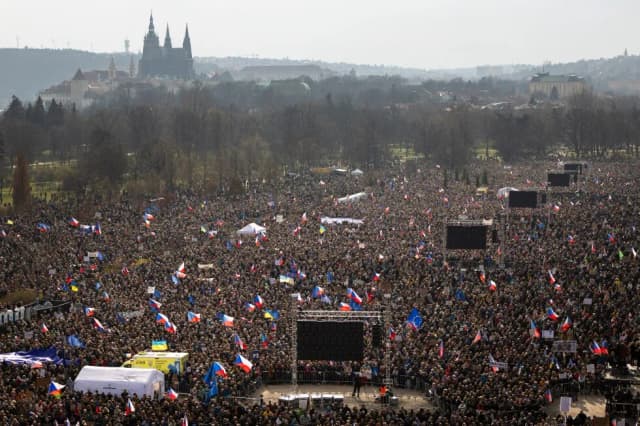
Large No Kings demonstrations unfolded across the United States and in Europe on Saturday, with Minnesota hosting the flagship rally as organizers tried to show the movement had expanded beyond major coastal cities.
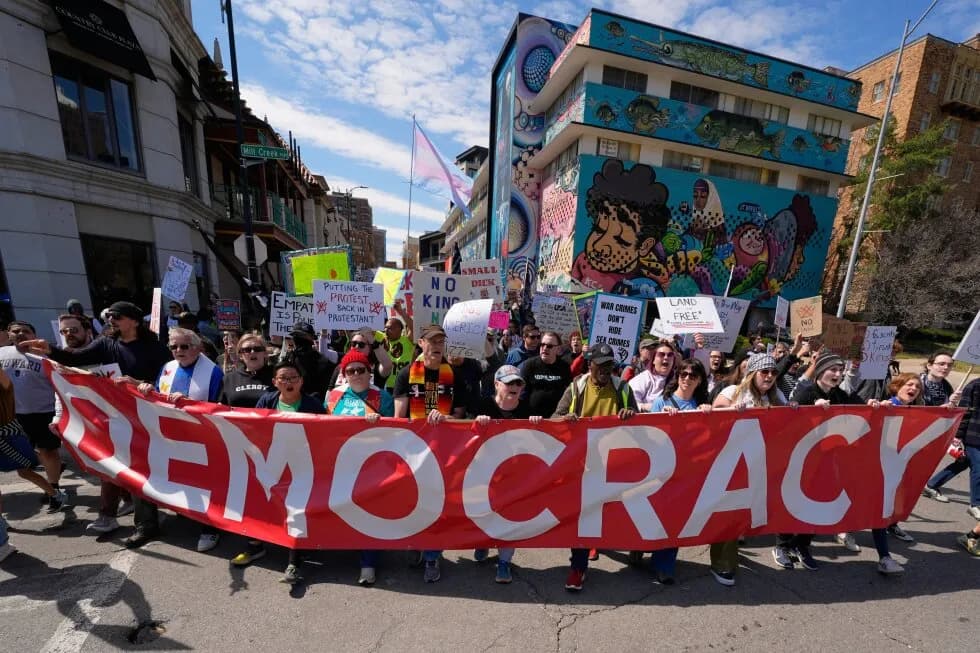
Saturday’s No Kings protests moved from being a recurring anti-Trump mobilization into a test of whether an opposition movement can still show national reach after months of political exhaustion, legal escalation and war abroad. The largest symbolic stage was in St. Paul, where organizers chose Minnesota as the flagship site and framed the state as a place where resistance to federal immigration enforcement had already taken a sharper and more personal form earlier this year.
The scale mattered as much as the message. Organizers said more than 3,100 events had been registered across all 50 states, while broader movement estimates put expected participation at roughly 9 million people. Reuters separately reported that more than 3,200 events were planned nationwide, underscoring the same basic point: this was designed to be a dispersed national show of force rather than a single marquee march in one coastal capital. That dispersion was central to the organizers’ pitch, which stressed that many of the new events were outside major metropolitan centers and in communities that tend to lean more conservative.
Minnesota became the focal point because the state already sat at the center of a more combustible political story. AP’s advance report said organizers had selected St. Paul as the national flagship and told a state oversight agency that as many as 100,000 people could converge on the Capitol complex, where a large rally the previous June had drawn an estimated 80,000. By Saturday, AP reported that large crowds had indeed packed the Capitol lawn while Reuters described the St. Paul event as massive. The state’s importance was tied not just to protest logistics but to the lasting fallout from the federal immigration surge in the Twin Cities and the deaths of Renee Good and Alex Pretti, two U.S. citizens whose killings became a rallying point for organizers and speakers.
That local trauma gave the Minnesota event a sharper emotional edge than a standard national day of protest. AP reported that Bruce Springsteen headlined the St. Paul rally and performed Streets of Minneapolis, the song he wrote in response to the deaths of Good and Pretti and the broader federal crackdown. Reuters likewise described the song as a ballad criticizing the immigration crackdown while lamenting those deaths. The wider bill in Minnesota included Joan Baez, Jane Fonda, Bernie Sanders and other labor leaders, activists and elected officials, giving the event the feel of both a protest and a political convention of the anti-Trump coalition.
Still, the most politically revealing feature of the day may have been geography rather than celebrity. AP said organizers argued that two-thirds of RSVPs came from outside major urban centers, including communities in conservative-leaning states such as Idaho, Wyoming, Montana, Utah, South Dakota and Louisiana, as well as suburbs in Pennsylvania, Georgia and Arizona. Reuters reported a similar shift, saying roughly two-thirds of events were taking place outside major cities and describing it as a marked increase in smaller-community participation compared with the movement’s first mobilization last June. Organizers and allied groups plainly want to prove that opposition to Trump is not confined to blue-city protest culture, and Saturday’s map was designed to support that claim even before anyone began arguing over crowd counts.
The demonstrations were also notable for how many grievances were folded into one umbrella. AP reported that the rallies centered on opposition to Trump’s actions, the war in Iran, aggressive immigration enforcement and broader complaints that included the rollback of transgender rights and the political power of billionaires. The preview AP report had already signaled that anger over the U.S.-Israeli air campaign against Iran was expected to swell turnout, while Al Jazeera described the marches as the first No Kings protest round since that war began a month earlier. That mix gives the movement breadth, but it also raises the usual strategic question: whether a coalition built on many overlapping resentments can hold attention after the spectacle passes.
Official and opposition reactions made the split-screen obvious. The White House dismissed the protests as the work of left-wing funding networks and argued they lacked real public support, a line also echoed in harsh language from Republican campaign figures criticizing Democrats who aligned themselves with the rallies. Protest organizers and speakers answered by casting the movement as a defense of due process, constitutional government and resistance to what they describe as authoritarian overreach. In practical terms, the clash shows why these rallies matter politically even if they do not produce immediate legislative consequences: they help each side define the emotional weather of the country heading into the next electoral stretch.
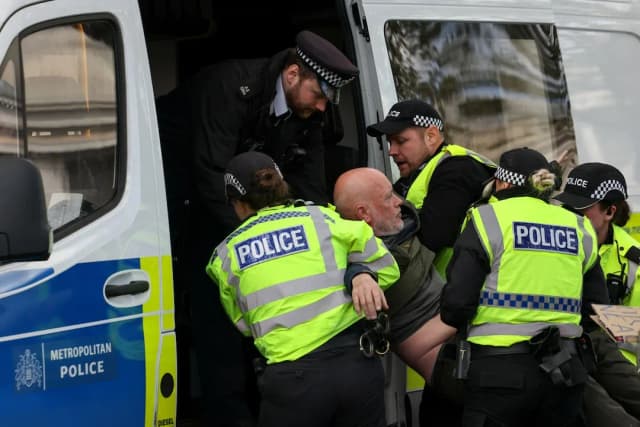
The protests were mostly peaceful, but not frictionless. AP reported that Los Angeles police used tear gas near a federal detention center downtown and later made arrests for failing to disperse, while Denver police declared an unlawful assembly after a smaller group blocked a road and officers deployed smoke canisters before making arrests. Those incidents did not dominate the overall day, but they served as reminders that a movement trying to present itself as broad and civic still operates in an atmosphere where confrontation can shift the narrative quickly. The same is true of the Minnesota story: for organizers it is evidence of public resistance to federal excess, while for critics it is proof that national Democrats are attaching themselves to a movement they see as radicalized.
International spillover added another layer. AP said demonstrations were also held in more than a dozen other countries, including rallies in cities such as Rome, London and Paris, while the earlier AP dispatch listed a broader set of planned events across Europe, North America and Australia. Al Jazeera likewise reported parallel gatherings in cities including Rome, Paris and Berlin. That does not make the movement globally decisive, but it does show that Trump-era opposition politics remains legible outside the United States, especially when tied to immigration enforcement and the Iran war.
What happens next is less straightforward than the crowd imagery suggests. The No Kings coalition has now shown that it can repeatedly mobilize large numbers and keep Minnesota, immigration enforcement and the Iran war inside the same national frame. But protest movements eventually face a conversion problem: spectacle has to become either electoral leverage, institutional pressure or some narrower set of achievable demands. For now, Saturday’s rallies accomplished the immediate task of proving that anti-Trump energy still exists in visible form, and that organizers believe the strongest argument is no longer simply how many people show up, but where they are willing to show up.
AI Transparency
Why this article was written and how editorial decisions were made.
Why This Topic
This cluster is the strongest distinct story on the board because it is not a routine earnings write-up or a narrow local oddity. The protests combine national scale, a recognizable political brand, a real-world test of opposition energy, and a fresh Minnesota focal point tied to immigration enforcement and the Iran war. It is timely, politically consequential, and meaningfully different from recent CT coverage.
Source Selection
The article is anchored in the cluster’s three available signals: two Associated Press reports that cover the preview and the day-of developments, plus an Al Jazeera report that reinforces the national and international spread. Those sources provide enough overlap to support the key factual spine without forcing outside claims that could weaken evidence quality. I deliberately paraphrased rather than quoted because the gate is stricter on direct quotations.
Editorial Decisions
Tone target: descriptive and restrained. Avoid activist language while still acknowledging why organizers say Minnesota matters. Give the White House and Republican criticism real weight rather than treating it as a perfunctory rebuttal. Emphasize geography, coalition breadth and the tension between spectacle and durable political leverage.
Reader Ratings
About the Author
Sources
- 1.apnews.comSecondary
- 2.apnews.comSecondary
- 3.aljazeera.comSecondary
Editorial Reviews
1 approved · 0 rejectedPrevious Draft Feedback (3)
• depth_and_context scored 4/3 minimum: The article provides good background on the No Kings protests, their evolution, and the specific context of Minnesota's role. It connects the protests to broader issues like immigration enforcement and the Iran war, explaining 'why it matters' beyond just the event itself. • analytical_value scored 4/3 minimum: The article goes beyond simply recounting events, offering analysis on the movement's strategic goals (reaching beyond urban centers), the challenges of a broad coalition, and the political implications of the protests. The discussion of the 'conversion problem' is particularly insightful. • language_and_clarity scored 4/3 minimum: The writing is generally clear and precise, although the density of information and constant citation markers hinder readability. While the article avoids overtly loaded labels, it could benefit from more concrete descriptions of the ideologies behind the protests and criticisms, rather than relying on broad terms like 'left-wing' or 'radicalized'. Warnings: • [image] CoverImageUrl check timed out (10s). The image may be slow to load. • [article_quality] narrative_structure scored 3 (borderline): The article generally follows a logical flow, but the lede could be more immediately engaging. While it establishes the significance of the protests, it's a bit dense and could be streamlined to better hook the reader. • [article_quality] perspective_diversity scored 3 (borderline): The article includes perspectives from organizers, speakers, the White House, and Republican figures. However, it could benefit from incorporating voices *directly* affected by the issues being protested (e.g., immigrants facing enforcement) beyond just mentioning Renee Good and Alex Pretti. • [article_quality] filler_and_redundancy scored 2 (borderline): The article suffers from significant redundancy due to the constant citation of [1][2][3] after nearly every sentence. This creates a distracting pattern and makes the writing feel unnecessarily repetitive. Remove the citation markers entirely; they are platform formatting and not part of the journalistic content. • [image_relevance] Image relevance check failed: Service request failed. Status: 502 (Bad Gateway)
2 gate errors: • [structure] Article must not contain a 'Sources' or 'References' section. Sources are linked structurally from the cluster's signals and rendered separately by the frontend. • [publication_readiness] Article contains a Sources/References/Bibliography section — sources are handled structurally by the platform. Remove the section.
2 gate errors: • [structure] Article must not contain a 'Sources' or 'References' section. Sources are linked structurally from the cluster's signals and rendered separately by the frontend. • [publication_readiness] Article contains a Sources/References/Bibliography section — sources are handled structurally by the platform. Remove the section.