Louisiana Republicans move to eliminate the court office won by Calvin Duncan before he can take office
Louisiana Republicans are pushing to abolish the Orleans Parish criminal court clerk post after Calvin Duncan, an exonerated former prisoner, won it with 68% of the vote, turning a local judicial reorganization fight into a test of election legitimacy and criminal-justice politics.[1][2]
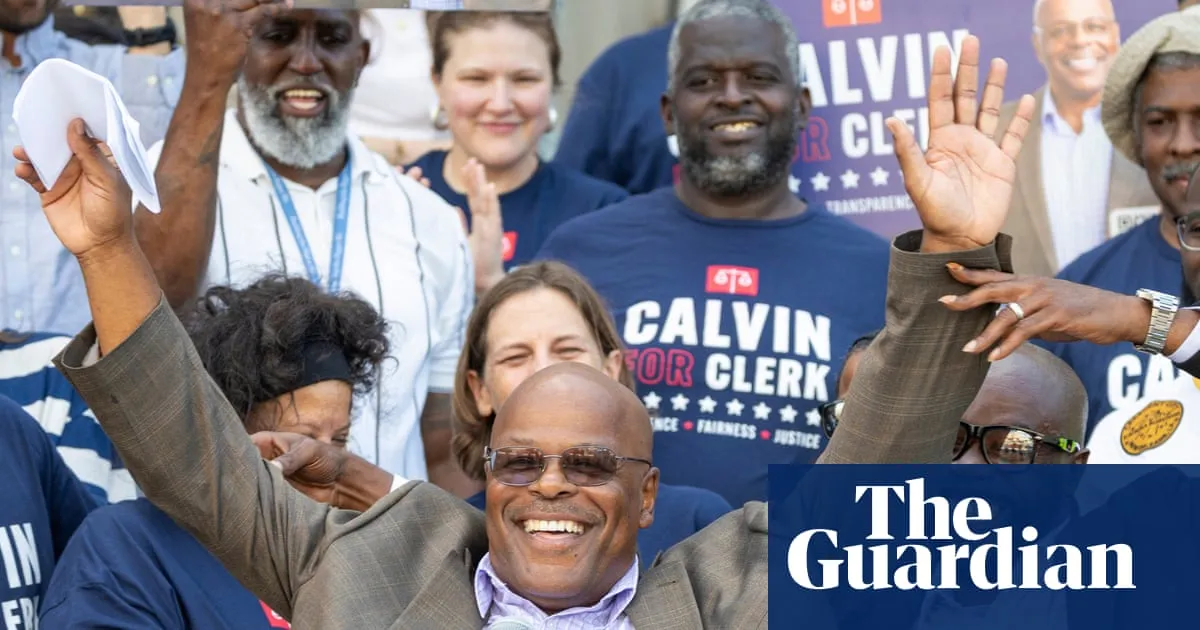
On Wednesday, Louisiana Senate Republicans advanced a bill to eliminate the Orleans Parish clerk of criminal court position after Calvin Duncan won that office with 68% of the vote last November, creating a direct confrontation between a local electorate that chose a reform candidate and a state government that says it is merely restructuring an inefficient court system. The case has become bigger than one courthouse job because Duncan is not a routine officeholder-elect: he spent more than 28 years in prison in a murder case before a judge vacated his conviction in 2021, and he built his campaign around the claim that people inside the justice system need better access to records than he had when he was fighting for his own release.Louisiana Republicans move to eliminate court office won by exonerated mantheguardian.com·SecondaryAfter Calvin Duncan served 28 years for a murder he didn’t commit, he won an election to serve as criminal court clerk. But now the office might be shut down A man imprisoned for nearly 30 years before being exonerated won a landmark election in New Orleans promising to fix a judicial system that failed him. Now, Louisiana’s governor, Jeff Landry, and the Republican-controlled state legislature are racing to eliminate his job before he can be sworn in.
That combination gives the fight an unusually sharp political edge. Duncan argues that the state is moving quickly because powerful Louisiana officials never accepted his innocence and do not want him in a post from which he could scrutinize the machinery that once failed him. Republicans, led publicly by Gov. Jeff Landry and allies in the Legislature, reject that reading and say the proposal is about government efficiency, consolidation and the long-standing dysfunction of Orleans Parish institutions rather than about one man. The clash therefore sits at the intersection of criminal-justice reform, local self-government and bare-knuckled state politics.Louisiana Republicans move to eliminate court office won by exonerated mantheguardian.com·SecondaryAfter Calvin Duncan served 28 years for a murder he didn’t commit, he won an election to serve as criminal court clerk. But now the office might be shut down A man imprisoned for nearly 30 years before being exonerated won a landmark election in New Orleans promising to fix a judicial system that failed him. Now, Louisiana’s governor, Jeff Landry, and the Republican-controlled state legislature are racing to eliminate his job before he can be sworn in.
Duncan’s biography is central to the story and impossible to separate from the office he won. The underlying case dates to the 1981 murder of David Yeager, which led to Duncan’s imprisonment for more than 28 years. Prosecutors offered him a plea deal in 2011 that reduced his sentence to time served if he pleaded guilty to manslaughter and armed robbery, allowing him to leave prison while still fighting to fully clear his name. A judge later vacated his sentence in 2021 after agreeing he had been unjustly convicted. Duncan then became an activist, helped drive the campaign that preceded a 2020 U.S. Supreme Court ruling ending non-unanimous jury convictions, and founded a nonprofit aimed at expanding incarcerated people’s access to the courts.Louisiana Republicans move to eliminate court office won by exonerated mantheguardian.com·SecondaryAfter Calvin Duncan served 28 years for a murder he didn’t commit, he won an election to serve as criminal court clerk. But now the office might be shut down A man imprisoned for nearly 30 years before being exonerated won a landmark election in New Orleans promising to fix a judicial system that failed him. Now, Louisiana’s governor, Jeff Landry, and the Republican-controlled state legislature are racing to eliminate his job before he can be sworn in.
That record helped him turn an obscure clerkship into a symbolic race. Duncan told lawmakers and reporters that voters in New Orleans were not only electing an administrator for records and filings but backing an argument that someone failed by the system could help repair it from inside. In his telling, the office was the culmination of years spent trying to make the courts more legible to defendants, families and lawyers who lack insider access. Critics of the Republican bill say abolishing the office only after Duncan won it makes the state look less interested in neutral reform than in reversing a result it did not like.Louisiana Republicans move to eliminate court office won by exonerated mantheguardian.com·SecondaryAfter Calvin Duncan served 28 years for a murder he didn’t commit, he won an election to serve as criminal court clerk. But now the office might be shut down A man imprisoned for nearly 30 years before being exonerated won a landmark election in New Orleans promising to fix a judicial system that failed him. Now, Louisiana’s governor, Jeff Landry, and the Republican-controlled state legislature are racing to eliminate his job before he can be sworn in.
The official Republican case is more procedural and more sober than Duncan’s supporters often acknowledge. Landry told the Associated Press that the move is about improving government efficiency and cleaning up a New Orleans system he says has been plagued for years by dysfunction and corruption. Supporters of consolidation note that other Louisiana parishes combine civil and criminal clerk functions, and Sen. Jay Morris, the Republican sponsoring the bill, has argued that eliminating the separate criminal clerk office fits a broader effort to streamline the judiciary rather than a one-off intervention aimed at Duncan alone. For center-right readers especially, that argument deserves to be taken seriously because states do routinely merge duplicative offices and local courthouse structures are often hard to defend on efficiency grounds.Louisiana Republicans move to eliminate court office won by exonerated mantheguardian.com·SecondaryAfter Calvin Duncan served 28 years for a murder he didn’t commit, he won an election to serve as criminal court clerk. But now the office might be shut down A man imprisoned for nearly 30 years before being exonerated won a landmark election in New Orleans promising to fix a judicial system that failed him. Now, Louisiana’s governor, Jeff Landry, and the Republican-controlled state legislature are racing to eliminate his job before he can be sworn in.
But the details make the efficiency case harder to treat as clean and fully detached from politics. According to the reporting, the legislative auditor estimated savings of about $27,300, while also saying the costs of combining the offices were unknown. Morris himself acknowledged that the civil clerk could struggle to absorb the added caseload and suggested the answer would simply be to hire someone. That is a thin fiscal case for immediately voiding an office that voters just filled in a landslide. More strikingly, other New Orleans judicial officials whose roles may later be abolished would be allowed to finish their terms, but Duncan would be stopped before his begins, an asymmetry that gives his retaliation claim real force even if one accepts that consolidation is a legitimate policy goal in the abstract.Louisiana Republicans move to eliminate court office won by exonerated mantheguardian.com·SecondaryAfter Calvin Duncan served 28 years for a murder he didn’t commit, he won an election to serve as criminal court clerk. But now the office might be shut down A man imprisoned for nearly 30 years before being exonerated won a landmark election in New Orleans promising to fix a judicial system that failed him. Now, Louisiana’s governor, Jeff Landry, and the Republican-controlled state legislature are racing to eliminate his job before he can be sworn in.
Timing is what makes this story nationally resonant. Duncan is scheduled to be sworn in on May 4, and Morris said the aim is to get the measure enacted before his four-year term starts. In practical terms, that means Republicans are not merely redesigning a court system for some future cycle; they are trying to nullify a fresh local mandate before it can take legal effect. Democrats and criminal-justice advocates have seized on that point, arguing that the state is sending a blunt message to New Orleans voters: you may cast ballots, but Baton Rouge still decides whether your choice will be allowed to matter. State Sen. Royce Duplessis framed the move in especially stark terms on the Senate floor, saying history would record what lawmakers were doing.Louisiana Republicans move to eliminate court office won by exonerated mantheguardian.com·SecondaryAfter Calvin Duncan served 28 years for a murder he didn’t commit, he won an election to serve as criminal court clerk. But now the office might be shut down A man imprisoned for nearly 30 years before being exonerated won a landmark election in New Orleans promising to fix a judicial system that failed him. Now, Louisiana’s governor, Jeff Landry, and the Republican-controlled state legislature are racing to eliminate his job before he can be sworn in.
The broader backdrop matters too. The AP and Guardian accounts both place the fight inside a larger contest between heavily Republican state power and Democratic New Orleans, a city whose political culture, racial makeup and criminal-justice debates differ sharply from much of the rest of Louisiana. Duncan’s supporters see the bill as part of that longstanding struggle, not an isolated administrative tidy-up. They also note that Landry, while serving as attorney general in 2023, opposed Duncan’s compensation petition for wrongful conviction, and that Attorney General Liz Murrill previously warned Duncan against describing himself as exonerated despite his place on the National Registry of Exonerations. Those facts do not prove coordination on this bill, and Murrill says she had no involvement, but they make it harder to dismiss Duncan’s suspicion as simple paranoia.Louisiana Republicans move to eliminate court office won by exonerated mantheguardian.com·SecondaryAfter Calvin Duncan served 28 years for a murder he didn’t commit, he won an election to serve as criminal court clerk. But now the office might be shut down A man imprisoned for nearly 30 years before being exonerated won a landmark election in New Orleans promising to fix a judicial system that failed him. Now, Louisiana’s governor, Jeff Landry, and the Republican-controlled state legislature are racing to eliminate his job before he can be sworn in.
There is also a real institutional question beneath the emotion. If elected offices can be abolished whenever the winning candidate becomes inconvenient, local government stops looking like a set of stable rules and starts looking like a contest in which one side can rewrite the structure after the votes are counted. Conservatives who favor stronger local accountability should be uneasy about that precedent even if they sympathize with Landry’s critique of Orleans Parish government. By the same token, reform advocates should admit that victory at the ballot box does not by itself prove a particular office is well designed or cost effective. The stronger criticism is not that every consolidation is illegitimate, but that this one looks targeted, rushed and justified by savings too small to explain the political risk.Louisiana Republicans move to eliminate court office won by exonerated mantheguardian.com·SecondaryAfter Calvin Duncan served 28 years for a murder he didn’t commit, he won an election to serve as criminal court clerk. But now the office might be shut down A man imprisoned for nearly 30 years before being exonerated won a landmark election in New Orleans promising to fix a judicial system that failed him. Now, Louisiana’s governor, Jeff Landry, and the Republican-controlled state legislature are racing to eliminate his job before he can be sworn in.
What happens next is fairly clear. The bill appears likely to move through the GOP-controlled House and would take effect immediately once signed by Landry, meaning the fight could soon shift from legislative maneuvering to court challenges, public pressure and a renewed argument over whether Duncan’s status as an exonerated man should be treated as settled fact or still politically contestable because of his earlier plea deal. However the legal details shake out, the optics are already set: a man once imprisoned by the state won a court office by a wide margin, and the same state establishment is now trying to erase the office before he can sit in the chair. That is why this local Louisiana dispute is drawing broader attention. It touches a basic democratic question about whether reform is permitted only when the existing power structure approves the reformer.Louisiana Republicans move to eliminate court office won by exonerated mantheguardian.com·SecondaryAfter Calvin Duncan served 28 years for a murder he didn’t commit, he won an election to serve as criminal court clerk. But now the office might be shut down A man imprisoned for nearly 30 years before being exonerated won a landmark election in New Orleans promising to fix a judicial system that failed him. Now, Louisiana’s governor, Jeff Landry, and the Republican-controlled state legislature are racing to eliminate his job before he can be sworn in.
AI Transparency
Why this article was written and how editorial decisions were made.
Why This Topic
This cluster is the strongest genuinely newsworthy non-duplicate item on the board because it combines a fresh state legislative move, a direct challenge to a recent election result, and a protagonist whose wrongful-conviction history gives the dispute broader national resonance. It also offers real ideological tension rather than one-sided outrage: Republicans can plausibly argue administrative reform, while Duncan and New Orleans Democrats argue retaliation and disenfranchisement.
Source Selection
The cluster has two usable tier-1 signals that materially overlap on the core facts: an AP report and a Guardian piece built on the same underlying developments. AP provides the cleanest straight-news baseline for dates, vote share, Landry's position, Morris's bill mechanics and Duncan's background. The Guardian adds political framing and the same key legislative details, giving enough corroboration to write a balanced, evidence-grounded article without relying on outside claims for numbered citations.
Editorial Decisions
Frame the story as a power struggle over election legitimacy, court administration and criminal-justice politics. Keep the headline descriptive rather than indignant. Give Landry and Morris a fair hearing on efficiency and consolidation, but note that the immediate timing, small estimated savings and Duncan-specific carve-out make the retaliation argument materially stronger than a routine reorganization story would suggest.
Reader Ratings
About the Author
Sources
- 1.theguardian.comSecondary
- 2.apnews.comSecondary
Editorial Reviews
1 approved · 0 rejectedPrevious Draft Feedback (1)
• depth_and_context scored 5/3 minimum: The article excels at providing necessary background, detailing Duncan's history, the nature of the office, and the broader political context (state vs. local power). It successfully frames the issue beyond a simple administrative dispute. • narrative_structure scored 4/3 minimum: The structure is strong, moving logically from the immediate conflict (the bill) to the background (Duncan's history) and concluding with implications. To improve, the transition between the procedural details (auditor's estimate) and the political timing could be slightly smoother. • perspective_diversity scored 5/3 minimum: The piece masterfully presents multiple viewpoints: Duncan's supporters, the Republican leadership (Landry/Morris), procedural efficiency advocates, and neutral observers questioning the timing. This balance is excellent. • analytical_value scored 5/3 minimum: The article consistently interprets the events, moving beyond mere reporting to analyze the political implications—e.g., the asymmetry of the timing, the challenge to local mandates, and the broader struggle between state and city power. This is highly analytical. • filler_and_redundancy scored 5/2 minimum: The writing is dense with information but highly efficient. It avoids padding by integrating necessary background details directly into the analysis, making every paragraph feel essential to the argument. • language_and_clarity scored 5/3 minimum: The prose is crisp, sophisticated, and engaging, maintaining a high journalistic standard. It avoids overused labels, instead focusing on describing the specific political actions and stakes involved.



Discussion (0)
No comments yet.