Bulgarians vote in eighth parliamentary election in five years as Rumen Radev leads fragmented field
Bulgarians are voting for the eighth time in five years after another government collapse, with former president Rumen Radev leading on an anti-corruption message that supporters see as a break with the old order and critics see as a riskier turn away from Brussels and Kyiv.[1][2]
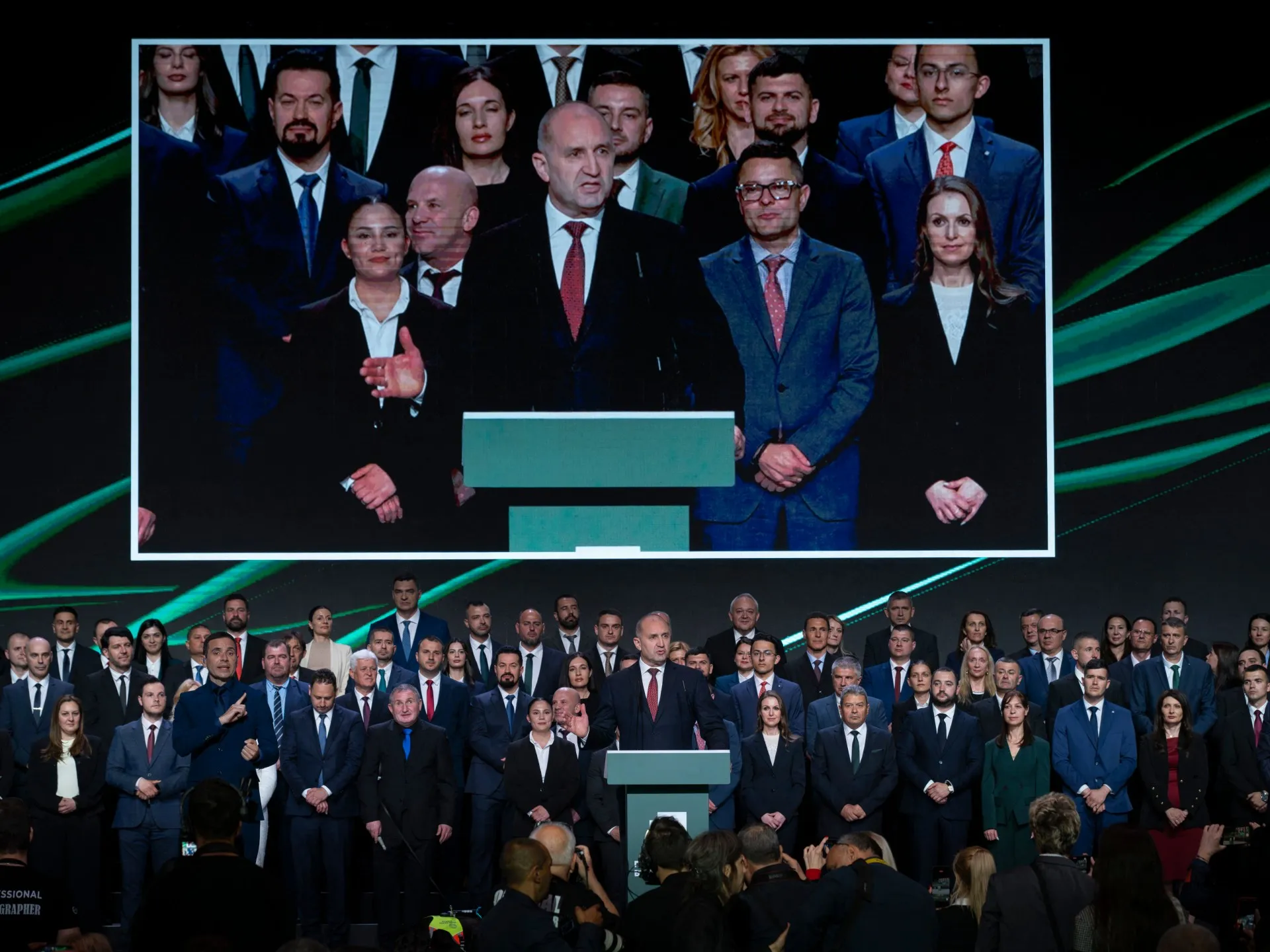
Bulgarians went to the polls on Sunday for the eighth parliamentary election in five years, a striking measure of how deeply the country’s political system has stalled since 2021. Polling stations opened at 7 a.m. local time and are due to close at 8 p.m., with exit polls expected after voting ends and preliminary results expected on Monday. The repeated returns to the ballot box reflect years of short-lived coalitions, collapsing cabinets and a level of voter fatigue that has steadily weakened confidence in parliament as the place where Bulgaria’s crises can actually be settled.Bulgaria heads to the polls in eighth general election in five yearsfrance24.com·SecondaryVoters in Bulgaria headed to the polls Sunday for an eighth general election in five years, with ex-president Rumen Radev tipped to win on anti-corruption pledges. The election comes after unrest toppled Boyko Borissov’s rule and left the pro-European GERB party trailing.
This time the race has centered on whether former president Rumen Radev can convert personal popularity into a governing mandate through his new center-left Progressive Bulgaria coalition. Radev resigned from the presidency in January, months before the end of his second term, in order to run directly for executive power as prime minister rather than continue in a largely ceremonial office. Opinion surveys cited by the main source reports put his coalition above 30 percent and roughly 10 points ahead of former prime minister Boyko Borissov’s center-right GERB party, though reported margins of error of roughly 3 to 3.5 points still leave room for a tighter final tally than campaign momentum suggested.Bulgaria heads to the polls in eighth general election in five yearsfrance24.com·SecondaryVoters in Bulgaria headed to the polls Sunday for an eighth general election in five years, with ex-president Rumen Radev tipped to win on anti-corruption pledges. The election comes after unrest toppled Boyko Borissov’s rule and left the pro-European GERB party trailing.
The political opening that made this contest possible came from the collapse of the previous conservative-led government after nationwide protests last December. Those demonstrations drew hundreds of thousands of people, many of them younger voters, into the streets with demands for a more independent judiciary and a more serious crackdown on entrenched corruption. For reform-minded voters, that sequence turned the election into more than another routine parliamentary contest; it became a test of whether the protest energy can be translated into legislation, institutional cleanup and a coalition durable enough to outlast the country’s now familiar cycle of breakdown and reset.Bulgaria heads to the polls in eighth general election in five yearsfrance24.com·SecondaryVoters in Bulgaria headed to the polls Sunday for an eighth general election in five years, with ex-president Rumen Radev tipped to win on anti-corruption pledges. The election comes after unrest toppled Boyko Borissov’s rule and left the pro-European GERB party trailing.
That is why Radev has been able to present himself as both an outsider to the established party cartel and as the one figure strong enough to force a new alignment. At rallies he has cast the election as a chance to remove what he calls the country’s corrupt oligarchic model from political power, and many supporters back him because they believe the old parties have had repeated chances to fix the judiciary, clean up procurement networks and restore basic trust but failed. Among parts of the electorate, especially older and rural voters, that message lands because it combines anger at elite bargaining with a promise of a more forceful state that would be less dependent on the same political class that has traded power back and forth through weak coalitions.Bulgaria heads to the polls in eighth general election in five yearsfrance24.com·SecondaryVoters in Bulgaria headed to the polls Sunday for an eighth general election in five years, with ex-president Rumen Radev tipped to win on anti-corruption pledges. The election comes after unrest toppled Boyko Borissov’s rule and left the pro-European GERB party trailing.
But the election is not only an anti-corruption referendum. It is also a strategic argument about Bulgaria’s place inside Europe at a moment when the country has just entered the eurozone and recently joined the Schengen travel area as a full member of the border-free bloc. Critics of Radev argue that his rise carries a real geopolitical edge because he has repeatedly opposed military aid to Ukraine, criticized the previous government’s euro adoption and spoken in favor of reopening talks with Russia as part of ending the war. For those voters, the danger is not simply that another new coalition may fail; it is that Bulgaria could drift toward a more Eurosceptic and Moscow-friendlier posture precisely when Brussels and NATO allies want a steadier line from Sofia.Bulgaria heads to the polls in eighth general election in five yearsfrance24.com·SecondaryVoters in Bulgaria headed to the polls Sunday for an eighth general election in five years, with ex-president Rumen Radev tipped to win on anti-corruption pledges. The election comes after unrest toppled Boyko Borissov’s rule and left the pro-European GERB party trailing.
That concern helps explain why younger urban and pro-European voters have rallied around alternatives such as the We Continue the Change-Democratic Bulgaria alliance, which argues that the answer to the crisis is not a nationalist reset but a cleaner, more explicitly European parliamentary order. One 23-year-old candidate highlighted in reporting described the recent protest wave as only half the job and said the other half is turning public anger into laws and rules through parliament.Bulgaria heads to the polls in eighth general election in five yearsfrance24.com·SecondaryVoters in Bulgaria headed to the polls Sunday for an eighth general election in five years, with ex-president Rumen Radev tipped to win on anti-corruption pledges. The election comes after unrest toppled Boyko Borissov’s rule and left the pro-European GERB party trailing. Analysts quoted in the same reporting said many younger voters do not see Radev as a true break with the old system, arguing instead that he represents another version of the status quo and that his presidential years gave him ample opportunity to confront the networks he now condemns.Bulgaria heads to the polls in eighth general election in five yearsfrance24.com·SecondaryVoters in Bulgaria headed to the polls Sunday for an eighth general election in five years, with ex-president Rumen Radev tipped to win on anti-corruption pledges. The election comes after unrest toppled Boyko Borissov’s rule and left the pro-European GERB party trailing.
Borissov and GERB, meanwhile, remain the clearest center-right counterweight even after years of anti-establishment backlash. Their case is less romantic than Radev’s but still politically serious: Bulgaria, they argue implicitly through their positioning, needs predictability, coalition arithmetic and working ties with European institutions more than another experiment built around one dominant political personality. That message also has an audience among voters who may be angry at corruption but are wary of handing power to a figure whose rhetoric on Russia, Ukraine and the euro has often cut against the preferences of mainstream Atlantic institutions. In other words, the election has split the electorate along more than one axis at once: generational frustration, corruption fatigue, rural versus urban priorities, and the unresolved argument over whether sovereignty talk is a corrective to failed liberal management or just another route to paralysis.Bulgaria heads to the polls in eighth general election in five yearsfrance24.com·SecondaryVoters in Bulgaria headed to the polls Sunday for an eighth general election in five years, with ex-president Rumen Radev tipped to win on anti-corruption pledges. The election comes after unrest toppled Boyko Borissov’s rule and left the pro-European GERB party trailing.
There is also a harder institutional fact hanging over the vote: even if Radev finishes first, Bulgaria’s parliamentary fragmentation may once again make stable government difficult. The country of 6.5 million has already spent half a decade cycling through assemblies that could not produce durable governing majorities, and turnout at the last election in 2024 fell to just 39 percent, a sign that large parts of the public doubt elections alone can repair the machinery of state.Bulgaria heads to the polls in eighth general election in five yearsfrance24.com·SecondaryVoters in Bulgaria headed to the polls Sunday for an eighth general election in five years, with ex-president Rumen Radev tipped to win on anti-corruption pledges. The election comes after unrest toppled Boyko Borissov’s rule and left the pro-European GERB party trailing. Parties have accused each other during this campaign of trying to steal the election, police operations reportedly seized at least €1 million in suspected vote-buying schemes, and the broader climate has been shaped by claims of disinformation and by the exhaustion that comes from asking voters to start over again and again.Bulgaria heads to the polls in eighth general election in five yearsfrance24.com·SecondaryVoters in Bulgaria headed to the polls Sunday for an eighth general election in five years, with ex-president Rumen Radev tipped to win on anti-corruption pledges. The election comes after unrest toppled Boyko Borissov’s rule and left the pro-European GERB party trailing.
So the immediate question on Sunday is who finishes first, but the larger question is whether any winner can turn that result into a parliament that lasts. If Radev’s coalition performs as polls suggested, he will claim a mandate to uproot a corrupt order and rebalance Bulgaria’s foreign posture with a more skeptical tone toward Brussels orthodoxy and military escalation in Ukraine. If his lead narrows or coalition talks stall, his opponents will argue that personal popularity is not the same thing as governability and that Bulgaria remains trapped until a pro-system majority can combine reform with institutional continuity. Either way, this election is important not because it guarantees a solution, but because it shows how far Bulgaria still is from one.Bulgaria heads to the polls in eighth general election in five yearsfrance24.com·SecondaryVoters in Bulgaria headed to the polls Sunday for an eighth general election in five years, with ex-president Rumen Radev tipped to win on anti-corruption pledges. The election comes after unrest toppled Boyko Borissov’s rule and left the pro-European GERB party trailing.
AI Transparency
Why this article was written and how editorial decisions were made.
Why This Topic
This is the top fresh politics cluster with a score above threshold and a clear national event horizon: voters are at the polls now in an eighth election within five years. The story matters beyond Bulgaria because it combines chronic domestic instability, corruption fatigue, eurozone integration and a live argument over Russia, Ukraine and the country’s future alignment inside the EU and NATO.
Source Selection
The cluster has two usable source signals that complement each other. AP provides the hard-news spine: poll opening, parliamentary instability, Radev’s lead, GERB’s position, eurozone and Schengen context. The Guardian adds social texture and opposing voter perspectives, especially the generational split, youth protest movement, concerns over corruption and skepticism from reform-oriented young voters. That combination supports a balanced, sourced narrative without relying on off-cluster factual claims.
Editorial Decisions
Tone kept descriptive and non-moralizing. Article gives Radev’s anti-corruption case real weight while also laying out the European, pro-Ukraine and institutional arguments against him. Avoided loaded language beyond source-grounded descriptors like pro-Russian or Eurosceptic when clearly attributed by source context.
Reader Ratings
About the Author
Sources
- 1.france24.comSecondary
- 2.theguardian.comSecondary
- 3.apnews.comSecondary
- 4.aljazeera.comSecondary
Editorial Reviews
1 approved · 0 rejectedPrevious Draft Feedback (6)
• depth_and_context scored 5/3 minimum: The article excels at providing necessary background, detailing the cycle of failed coalitions, the significance of the protest movements, and the geopolitical context (Eurozone/Schengen). It clearly explains *why* this election is happening and *what* the stakes are beyond just the vote count. • narrative_structure scored 4/3 minimum: The structure is strong, moving logically from the immediate event (the election) to the key players (Radev vs. Borissov) and then expanding into the deeper thematic conflicts (anti-corruption vs. EU alignment). It could benefit from a slightly punchier lede that immediately frames the central tension rather than just stating the election date. • perspective_diversity scored 5/3 minimum: The piece masterfully presents multiple viewpoints: Radev's supporters, critics of Radev (pro-EU/young voters), Borissov's base, and the institutional analysts. This balance prevents the narrative from becoming a simple partisan report. • analytical_value scored 5/3 minimum: The article consistently interprets the events, moving beyond mere reporting to analyze the underlying tensions—e.g., the split between anti-corruption sentiment and geopolitical alignment. The concluding paragraphs synthesize these tensions effectively. • filler_and_redundancy scored 5/2 minimum: The writing is dense with information but highly efficient. It uses repetition of themes (e.g., 'failed coalitions,' 'corruption') to build context rather than repeating facts, resulting in a high information-to-word ratio. • language_and_clarity scored 4/3 minimum: The prose is sophisticated, precise, and engaging. It avoids generic AI-speak and handles complex political concepts well. To reach a 5, the author should ensure that when discussing Radev's 'skeptical tone toward Brussels orthodoxy,' they briefly cite one specific policy or statement that exemplifies this skepticism, rather than leaving it as a general accusation.
Rejected after 5 review rounds. 1 gate errors: • [image] CoverImageUrl returned HTTP 401. The image does not exist or is inaccessible.
Rejected after 4 review rounds. 1 gate errors: • [image] Cover image is visually identical to "Carney heads into Canada byelections one seat short of a majority as Liberals test a broader coalition" (carney-heads-into-canada-byelections-one-seat-short-of-a-majority-as-liberals-test-a-broader-coalition, similarity: 88 %). Each article must have a unique cover image.
Rejected after 3 review rounds. 1 gate errors: • [image] Cover image is 599x399px — minimum required is 800x400px.
1 gate errors: • [image] Cover image is visually identical to "Carney heads into Canada byelections one seat short of a majority as Liberals test a broader coalition" (carney-heads-into-canada-byelections-one-seat-short-of-a-majority-as-liberals-test-a-broader-coalition, similarity: 88 %). Each article must have a unique cover image.
1 gate errors: • [image] Cover image is visually identical to "Carney heads into Canada byelections one seat short of a majority as Liberals test a broader coalition" (carney-heads-into-canada-byelections-one-seat-short-of-a-majority-as-liberals-test-a-broader-coalition, similarity: 88 %). Each article must have a unique cover image.
Discussion (0)
No comments yet.